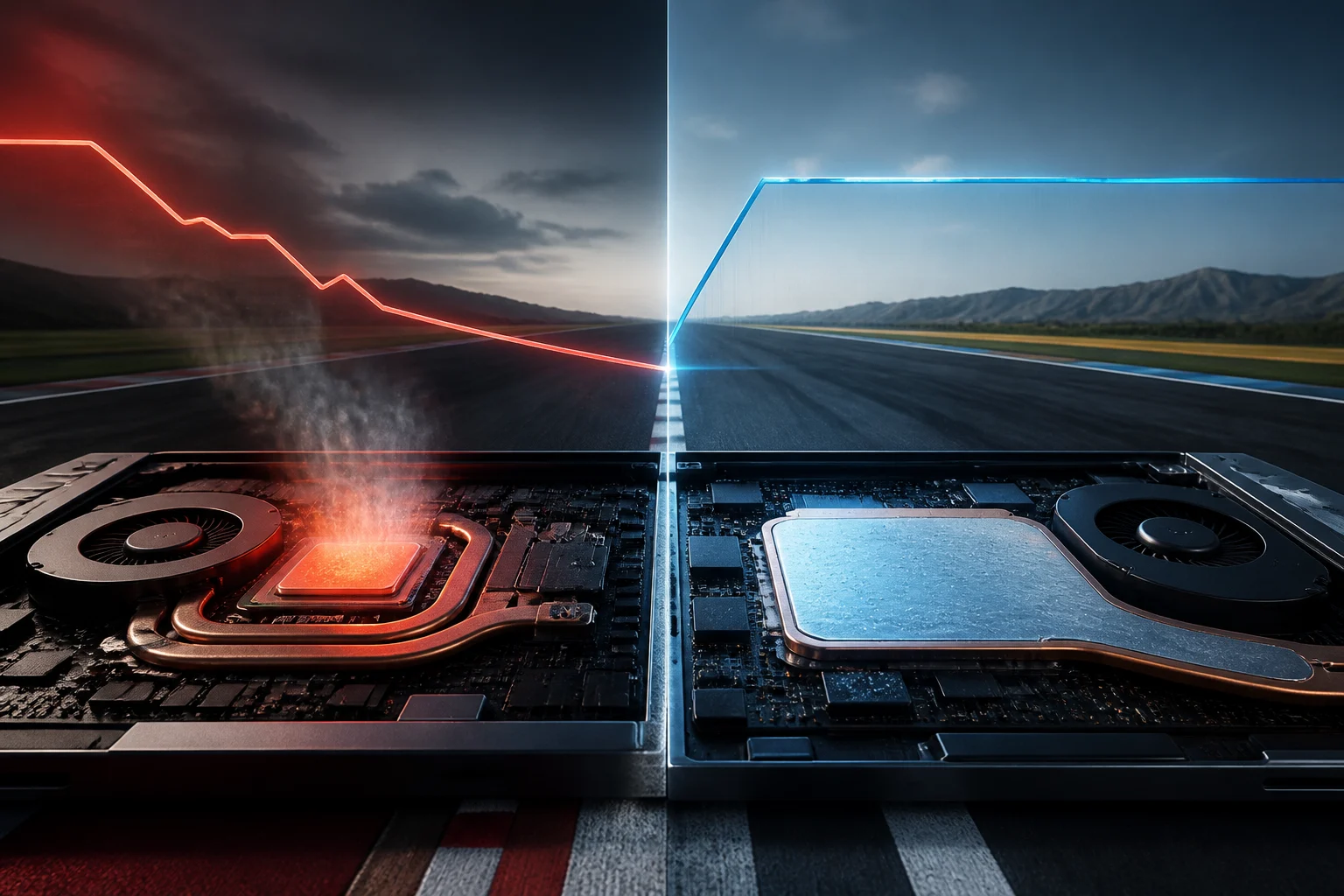
Performance versus power: why “the fastest” is no longer enough
For years, a single headline number—max frequency, core count, or a benchmark score—seemed to settle any debate. Today, that shortcut often fails. There are two key reasons: modern chips dynamically adjust voltage and frequency based on temperature and available power budget, and real workloads have varying demand profiles. In practice, usable performance depends on how much power the system can sustain without thermal throttling and how it allocates that power across the CPU, GPU, and accelerators.
This shift is not merely semantic; it reshapes product design and how we interpret specifications. Intel itself reminds buyers that its processor numbers are not a measure of performance, underscoring that marketing names cannot replace data on power and configuration. Likewise, within the same chip family, turbo policies, power limits, and the quality of the thermal solution can yield diametrically different results under identical loads. Two laptops with the same processor can differ by dozens of percentage points in sustained performance if one prioritizes silence while the other allows more watts for longer.
Meanwhile, industrial PC vendors emphasize energy efficiency as a pillar of reliability and total cost of ownership: for the same task, fewer watts mean less heat to dissipate, reduced cooling needs, and more headroom to hold clock speeds over long stretches. This direct link between energy and stability turns efficiency into a performance attribute, not just an environmental virtue. The more efficient a system is at a given task, the more likely it is to maintain its speed without throttling and the cheaper it is to keep it within safe thermal limits in adverse environments.
Thermal limits: physics sets the sustained clock
Power turns into heat, and heat must be removed. If the thermal flux exceeds the cooling system’s capacity, the chip will drop frequency and voltage to protect itself. That is why two devices with the same silicon can behave very differently depending on chassis, airflow, and power delivery stages. Even with intermittent loads, a borderline thermal design accumulates heat and throttles earlier, degrading the experience in video editing, gaming, or large builds.
Thermal dynamics also have memory. A short spike might seem harmless, but successive spikes in quick succession lift the package temperature and the surrounding environment, shrinking the headroom to hold high turbo states. In compact systems, surface temperature, inlet air temperature, and the heatsink’s own temperature chain together to set the sustained clock. This is why evaluating only the first minute of a test fails to capture real behavior during extended work or gaming sessions.
Power and compute industries alike agree: thermal management enables sustained performance. In power electronics, the adoption of wide-bandgap semiconductors (SiC, GaN) and advanced heat extraction techniques improves losses and operating temperature, raising power density without sacrificing reliability. Although these materials target power conversion, the general principle applies: lower switching and conduction losses produce less heat, enabling more sustained performance per watt in systems that combine compute with power stages. In other words, optimizing the entire energy chain—from the source to the compute silicon—cuts parasitic heat and raises the thermal ceiling that dictates which frequencies can be held over time.
Efficient architectures: heterogeneity and dedicated accelerators
Architectural redesign is a key efficiency lever. Heterogeneous cores—high-performance cores paired with high-efficiency cores—let light tasks run at lower power while reserving the big cores for demanding bursts. This approach multiplies the utility of the energy budget: when idle or under I/O-latency-bound workloads, efficient cores preserve responsiveness without waking power-hungry blocks. At the professional extreme, setups with dozens of efficiency cores and multiple integrated graphics engines show that segmenting work reduces unnecessary peak draw and enables a more elastic response to load.
Specialization is another lever. NPUs and other accelerators offload AI algorithms from the CPU/GPU, achieving more work per joule. Dedicated blocks avoid general-purpose execution paths that are less efficient and, in doing so, mitigate heat generation for a given task. This trend now reaches consumer segments, where spec sheets list dedicated NPUs for improved efficiency in vision tasks or small models, with power management tuned to sustain performance over time rather than chase short-lived bursts. The practical outcome is twofold: more autonomy on battery in mobile devices and workstations that hold their performance throughout long days without resorting to aggressive acoustic profiles.
Memory topology and data proximity round out the picture. Low-latency interconnects and well-provisioned cache hierarchies reduce unnecessary DRAM transactions, a component with significant per-access energy cost. By minimizing off-chip traffic and favoring data locality, systems cut energy per operation and smooth thermal spikes, which in turn helps maintain stable frequencies during long sessions.
Useful metrics: from TDP to watt-hours per task
Measuring only peaks hides half the story. For informed decisions, consider metrics that tie work to energy: watt-hours per render, frames per joule, seconds per image at a power cap, or sustained throughput at a stated thermal limit. TDP is a starting point, but it varies by platform and does not always reflect actual draw under different loads and power policies. Moreover, vendors define and enforce limits differently, so comparing TDPs without context can mislead.
A sound test protocol declares: a) the task (for example, encoding 30 minutes of 4K H.265 video), b) the setup (power caps, power plan, thermal mode, driver versions), c) the measured window (to capture thermal steady state), and d) the environment (ambient temperature, device position). Reporting both initial performance and sustained performance after thermal stabilization prevents interpretations skewed by momentary spikes. Including total energy consumed during the test enables energy-cost-per-result metrics, useful to compare platforms with distinct turbo philosophies.
Visualizing time-series adds clarity: a 20–30 minute timeline of throughput and temperature reveals whether the system reaches a stable state, oscillates due to aggressive thermal control, or degrades progressively as the heatsink saturates. The area under the performance curve—weighted by power—is a truer summary of practical value than a single maximum number.
Materials and thermal management trends: higher density without burn-out
In parallel with system design, power materials are evolving to raise the thermal-energy ceiling. Silicon carbide (SiC) MOSFETs and gallium nitride (GaN) devices offer lower losses and improved thermal behavior versus traditional silicon in power supplies and converters, delivering cleaner and more efficient power to compute subsystems. The indirect result is less parasitic heat across the platform and more headroom to sustain CPU and GPU performance. This improvement in “energy hygiene” also reduces stress on fans and heatpipes, which can operate more steadily.
Advances in two-phase cooling, microchannels, and miniature capillary loops also benefit compact, high-density use cases by increasing effective thermal conductivity and evacuating bursts. The use of cold plates with microstructures, vapor chambers, and high-conductivity thermal interface materials reduces total thermal resistance from die to ambient. While mass adoption in consumer laptops is still limited, these are clear signals of where the physical limits are moving—the very limits that ultimately determine what performance can be maintained within a given form factor. In data centers and 24/7 embedded gear, such techniques already yield measurable differences in availability, rack density, and operating cost.
Another line of progress is intelligent orchestration between power and compute subsystems: faster, more efficient regulators reduce transient losses when load changes abruptly, avoiding voltage droops that would force frequency cuts. Aligning energy policies with the system’s thermal response smooths oscillations and increases dwell time in optimal efficiency points.
Practical implications for users: choose wisely, configure better
- Prioritize sustained performance: look for reviews or data reporting throughput after 15–30 minutes of continuous load, not just the ramp-up. If none exist, set a manual power limit and verify throughput stability over time. - Look beyond the chip name: the same CPU can deliver different results depending on the OEM’s power limits and the device’s thermal solution. - Value accelerators: NPUs and dedicated media engines can cut power in everyday tasks (background blur in calls, local transcription, image filters), translating into longer battery life without sacrificing fluidity. - Mind the thermal ecosystem: better-vented chassis, quality thermal compounds, and configurable fan profiles often spell the difference between a flashy spike and consistent delivery.
Beyond the purchase, day-to-day configuration matters. Tuning power plans, setting reasonable power caps, and keeping air paths clean preserves the system’s thermal health. On laptops, slightly elevating the base improves airflow; on desktops, routing cables to clear intakes and exhausts helps maintain quieter fan curves. In software, prefer hardware-accelerated codecs and enable smart-saving features in videoconferencing apps to lower CPU/GPU load without hurting perceived quality.
For professional and industrial contexts, efficiency means lower operating cost and higher availability. Systems designed for 24/7 duty emphasize thermal reliability and energy efficiency because they reduce downtime, extend component life, and simplify HVAC sizing. In offices and homes, the same logic yields fewer fan noise events, less ambient heat, and better battery autonomy in portable devices. At an organizational scale, measuring and optimizing energy cost per task helps plan hardware refreshes with criteria that balance CAPEX and OPEX, favoring solutions that meet performance targets within a manageable thermal envelope.
How to compare rigorously: a mini-checklist
- Define the task: what mirrors your real use? Choose tests that match in duration and intensity. - Set limits: pick a power target (e.g., 20 W sustained) and compare throughput under those conditions, not only at max turbo. - Report context: note ambient temperature, power mode, driver and firmware versions. - Measure efficiency: complement FPS or seconds with watt-hours consumed. - Watch stability: chart performance and temperature over time; sawtooth patterns often indicate throttling or aggressive thermal management.
Adopting this protocol turns a table of figures into a decision guide. In a market where peak numbers look increasingly similar across brands and process nodes, the real difference emerges when you ask: how much of that peak can I sustain, for how long, and at what energy cost? Framing the comparison that way avoids post-purchase surprises, prioritizes continuous experience over momentary bursts, and aligns metrics with what truly matters: finishing the same task sooner while consuming less energy, time and again.