The label alone does not describe the process
“3D printing” is often used as a general term for manufacturing objects through processes that build material layer by layer. This description is useful as a starting point, but it leaves important questions unanswered: which technology was used, what material was processed, how the part was prepared, and which properties were measured. Dassault Systèmes’ introductory guide presents 3D printing as a group of manufacturing processes, not as a single machine or method. Source: Dassault Systèmes.
For that reason, a statement such as “3D printing can be used to manufacture strong components” is too broad to assess a specific application. Strength is not an abstract property independent of design and method: we would need to know which part was made, from what material and under what conditions, and which test was used. Without those details, an appealing image or a part that retains its shape demonstrates visual feasibility, not necessarily functional performance. It is also important that the measured property relate to the intended function: observing that a part keeps its appearance is not the same as checking that it meets the requirements of use.
The first check is to look for precise identification of the process. If a report only says “3D printing,” the evidence may be insufficient to reproduce or compare the result. At a minimum, look for the manufacturing method, the material and its preparation, the part’s orientation and geometry, relevant process parameters, and post-processing operations. Not every study has to publish precisely the same level of detail, but it should make clear what was done and which result the conclusion refers to. These details also help determine whether two apparently similar results were obtained under conditions that can genuinely be compared.
What a technical test should demonstrate
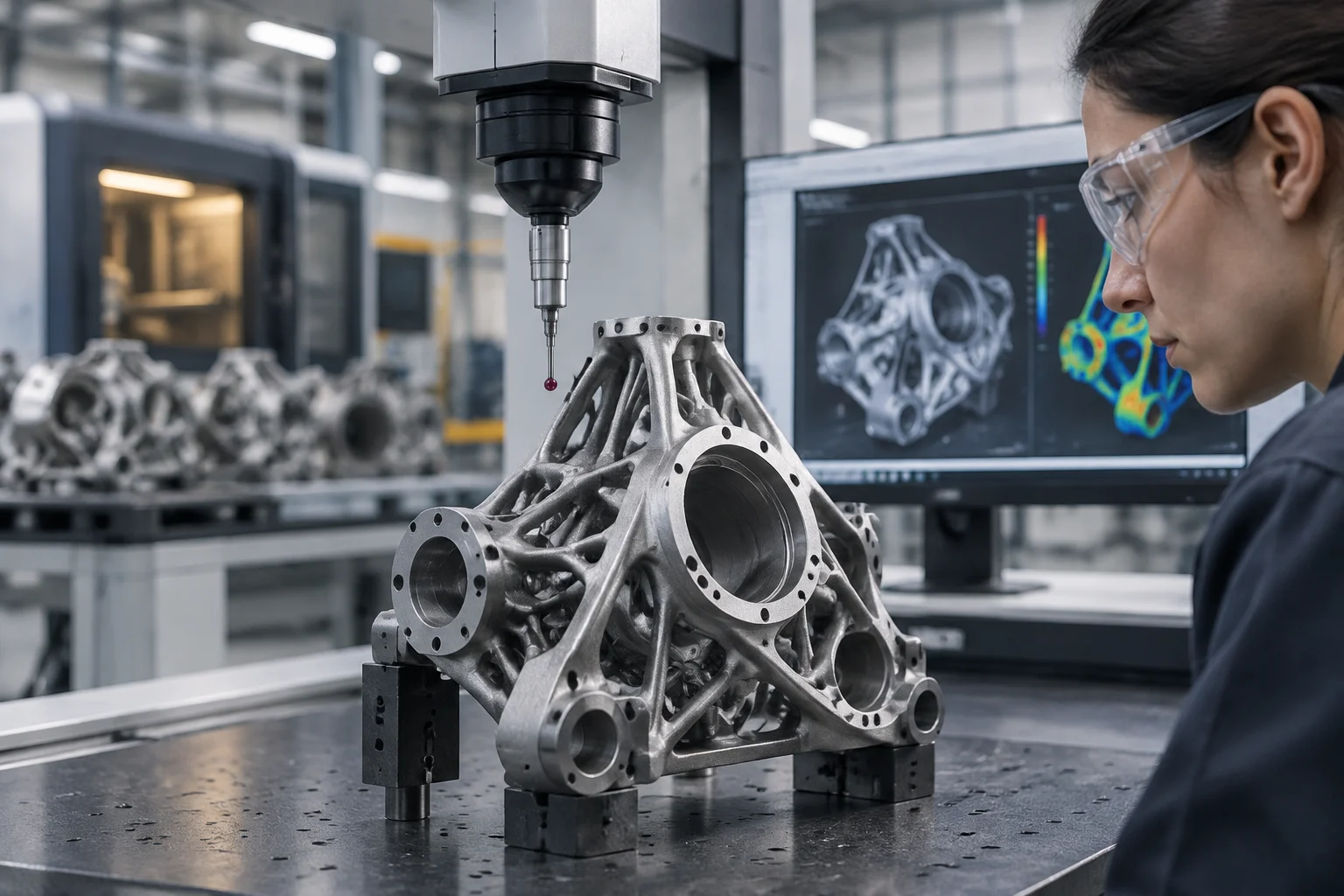
A useful study distinguishes the application’s objective from the test that supports it. “Making a part” may show that a process can produce a particular geometry; by itself, it does not establish that the part performs a function, withstands a load, retains its dimensions, or is safe in its intended environment. The right question is not whether the object came out of the printer, but which requirement was tested and what criteria determined whether it was met. Stating the requirement clearly makes the result easier to interpret and prevents confusing the manufacture of a sample with validation for use.
To interpret the result, readers need to connect four elements: the research question, the manufacturing procedure, the measurement method, and the acceptance criterion. If a part is described as accurate, for example, the study should explain which dimensions were compared and against what reference. If it is described as strong, it should identify the test, the conditions, and the type of failure observed. An isolated figure has limited value if we do not know what it measured, how many samples were tested, or what uncertainty applied. Nor does the same figure necessarily answer different questions: its meaning depends on the specific test and the requirement being examined.
A practical reading checklist can include the following:
- Process and material: specific names and relevant preparation conditions.
- Test design: geometry, orientation, number of parts, and manufacturing conditions.
- Quality: measurements relevant to the function, including method and tolerances where reported.
- Result: values, variation between parts, and failures—not just the best specimen.
- Scope: what conclusions the data support and which questions remain outside the test.
This list is an evaluation framework, not a universal standard or a claim that every article should use one protocol. The appropriate test depends on the part’s function. A dimensional comparison and a fatigue test, for example, answer different questions; neither can substitute for the other. Readers should therefore judge whether the selected measurement corresponds to the stated requirement rather than assume that any technical result is sufficient to support any application.
Repeatability: from a specimen to a reliable process
A satisfactory part does not automatically show that the process can reproduce the result. To distinguish a successful specimen from consistent production, it matters how many samples were made, whether they were produced in different runs, and how much variation occurred between them. Failures matter too: excluding them without explaining the criteria can make performance appear better than it was. Observed variation is part of the result, not a secondary detail. Reporting only the best specimen makes it impossible to judge how similar the resulting parts are to one another.
Repeatability also depends on what was kept constant. Changes in machines, material batches, settings, orientation, or post-processing can affect comparisons. If a study evaluates a single configuration, it may support a conclusion limited to those conditions; it does not demonstrate that the same performance will occur on other equipment or in other environments. It is useful to distinguish repeating a fabrication under tightly controlled conditions from transferring a procedure to a different production setting. This distinction clarifies whether a result describes a particular test or supports a more generalizable process.
NIST has published an assessment of guidelines for round robin studies in additive manufacturing, a type of interlaboratory exercise that makes it possible to examine results obtained by different participants under a common design. The existence of this work supports the methodological importance of studying comparability between laboratories; it does not mean that every process or part has been validated, or that a particular protocol guarantees quality on its own. Source: NIST. When evaluating a study, check whether it reports samples, variation, conditions, and limits on generalization, rather than only the most favorable result. Information about these conditions helps establish how far an observation can be extended without assuming that results will be reproduced identically in other contexts.

Scalability and comparison with conventional manufacturing
“Scalable” can mean different things: making more units, maintaining quality as volume increases, moving the process to another facility, or reducing cost per part. A laboratory demonstration does not automatically answer all of these questions. To support a claim of scalability, a study would need to identify which dimension it examined and provide relevant results at that scale. The number of parts and the manufacturing conditions matter: producing a selected sample is not equivalent to reporting the outcome of a series made against defined acceptance criteria. Clarifying what “scaling up” means prevents a conclusion about one aspect from being interpreted as proof of the others.
A comparison with a conventional method also needs a common basis. It should concern an equivalent part or function, with comparable quality requirements and a clearly defined unit of analysis. If costs are compared, the included cost items should be explained; if discarded material is compared, the accounting method should be clarified; and if time is assessed, it should be clear whether preparation, manufacturing, and finishing are included. Without defining the system, a figure may describe only one part of the process, not its total cost or impact. A comparison is more meaningful when it is clear what is counted and what is excluded, rather than presenting a partial measure as if it described the whole.
An academic thesis hosted by the Public University of Navarre raises precisely the comparison between metal additive manufacturing and conventional technologies through the question of sustainability. Its title establishes the research topic, but the information available here does not provide quantitative results that would allow us to say which alternative is more sustainable. Source: Public University of Navarre. This is an important qualification: comparing one dimension does not automatically resolve the others. A demonstrated advantage in material waste, if established, would not by itself be enough to conclude that there is an overall advantage in cost, energy, or performance. Broader conclusions would require data covering those other dimensions too, rather than extrapolation from a single measure.
A conclusion proportionate to the evidence
Standards and technical guidance can help structure an evaluation, but citing them does not replace the study’s data. ASTM International brings together standards related to additive manufacturing technologies; its page helps locate the scope of its documents, but it does not demonstrate that a particular application meets a requirement or identify, by itself, which standard is appropriate. Source: ASTM International. An evaluation should check which document was applied, to which material and process, and whether its scope matches the claim it is meant to support. Citing a standard without specifying how it was applied does not show what was assessed or what conclusion follows.
A careful reading can organize conclusions into three levels. First, what was directly observed: for example, that specified samples were manufactured and a property was measured using a described method. Second, the reasonable inference: that these results justify exploring an application or repeating the test under broader conditions. Third, what has not yet been demonstrated: consistent production, economic or environmental advantages, or performance in real-world use, if those aspects were not measured. This separation reduces the risk of presenting potential as a proven outcome. It also recognizes the value of an initial test without attributing conclusions that its data do not support.
To decide whether an application has moved beyond the prototype stage, readers can ask: Is the process and material identified? Does the test measure a relevant function? Are variation and failures reported? Does the scale match the conclusion? Does the comparison use equivalent conditions? If answers are missing, the appropriate conclusion is not that the technology does not work, but that the evidence presented does not yet support a broader claim. This distinction leaves room for progress without turning a one-off demonstration into an industrial promise. The final assessment should remain proportionate to what was measured: neither dismissing a promising application automatically nor treating as validated something that has not yet been tested at the necessary scope.