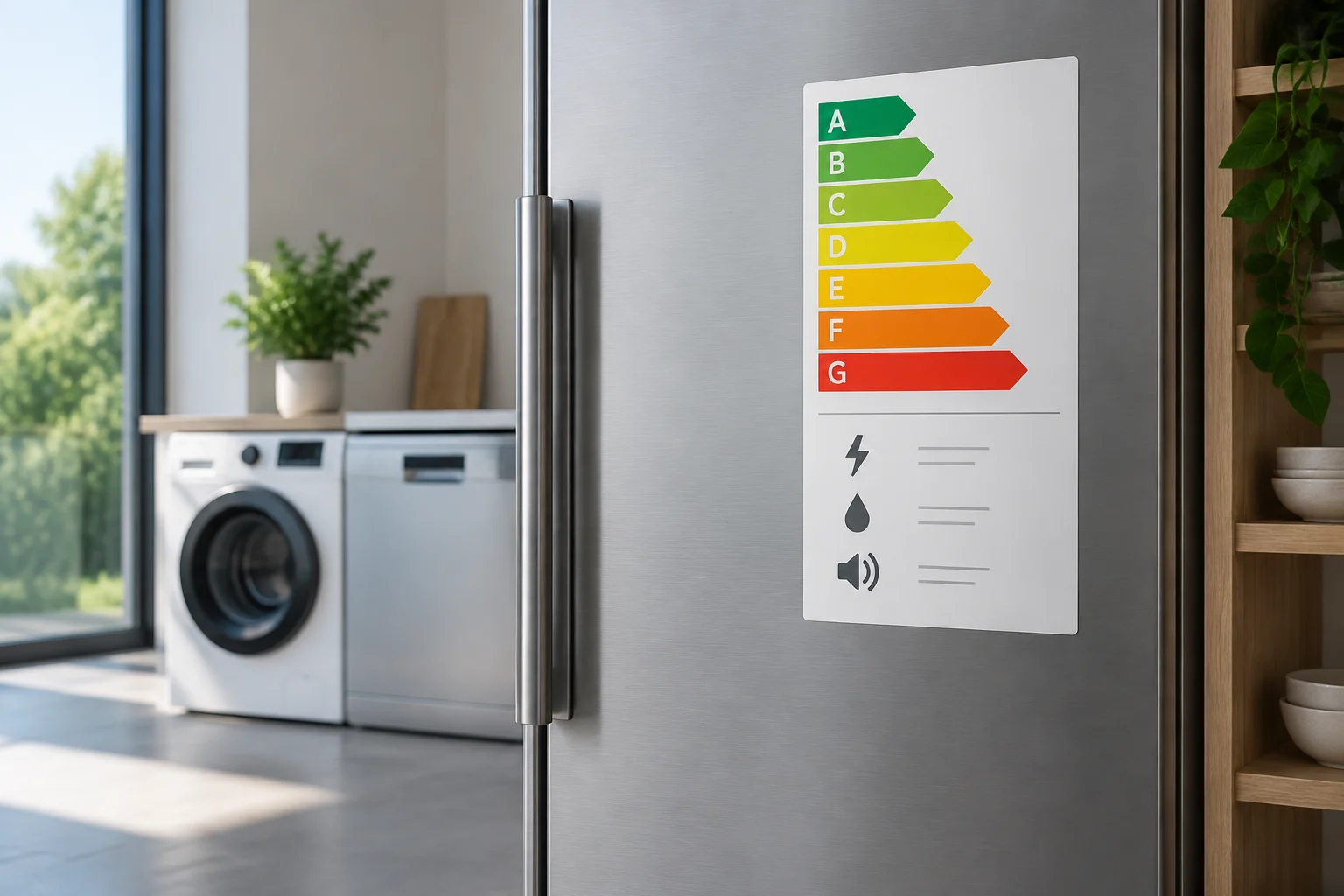
A comparison tool, not a complete assessment of an appliance
The European energy label presents efficiency information and other relevant data in a way that makes products within the same category comparable. Its general framework is Regulation (EU) 2017/1369, which sets rules for energy labelling and provides for specific requirements to be defined by product group. A washing-machine label should therefore not be read as though it were a refrigerator label with different pictures: each product family has its own parameters. Regulation (EU) 2017/1369
In categories that have been rescaled, the visible classification runs from A to G, from higher to lower relative efficiency on the applicable scale. Returning to a scale without “+” signs makes it easier to read than the former A+, A++ and A+++ classes, but it does not turn the letter into a universal measure of energy use. A class only makes sense in relation to the method and limits established for that category; it is not a score that can automatically be compared across different types of appliance. European Commission: history of energy labelling ECC Belgium: European energy labels
A useful reading starts by separating three things: the efficiency class, any additional figures or pictograms for that category, and the conditions under which the information is obtained. The label summarises selected regulated criteria; it does not describe every quality that could matter when buying, such as interior design, ease of repair, actual service life in a particular home or purchase price. Those questions require additional documentation and, where appropriate, other sources.
The letter is not a bill in euros
An energy class helps place a model alongside others in the same category under defined criteria. It does not directly state what a household will pay: estimating electricity costs also requires the consumption figure shown on the label, the electricity price and an assumption about use. Even that calculation would be an estimate, not a guarantee, because the number of cycles, selected settings and operating conditions may differ from one household to another.
The essential distinction is between standardised efficiency and consumption observed at home. The former enables a comparison based on common rules; the latter depends on how, how much and where the appliance is used. A better letter therefore cannot, by itself, show how much an individual will save or when they will recoup a price difference between two models. To estimate this, state the assumptions and do not confuse them with a value measured or guaranteed by the label.
When comparing two appliances in the same family, check both the class and the figures and units on their respective labels. Do not convert a consumption figure into euros without stating the tariff used, or extrapolate a figure for one period or cycle to a different pattern of use. The letter summarises a position within the classification system; it does not replace a context-specific cost calculation.
What to look at on a washing machine
The European Commission’s washing-machine page confirms that this category is subject to energy-labelling and ecodesign requirements. A washing-machine label should be interpreted within that category and with the indicators that apply to it, rather than by looking only at its colour or class. Official product information and the specific regulations are the right references for understanding how each value is defined. European Commission: washing machines
In practice, read the declared capacity, consumption information and any operating indicators shown on the model’s label together. Units matter: a figure linked to a cycle or regulated procedure is not automatically equivalent to the consumption of every load washed at home. It is also necessary to check that the models being compared are the same type and that the product information applies to the specific market and version.
Do not infer washing quality, programme duration or suitability for a household from the energy class. These are related but separate decisions. The label helps compare the information it regulates; for everything else, check the full product information and the manufacturer’s stated conditions of use. If a figure has no unit or context, it is unwise to treat it as a prediction of household use.
What changes when comparing refrigerators
Refrigerators and freezers are also among the categories using the rescaled label, but their data describe different aspects from those on a washing machine. Read the class alongside the category-specific measurements and symbols shown on the label and product information. It is not appropriate to transfer to a refrigerator an interpretation of consumption per cycle intended for another appliance. ECC Belgium: categories using the rescaled label
For a purchasing comparison, check that the figures relate to the exact model and are expressed in equivalent units. Usable capacity, compartment layout and available kitchen space may matter to the decision, but the energy class alone cannot answer all these questions. Nor is choosing the most favourable class enough if the size or interior layout does not meet your needs: a label is not an overall ranking of suitability.
The methodological point is the same: the label provides data under common rules, while the experience also depends on the surroundings and how the appliance is used. Its location, how often it is opened and the selected settings may affect household operation; the label should not be presented as a measurement of those individual conditions. Compare equivalent models and consider efficiency, capacity and fit in the home separately.
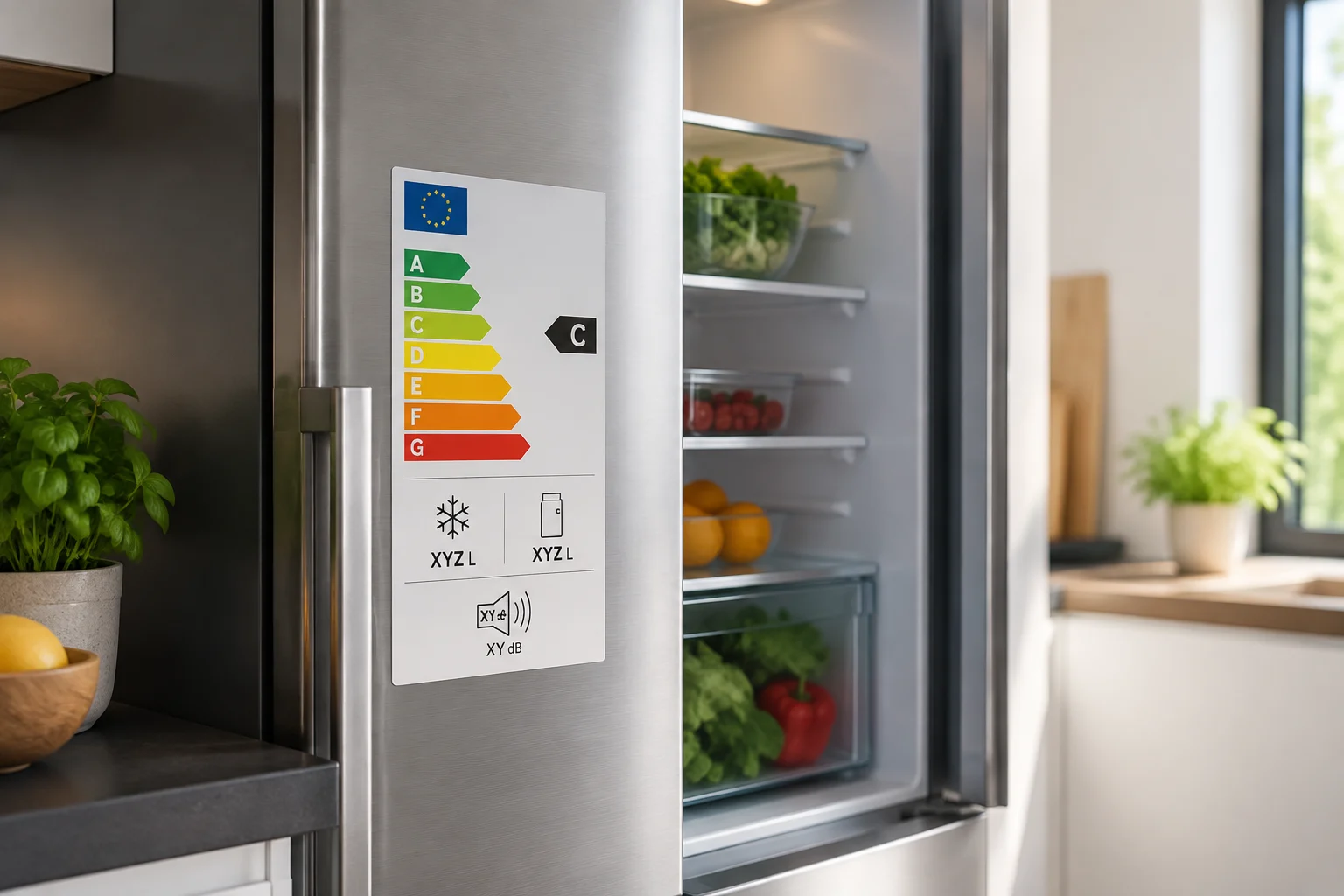
Why results may differ at home
Assessment procedures make a regulated comparison possible, but they do not reproduce every household routine. For washing machines, cycle type and frequency are part of how the appliance is used; for refrigerators, installation conditions and the way the appliance is used also matter. The difference between a standardised condition and a real home does not invalidate the label: it defines what conclusions its data can support.
European regulations establish the labelling framework, while specific measures are set out for product groups. A sound conclusion should therefore make its scope clear: “this model has this class under the applicable label” is more defensible than “this appliance will use less in every home”. The second statement adds a prediction that does not follow automatically from the letter.
It is also useful to distinguish what is declared from what is inferred. The label and product information provide values defined for a category; calculating an annual cost or saving requires assumptions about tariffs, intensity of use and the comparison period. Such estimates can be useful, but they should be presented as conditional calculations, not guaranteed results. Stating assumptions explicitly prevents a technical comparison from becoming a promise of savings.
A quick check before deciding
Before buying, use the label as a starting point and check the available official documentation for the model. The European Commission maintains information pages by category, including one for washing machines; the general framework and its obligations can be consulted on EUR-Lex. These references help confirm that the comparison is being made within the right product family and under current rules, rather than relying on a generic table or a commercial claim without context.
A practical check can follow this order:
- Confirm the category and exact model of each appliance; do not compare figures from different product families as though they were equivalent.
- Note the class and every additional value, together with its unit and the context given on the label.
- Check the model’s product information and make sure you are not using data for another variant or market.
- If you calculate a cost, state the electricity tariff, usage pattern and period assumed.
- Decide separately whether the capacity, features and dimensions meet your needs.