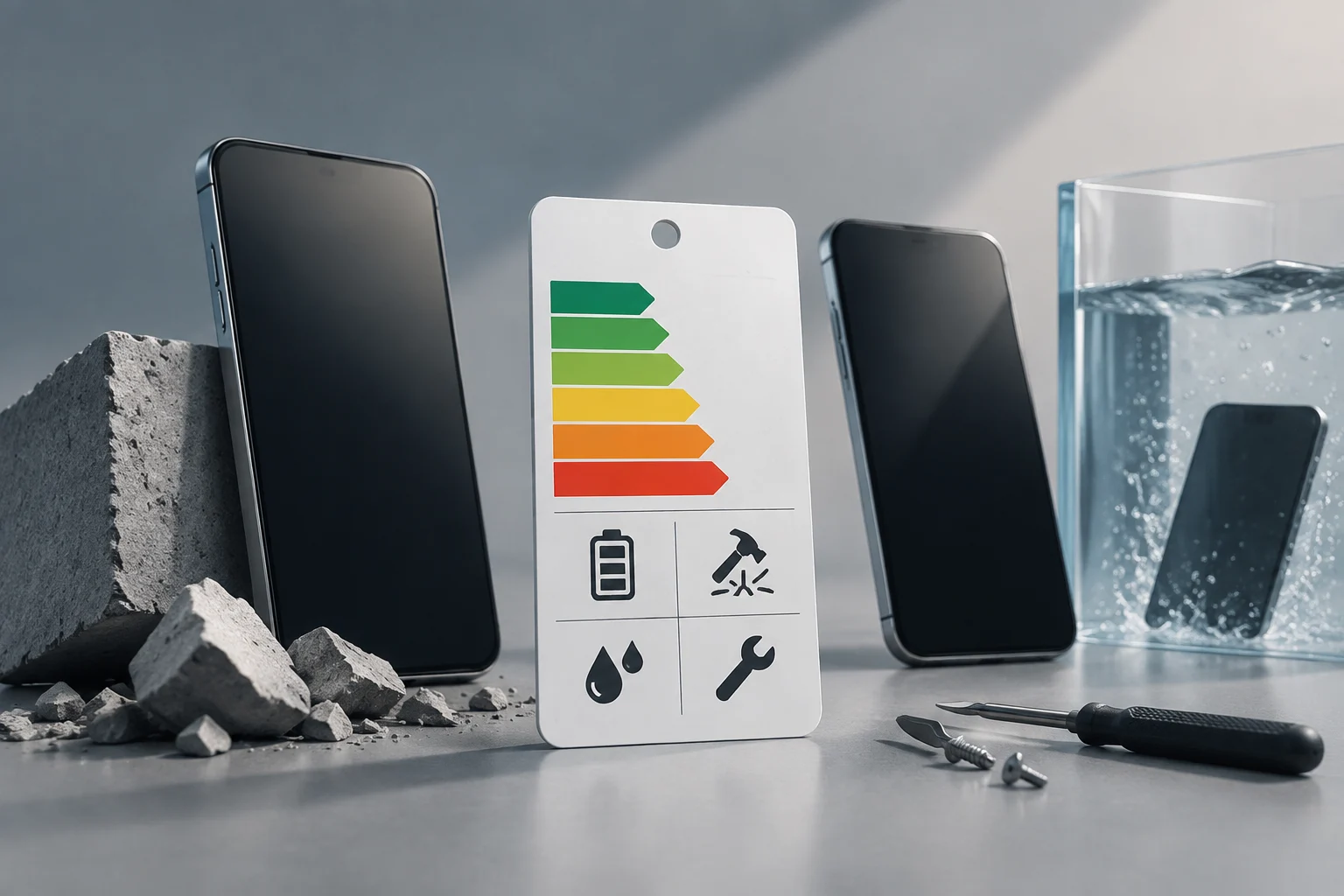
A common comparison sheet, not a verdict on the phone
Since 20 June 2025, mobile phones covered by European rules must display an energy label with several efficiency and durability indicators. Its main purpose is to present information in a common format, making it easier to compare models without relying solely on how each manufacturer writes its marketing specifications. Energy-labelling rules and ecodesign requirements are set out in separate, though related, regulations.
The label brings together an energy-efficiency scale from A to G, battery-life information, resistance to drops, protection against dust and water, and repairability. It also includes information about battery endurance in cycles. There is no single overall quality score: each symbol answers a different question and should be read separately. A strong rating in one area does not automatically mean the phone excels in the others.
This separation makes it quicker to identify which aspects best match your priorities, but it does not, by itself, establish which of two devices is better overall. To make that assessment, first decide what matters most—for example, battery life or the ability to repair the phone—and then compare each relevant indicator. The label organises the information; choosing requires weighing it against how you plan to use the phone.
Battery life: a useful figure when read in context
The label gives battery life on a full charge as a value in hours and minutes, alongside the corresponding energy-efficiency class. This makes for a more orderly comparison than setting battery capacities in milliampere-hours against one another: capacity alone does not tell you how long a phone will last, since consumption also depends on the display, processor, connectivity and system management.
That value is not a promise that everyone will get the same battery life. Mobile-data use, screen brightness, gaming, browsing, temperature and background apps can all change day-to-day results. The figure is useful for comparisons under a defined procedure, not for predicting exactly how many hours you will get with your own routine. The regulations are the reference for the applicable method; an independent review can add scenarios closer to your habits.
When interpreting a difference between two figures, remember that it refers to results obtained using the relevant procedure. Without more information, it does not show that the difference will be repeated in the same proportion with every app or setting. If you want to know how a phone performs over a particular day, tests that describe their tasks, settings and usage conditions provide context to complement the label value.
Drops and protection: different indicators for different risks
The label includes an indicator of reliability against repeated drops, expressed as the number of drops passed in the specified test. It is a comparative reference under controlled conditions, not a guarantee that a device will survive every impact. The surface, height, angle of impact, case and prior condition of the phone can all substantially affect the outcome of a real-world drop.
Protection against the ingress of dust and water is expressed through the relevant protection level. This helps identify the resistance declared for the product under the standard, but should not be read as an invitation to submerge the phone or deliberately expose it to liquids. Water resistance does not mean unlimited waterproofing: wear, repairs, impacts and specific conditions can affect the protection.
When comparing two models, do not treat these indicators as interchangeable. The drop figure does not measure water resistance, and water protection does not tell you how well the screen withstands an impact. Also check the manufacturer’s official instructions: they may specify usage restrictions, maintenance or warranty terms that the label is not intended to summarise. Read each figure in relation to the risk it describes, without attributing information it does not provide.
Repairability and battery: clues for thinking about long-term use
The label includes a repairability rating from A to E. Its purpose is to summarise aspects defined by the applicable rules, not to certify that every repair will be easy, inexpensive or possible at every repair shop. For a practical decision, find out which parts can be replaced, how much replacement parts cost, whether instructions and tools are available, and what service is offered in the market where you will buy the phone.
Battery endurance in cycles complements this information. A cycle should not necessarily be understood as a single connection to a charger: the value indicates battery durability according to the regulated method. Even so, it cannot predict on its own when a person will feel the need to replace the battery. Charging habits, heat and usage affect ageing; the experience also depends on how long the device is kept and whether replacing the battery is feasible.
To interpret repairability, compare the rating with documentation for the specific model. Look for the official support channel, repair terms and parts availability in your country. A comparable score adds context, but cost and practical access to service are part of the decision and can vary by market. Do not assume that two phones with the same letter necessarily have identical prices, turnaround times or coverage. Those details make a general rating more useful when assessing the cost and convenience of keeping the phone.
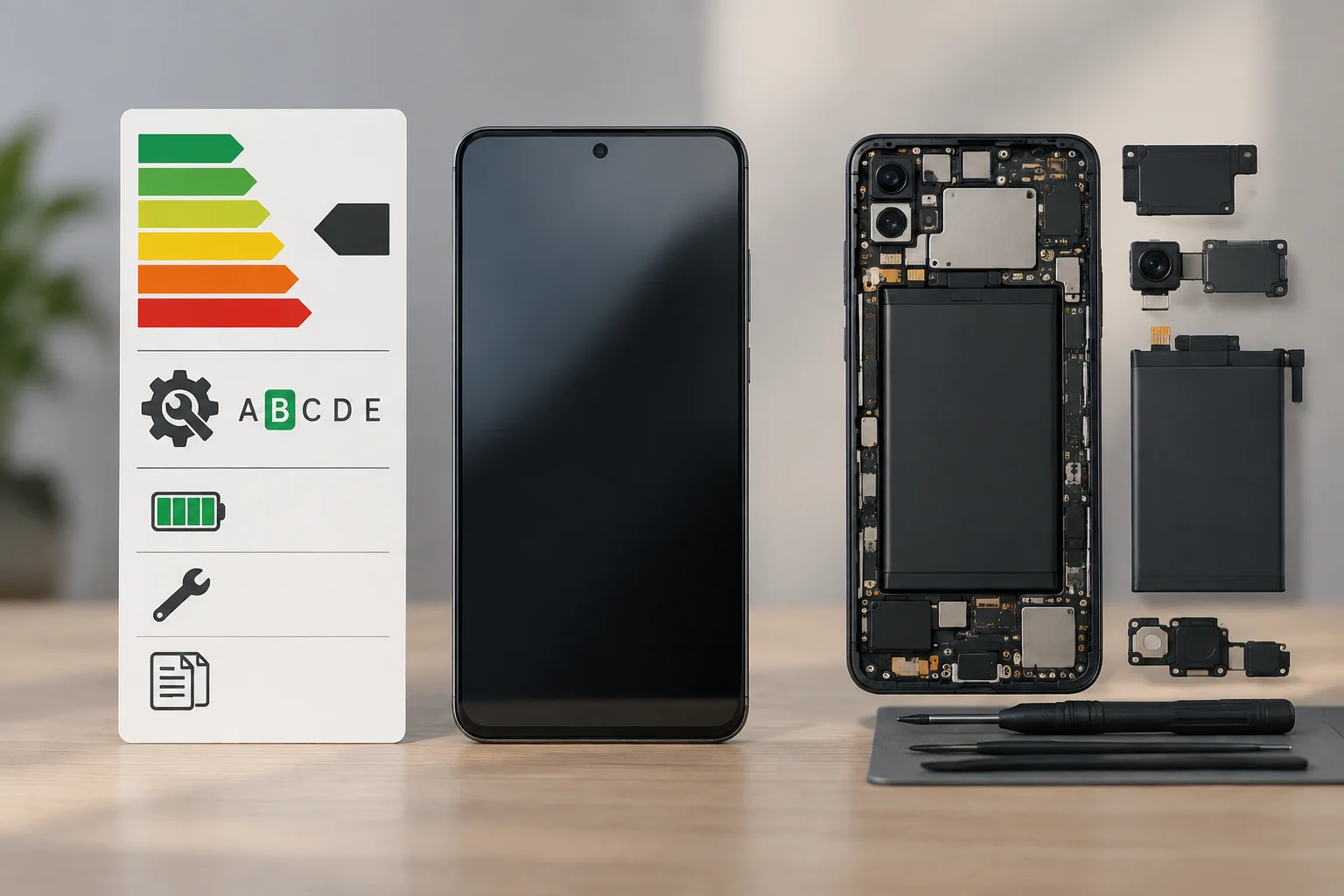
How to cross-check the label before buying
The label works best alongside sources that answer different questions. The regulations define what information must be shown and how tests are framed; the manufacturer’s page clarifies the specifications and conditions for its model; and an independent test can describe observed performance in specific scenarios. These sources are not interchangeable: each has a different scope and different limitations.
A useful check before deciding can follow these steps:
- Identify the exact model and variant. Do not assume versions with different storage, batteries or markets share all the same figures.
- Read each indicator separately. Compare battery life, drops, protection and repairability rather than mentally turning them into one overall score.
- Look for test context. If you want to estimate everyday use, check how independent tests measure battery life and which tasks they include.
- Verify local support. Check parts, repairs and warranty terms for the country where you will buy the device.
- Cross-check marketing claims. If the manufacturer’s specifications give a different figure or condition, find out whether they refer to the same model and method.
These steps help prevent comparisons between figures that look equivalent but relate to different variants or conditions. If information is missing and you cannot resolve a question, treat that as a limitation of the comparison rather than filling the gap by assuming the models are identical.
The decision: use the label as a filter and complete the comparison
The European label is especially useful for ruling out options that do not fit clear priorities. If battery life matters, compare the stated value with those of equivalent models; if you want to keep your phone for years, pay attention to repairability and cycle life; if the risk of impacts matters, check the drop indicator without assuming it predicts every accident. How relevant each figure is depends on your needs.
Then complete the comparison with information the label format does not cover. Check update policies, repair costs and warranty terms; look for battery tests that explain their methodology; and make sure protection limitations fit your use. A label does not replace judgement: it makes it better informed, provided it is not treated as a promise of identical results in every environment.
This analysis is documentary: it explains the indicators and how to use them, but does not test specific phones or practically verify their durability or battery life. The regulations provide a common basis for comparison; real-world use adds variables that do not fit on a label. To choose carefully, combine both perspectives and confirm that the documentation you consult applies to the exact model and market. In other words, the label is more valuable as a shared starting point than as a definitive answer: it shows what to check and helps frame a more focused comparison.