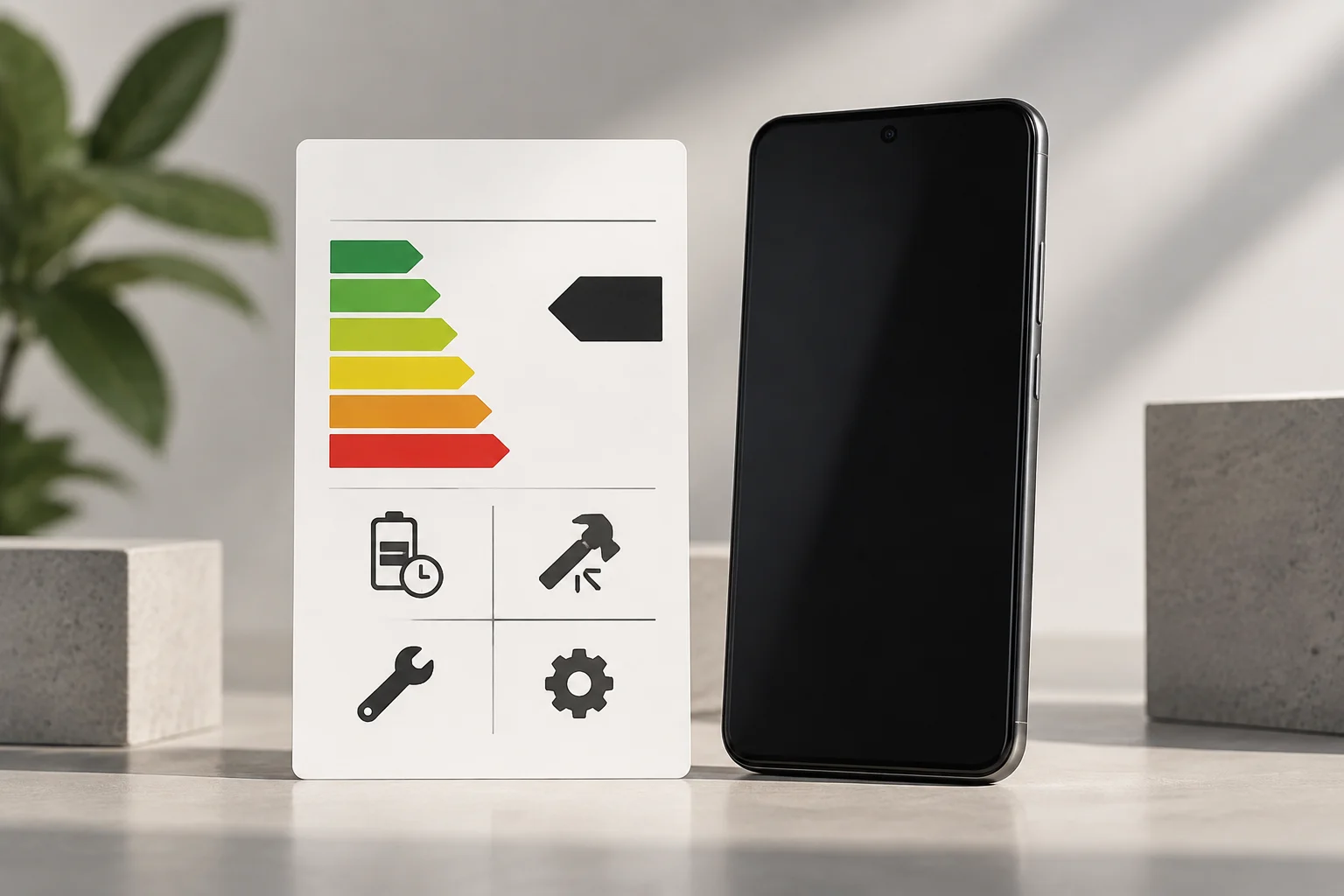
This is not breaking news: the labelling rules already apply
The European energy label for mobile phones and tablets is a comparison tool, not a recently announced update. The European Commission says that energy-labelling and ecodesign requirements for these categories have applied since 20 June 2025. So, for someone buying today, the useful question is not what future measure to anticipate, but what information the label provides and how to read it without claiming more than it shows. European Commission.
The label brings together data measured using defined methods, so some aspects of different models can be compared on a common basis. That does not make any one score an overall assessment of a phone. It does not sum up camera quality, performance, update coverage, the convenience of the operating system or the price. It is one piece of information in a broader decision, and should be read alongside the specifications and each manufacturer’s warranty and repair terms.
The Commission’s rules cover smartphones, tablets, mobile phones and cordless phones, with requirements depending on the product category. Do not assume that every device with a screen or connectivity falls under the same framework. Before comparing, check that both products belong to a covered category and that the information you are viewing applies to the exact models. The European page is a starting point for identifying the general scope; it does not replace the product’s own information sheet.
What each indicator on the label tells you
Rather than reducing your purchase decision to a single letter or number, look at the different data shown on the label. Relevant aspects include energy efficiency, battery life per charge cycle, resistance to drops and water, and repairability. The product information sheet associated with the label may add details such as battery cycle life and the availability of spare parts, depending on the applicable requirements. Taken together, these details help you ask more useful questions than “Which one has the best rating?”
Battery life on the label comes from a standardised procedure: it enables a controlled comparison, but does not predict exactly how many hours a phone will last in your hands. Your chosen brightness, signal strength, apps, games, browsing and camera use can all significantly affect consumption. Treat the figure as a comparative reference under defined conditions, not as a promise that everyone will get the same daily battery life.
Durability also needs context. A water- and dust-protection rating describes a level established by a test, not a guarantee that the phone is immune to every liquid, depth, pressure or form of wear. Likewise, a drop-resistance result does not mean that a particular unit will survive every impact intact. The indicators describe tests and criteria; they do not eliminate the possibility of damage in real-world use.
Repairability: a useful signal, not a repair quote
Repairability information helps you compare factors that are often left out of sales specifications: for example, whether spare parts are covered and what conditions apply to repairs. It is not, however, a promise of easy, inexpensive repairs or service in every location. A score or summary of the data is no substitute for checking which components can be replaced, how much the parts cost, what tools are needed and who provides the service.
It is worth distinguishing repairability assessed against common criteria from the actual experience someone may have at a repair shop. Access to spare parts, lead times, labour and repair restrictions can affect the final cost, and cannot necessarily be inferred from a single figure. Before buying, check the manufacturer’s information on warranties, authorised service centres, parts and support in your market; a European product sheet does not mean that every country has the same service offering.
The battery deserves a specific check. Its ability to retain charge over time and whether it can be replaced are related but separate issues. A charge-cycle figure alone does not tell you how many years a battery will last for an individual: habits, temperatures and charging conditions all play a part. Use the indicator to compare models on the same basis, then separately check replacement and repair terms.
How to turn the data into a practical comparison
Start by identifying two or three priorities. If you often charge your phone away from home, give more weight to measured battery life, then cross-check it against independent reviews that explain their own methods. If you plan to keep the device for years, look at durability and repairability, but also check the software update period in the manufacturer’s official documentation. The label does not replace that information.
To avoid comparing incompatible information, confirm the full model name, variant and market. Two phones in the same family may differ in battery, materials, configuration or parts availability. Check that the label refers to the version sold where you are buying and that the product sheet is not for another, similarly named model. If a detail is missing, it is better to mark it as unknown than to fill the gap with information from another variant.
A quick check can follow this order:
- Identify the exact category and model before comparing labels.
- Compare battery life and durability as test results, not guarantees of everyday use.
- Review repairability together with parts availability, service and warranty terms.
- Separately check software support, price and features the label does not cover.
- If an important detail is missing, ask the seller or manufacturer to confirm it rather than making an assumption.
What the label cannot settle, and how to decide
The label reduces some uncertainty, but it does not establish which phone is “best” for everyone. Nor can it, on its own, tell you the device’s total useful life, whether you will like the operating system, the quality of its photographs or its cost of ownership. Those aspects require additional information and, in some cases, independent reviews with transparent testing conditions. Do not treat an official score and a promotional claim as equivalent evidence.
The European Commission presents the requirements for phones and tablets as part of its energy-efficiency and ecodesign measures. This confirms the framework and its date of application, but is not enough to verify the result for every model on sale: for that, you need the label or product sheet for the particular device. The research for this article did not identify a more recent subsequent change that would justify treating the subject as breaking news. The article is therefore a buying guide based on the framework described by the source consulted.
The practical conclusion is simple: use the label to compare common, verifiable data, not to make a decision automatically. Consider battery life, durability and repairability alongside your own needs, the manufacturer’s documentation and the actual price. If two models appear close, a specific difference in software support, repair options or cost may matter more than a small variation in one indicator. And if the documentation does not clarify a decisive point, treat that lack of information as part of the comparison, not as a point in the product’s favour.