A technology is not, by itself, a product story
The material gathered about headphones combines general retail category pages with explanatory Bluetooth documentation. Together, these sources make it possible to describe a technology and establish that stores list headphones for sale, but they are not enough to attribute a recent announcement, product update, or availability date to a manufacturer. The distinction matters: a feature of a standard is not necessarily present in every model, and a sales page does not show that a product has just been introduced. Treating those different kinds of evidence as interchangeable would overstate what the sources establish.
The best-supported technological subject in this material is Auracast, Bluetooth’s name for broadcast audio. Bluetooth describes uses such as sharing a broadcast with multiple listeners or listening to television audio in public places. These are possibilities offered by the system, not proof that a particular headphone model supports them. The editorial conclusion is therefore limited: there is enough material to explain Auracast, but not to publish breaking news about a specific product. The available documentation also does not establish which devices are currently on sale with this feature. That would require evidence tied to individual models and their present availability.
What Auracast does, according to Bluetooth
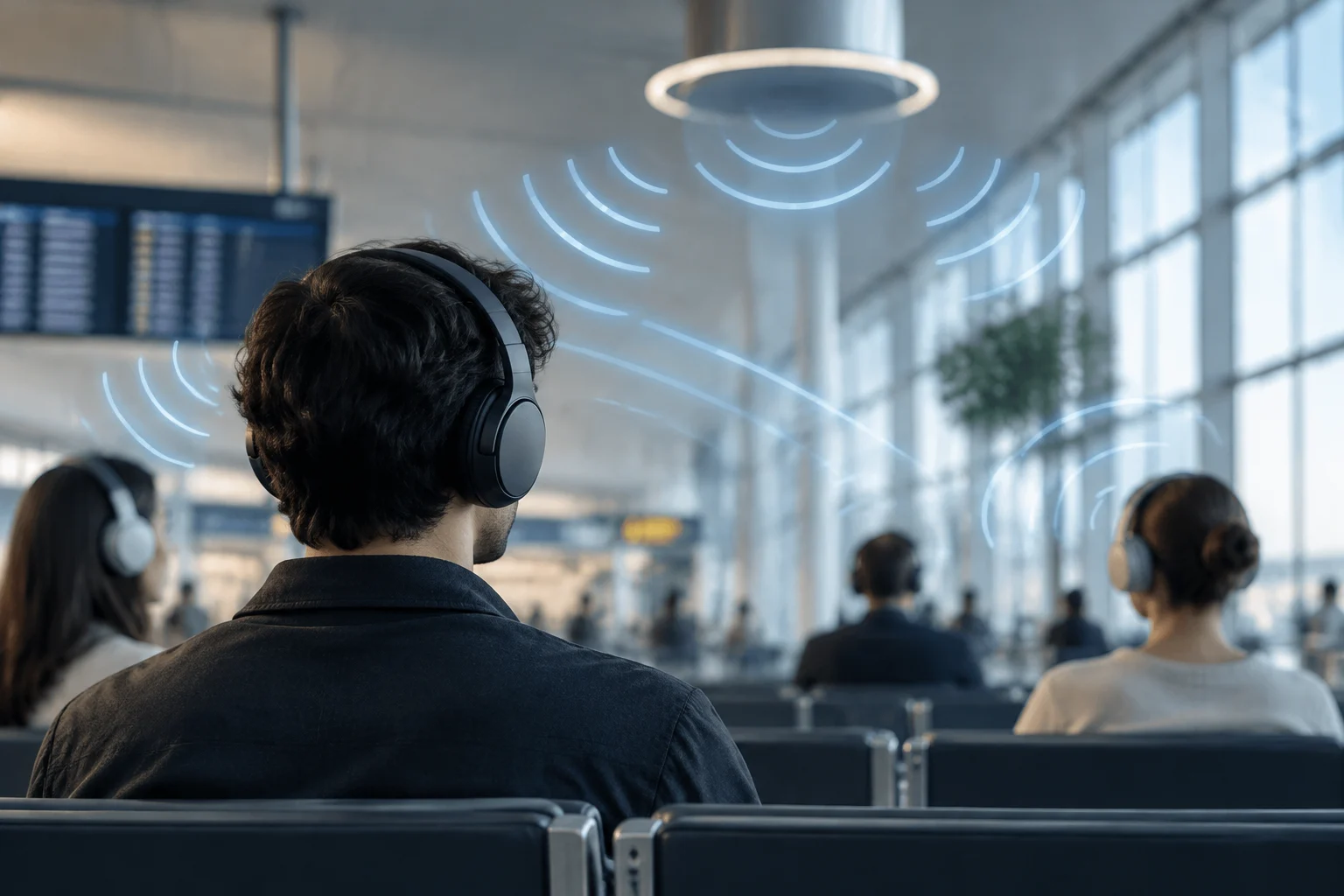
Bluetooth presents Auracast as an audio-broadcast capability associated with Bluetooth LE Audio. Rather than describing only a private connection between one source and one accessory, the concept allows a source to transmit audio that multiple compatible receivers can join. The organization gives examples such as sharing music or hearing the audio from a muted television in a public venue. In practical terms, the proposal brings wireless audio closer to a broadcast that can be heard by more than one person, rather than a stream reserved for one paired listener.
That does not mean every Bluetooth headphone can receive these broadcasts. For the experience to work, both the transmitting device and the receiving device must be compatible, and there must also be a way to discover or select the broadcast. The information provided here does not identify models, specific setup requirements, or compatibility by manufacturer. It is therefore important to distinguish the capability described by the organization from whether it is actually available in a product someone buys. The first is documented; the second calls for testing or official specifications for the exact model.
What the retail pages do establish
The MediaMarkt and Amazon links are general headphone sales pages. The material retrieved from MediaMarkt includes examples of products from different brands and categories, confirming that its catalogue covers more than one type of device. It does not, however, provide a verified technical comparison of Auracast compatibility or amount to a manufacturer announcement. A category page can also change over time: displayed prices and product selections should not be treated as permanent facts.
The difference between a retailer listing and a primary source is especially important for wireless features. A list of specifications can help someone find a product, but confirming a particular function requires checking the manufacturer’s official page or support documentation for that model. A generic mention of Bluetooth does not prove Auracast compatibility. Nor does the evidence received provide a basis for figures on adoption, sales, or regional availability of compatible headphones. Such claims would need dated, specific sources.
How to verify a possible announcement
If a claim appears that new headphones include Auracast, the first step is to find the manufacturer’s official announcement or the model’s technical specification sheet. The check should identify the exact retail name, variant and, where available, model number. It would then be sensible to look for support documentation confirming compatibility and clarifying whether it depends on a software update, an accessory, or a particular combination of devices. Without those details, a similar name or promotional label does not settle the question.
Independent reporting can check the scope of a claim, but it cannot replace product documentation. A specialist publication may add context about how the feature works, its limitations, or its availability date; a retailer may help verify that a product is offered in a particular market, provided the page is checked on a stated date. These sources serve different purposes. To say that a product is already on sale, for example, requires a source showing localized availability, not just an announcement. And to describe something as recent, the document’s date and the basis for calling it new must be explicit.
What this research does not allow us to conclude
The Bluetooth articles and pages included here describe Auracast and possible use cases. Their titles and descriptions also help distinguish an explanation of the capability and its history from discussion of possible market effects. But a view of what might happen in the future is not evidence that a prediction has come true. Similarly, an institutional page explains the technology from the perspective of the organization promoting it; it is not an independent assessment of adoption or proof that every manufacturer has incorporated it.
The absence of a verifiable announcement in the material consulted does not prove that no announcement has appeared through other channels or after those pages were published. It is a limit of coverage, not a claim about the entire market. In other words, the available material cannot date a recent development or confirm a compatible model; it can explain Auracast cautiously and set out what evidence would be needed. No products, prices, or launch dates are included because the supplied sources do not adequately support a specific commercial product as the story’s focus.
A useful conclusion for anyone comparing headphones
Anyone considering Auracast should check compatibility for both transmitter and receiver by model, rather than infer it from a brand name or generic Bluetooth connectivity. It is also sensible to confirm how a broadcast is accessed and whether the manufacturer requires an app, an update, or an extra step. The sources considered here describe the general idea, but do not answer those questions for any particular product.
For news coverage, the next step is not to extrapolate from the technology but to locate a dated primary announcement and corroborate its details with technical documentation and independent reporting. Until that evidence appears, the most precise wording is that Auracast is an audio-broadcast capability described by Bluetooth, and that the material consulted does not confirm a specific recent headphone development. Stating that limit clearly avoids turning a technological possibility into a product promise.