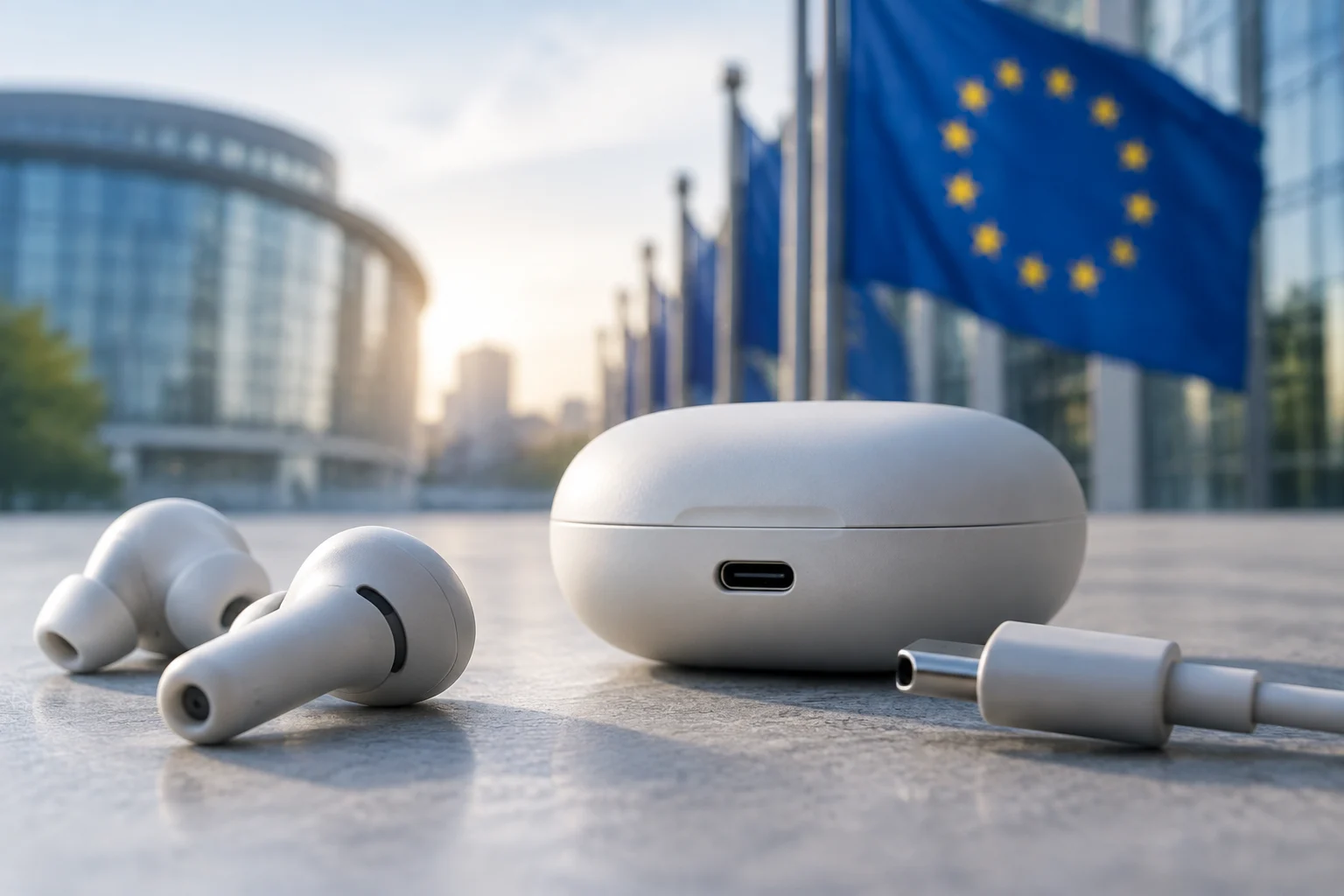
The rules exist, but this is not recent news
The practical question is simple: must every pair of headphones sold in the European Union be chargeable via USB-C? The answer needs some qualification. The EU common-charger rules cover certain audio equipment, including wireless headphones and headsets, but they do not make every product marketed as headphones a USB-C product. Nor do they require devices to share the same cable, charger or fast-charging performance. The scope depends on the device’s legal category, not just the commercial name shown in a shop. That distinction matters when a product listing uses a broad label that does not explain how the device is classified or recharged.
This is not a newly announced change, either. The requirement for the covered categories has applied since 28 December 2024; laptops have a different deadline, until 28 April 2026. As of this guide, the documentation provided does not establish that those dates have recently changed. The useful approach, therefore, is not to present the rule as breaking news, but to explain how it can inform a purchase and where its scope ends. The legal basis is Directive (EU) 2022/2380, which amends the rules on radio equipment.
Which headphones are covered by the requirement
The rule applies to the radio equipment listed in EU legislation that can be recharged by cable. The list includes wireless headphones and headsets, alongside other categories of portable electronics. For covered devices, USB-C is the required charging interface. In everyday terms, this points to headphones whose unit or charging case is recharged by connecting it to an external power source. It does not mean that every part of a set—for example, each tiny earbud on its own—must have its own port. A device can have several components while its charging system connects to the power source at only one point.
The distinction matters for products with a case. A sensible interpretation is to look at the product being marketed and at its charging system: headphones are generally stored and recharged in a case, and the case is connected by cable. The rule should not be turned into claims broader than the legal category it covers. For an unusual design, such as an audio accessory that is not recharged by cable, the commercial description alone is not enough to settle whether the requirement applies. That answer calls for checking the device’s features against the legal text rather than relying on a label or an assumption about all audio products.
The European Commission describes the common charger as applying to phones and other portable electronic devices, and identifies audio categories within the framework. CEN and CENELEC also cited headphones and headsets when explaining the implementation timetable. These sources help clarify the purpose and implementation; the legal text determines the obligation. A general guide cannot replace checking the specific category or the conditions under which the product is placed on the market. This is particularly relevant when a product’s design or charging method makes its category less obvious.
USB-C does not mean every charger is equivalent
A USB-C port does not, by itself, guarantee that a device will charge at the same speed with every adapter. USB-C identifies the connector type, while power and supported functions depend on the device, cable and power supply specifications. For equipment to which the requirement applies, the rules also include technical requirements related to charging and consumer information. They do not automatically turn every combination of charger and cable into an optimal charging solution. The connector is one part of the arrangement, not a promise about the performance of every component used with it.
For buyers, it is useful to keep three questions separate: the product’s connector, the power supply included and charging performance. The obligation to provide USB-C does not mean that the manufacturer must include a mains adapter in the box. EU legislation allows consumers to buy certain devices without a charger and requires information to help them make a choice. The availability of an option without an adapter does not mean that every manufacturer must offer every possible configuration in every shop. Buyers should check the actual contents and product information rather than assume what is in the box from the presence of a USB-C port.
Nor should you infer that a product supports every advanced charging protocol simply because it has a USB-C port. Before reusing an adapter, it is prudent to consult the manufacturer’s specifications, especially if the device indicates power limits or requires a particular cable. For headphones, whose power use and battery size are often different from those of a phone, differences between models may have more effect on recharging time than the connector’s shape. USB-C tells you what kind of port is present; it does not settle the separate questions of the compatible supply, cable or charging rate.
What to check before buying or charging
A quick check can reduce the risk of confusing a legal requirement with a commercial feature. In the product listing, locate the port on the case or headphones, the description of any included cable, and the information about an adapter. If the device is sold in the EU as wireless headphones that can be recharged by cable, and it is a new product within the applicable time scope, USB-C is the legal reference point. For older or refurbished products, or products marketed in particular circumstances, do not assume that the sale date alone settles every detail: it may be necessary to check the applicable rules and the seller’s information. A clear listing is useful, but where details matter, the model’s documentation is worth checking too.
A useful buying checklist is:
- Check which part is charged by cable: the headphones, the case or both.
- Confirm the port type in the listing or the manufacturer’s images; do not rely only on a generic compatibility label.
- Check whether the wall adapter is included or sold separately.
- If you already have a charger, check its power output and the headphone manufacturer’s recommendations.
- If the shop’s information conflicts with the official documentation for the model, ask for confirmation before buying.
What the regulation does not guarantee
The rules aim to reduce charger fragmentation and make it easier to reuse power supplies. They do not, by themselves, certify sound quality, battery life, battery durability, water resistance or noise-cancelling performance. Nor can you conclude that two charging cases with USB-C will behave identically when charging. Those characteristics remain specific to each model and should be checked in its documentation. A common connector can simplify one part of charging without making products otherwise alike, or removing the need to compare the features that matter to an individual buyer.
There is also a limit to what can be said about recent developments: the sources consulted explain the general framework and its dates, but do not demonstrate that a new headphone-specific extension was introduced in 2026. This article therefore does not present a recent announcement. The practical conclusion is narrower: for rechargeable wireless headphones included in the covered categories, USB-C is the relevant EU requirement from the applicable deadline; the particular conditions for each model—adapter, cable and performance—must be checked separately. If a purchase depends on a borderline case, the Directive, rather than a commercial summary, is the decisive reference.