What a plug-in meter measures—and what it doesn’t
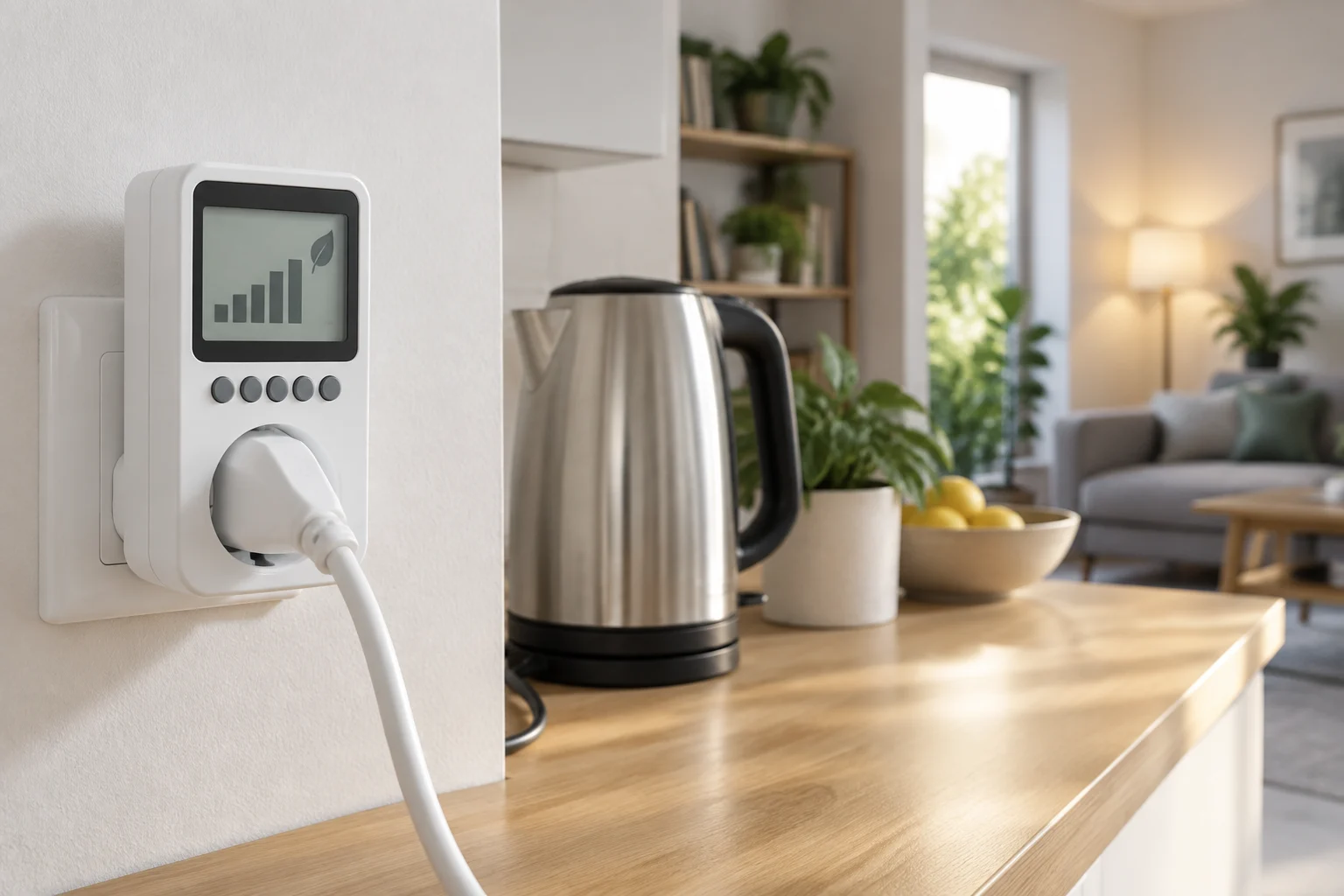
A plug-in meter sits between a power outlet and a compatible appliance. Depending on the model, it can display electrical measurements in real time and accumulate energy over a period. Its main purpose is to observe the consumption of one device connected to that outlet; it does not, by itself, break down your entire bill or automatically identify every source of household energy use.
That scope determines what is worth buying. If you want to compare a coffee maker, computer or dehumidifier, a plug-in model can help you collect observations under similar conditions. It does not directly measure hardwired appliances, such as many ovens or climate-control systems, and it is not equivalent to a meter installed in an electrical panel. Those applications require solutions compatible with the installation and, where appropriate, professional assistance.
Nor does a reading, on its own, explain why an appliance consumes energy or how much you could save by changing how you use it. An observed value describes consumption under specific conditions. Start your buying decision with the question you want to answer: accumulated consumption over a day, approximate operating power, or a comparison between two usage modes. If an appliance alternates between active and standby periods, look for a meter that can record a sufficiently long interval.
Power and energy: two measurements for different questions
Power, usually expressed in watts (W), describes the rate at which energy is being used at a particular moment. Energy consumption is commonly expressed in watt-hours or kilowatt-hours (Wh or kWh) and accumulates over time. These figures are not interchangeable: an instantaneous power reading is a snapshot, while an energy record summarises what happened over an interval.
For an appliance whose operation varies, the accumulated figure is usually more informative than a single reading. A refrigerator, for example, does not necessarily demand the same power at every moment. For appliances used briefly, one isolated measurement may not reflect the usual pattern; repeat the measurement under comparable conditions or, where practical, record a period that includes complete operating cycles.
Check which measurements the device offers and how it displays them. A screen showing W does not necessarily retain a kWh history; depending on its design, an accumulated reading may reset when the meter is unplugged or after a power cut. Consult the manual for how recording works, the units, reset functions and any stated measurement conditions. If the difference between two appliances is small, do not treat the displayed digits as proof of accuracy: display resolution and metrological accuracy are different things.
Features worth comparing
Begin with specifications that match your use, rather than the number of advertised features. Check the measurement range, stated resolution, available measurements and whether the device retains accumulated consumption. A large display or an app can make readings easier to consult, but neither replaces information about electrical limits and operating conditions.
Recording, readout and everyday use
If you want to compare appliances over several hours or days, look for a clear way to consult the accumulated reading and establish whether it is retained when the meter is unplugged. If you only need a one-off reading, connectivity and history may be unnecessary. A straightforward interface can help prevent mistakes: make sure you can distinguish current power, accumulated energy and estimated cost, if the latter is offered.
Resolution is the smallest increment the device displays; it does not, by itself, prove that a value falls within a particular margin of error. Assessing accuracy requires explicit specifications and, if the decision demands rigour, information about test conditions and methods. IEC standards for energy meters set requirements for equipment within their scope, but a standard cited on a sales page is not enough to conclude that a domestic plug-in meter is certified or suitable for every task.
Safety, plugs and compatibility
Before connecting an appliance, compare the voltage, maximum current and permissible power specified by the meter’s manufacturer with the appliance’s own data. Also check that the plug and socket formats are compatible and that the device is intended for the market and installation where you plan to use it. Do not infer safe capacity from its appearance or from a figure on the display.
Do not use the meter beyond its declared limits. If the appliance label or manual does not make it possible to determine whether the load is compatible, do not improvise: ask the manufacturer or a qualified person. Avoid chaining adapters or power strips unless the instructions explicitly allow that arrangement. A loose socket, damaged cable, unusual heat or signs of damage are reasons to stop using the setup.
IEC 62053-21 and IEC 62053-23 concern particular requirements for active and reactive electrical energy meters, respectively. They are technical documents for equipment within their scope; they are not a universal shopping checklist for domestic plug-in consumption meters. When choosing a product, the decisive information is the documentation for the specific model, its limits and the conformity information applicable in your market.
How to measure reproducibly
A comparison is useful only if the appliance, operating mode and duration remain reasonably consistent. Note which device you are measuring, when the recording starts and ends, and which setting was selected. For devices with cycles, try to include complete cycles; if actual use varies considerably, take several observations rather than presenting one isolated reading as typical.
A simple household procedure could be:
- Note the appliance model, programme or setting, and start time.
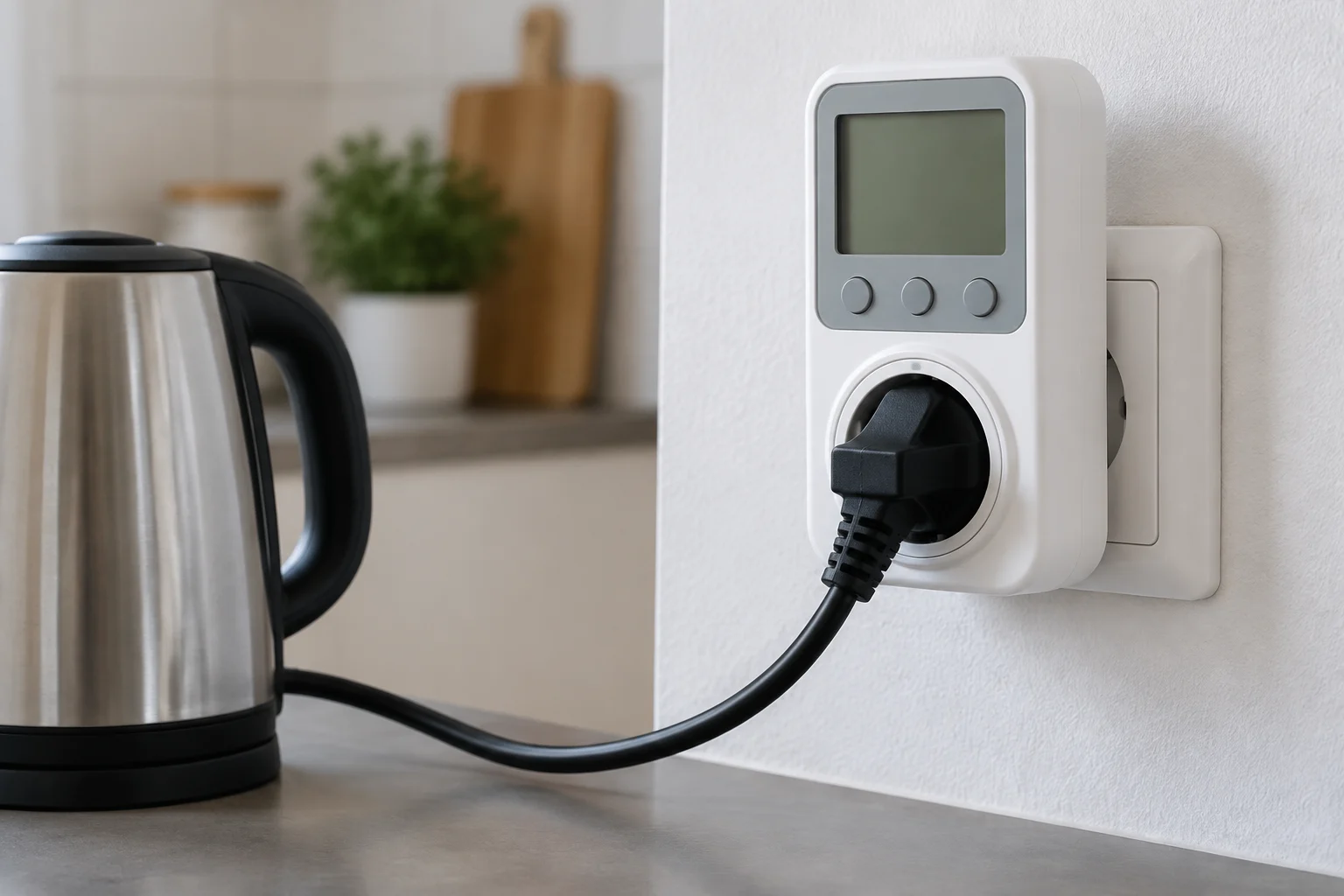
- Connect the meter directly to a compatible outlet and check that the load is within its limits.
- Record the accumulated reading after a defined interval; also note any interruption or change in use.
- Repeat the observation under similar conditions before comparing another appliance or setting.
- Keep the units and period alongside each figure; do not compare an instantaneous value with an accumulation over several hours.
The appropriate duration depends on the appliance and the question. For equipment that runs continuously, a representative interval may be sufficient; for something that switches on and off, a short interval may capture an unusual phase. If the meter does not retain its record when unplugged, avoid interrupting the test without making a note of it. The aim is not laboratory precision, but fewer differences caused by incompatible time periods or changes in settings.
From consumption to cost: an estimate, not a bill
If the meter records energy in kWh, a basic estimate of the energy cost is obtained by multiplying the measured kWh by the applicable price per kWh for the relevant period and contract. For example, if the reading is 2 kWh and the applicable price is €0.20/kWh, the product is €0.40 for that item. This example illustrates the calculation; it does not represent a current tariff or the total cost of a bill.
A bill may include components that a simple multiplication does not reflect, such as fixed charges, taxes or other items. The applicable price may also change with the contract, time of day or billing period. Use the relevant actual price and describe the result as an estimate of the cost of the measured energy, not a prediction of the complete bill. If the device calculates euros automatically, check which price has been entered and which items are included.
Nor should you turn a brief observation into an annual claim without justifying the extrapolation. Multiplying a result by days or months assumes that usage remains stable; that assumption may fail for seasonal or irregularly used appliances. To decide whether a change in habit is worthwhile, first compare equivalent periods and keep the measurement conditions consistent. A meter reveals a figure; whether consumption can be reduced depends on what use can be changed without compromising needs or safety.
What to check before buying
Look for a technical datasheet and manual for the exact model, not just a general description of the product category. Check accepted voltage and current, units and measurements, range and resolution, whether the record is retained, safety instructions and explicit limitations. If a cost-calculation or connectivity feature is advertised, check how it is configured and what data it needs; do not assume it will work in your country without adjustments.
Comparative reviews can help identify differences in ease of use, but check which models were tested, how they were measured and whether the article distinguishes manufacturer data from its own results. A ranking without a visible method, or a figure without conditions, does not let you assess its relevance with confidence. Standards pages explain a standard’s scope; they do not replace product documentation or independent verification of the particular model.
Before deciding, ask: can the appliance I want to measure be connected compatibly? Can the meter handle its load? Do I need instantaneous power or accumulated energy? Does the record cover the relevant period of use? Can I consult the model’s official documentation? If an essential answer is missing, compare another device or ask the seller for clarification. A well-chosen meter helps you observe and compare; it does not, by itself, guarantee savings, absolute accuracy or a particular bill.