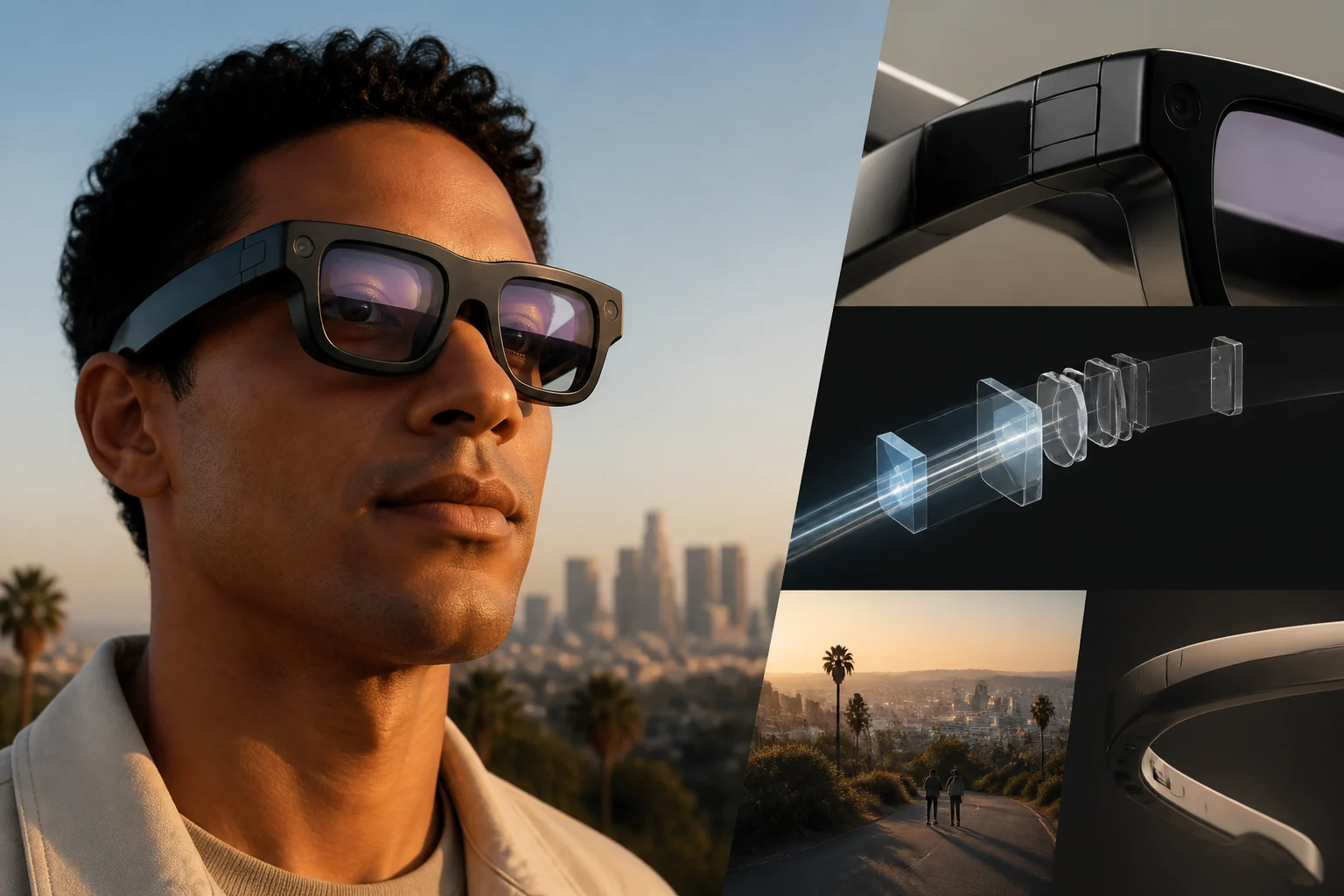
What’s new and availability: pre-orders live and first hands-on
As of September 16, 2026, Snap opened pre-orders for SPECS, its augmented reality glasses, with an official price and a refundable deposit. The company places the first shipments “later this fall” and confirms three initial markets: the United States, the United Kingdom, and France. For those who want a taste before deliveries begin, there will be an in‑person SPECS First Look in Los Angeles starting October 1. These concrete timelines help narrow down which consumer AR will actually be ready in the Northern Hemisphere’s fall of 2026—an important signal for early buyers and content teams planning launches and demos.
In the U.S., Snap also announced an ecosystem for retail and connectivity in partnership with carriers. Beyond the standard reservation, there will be a charging case with cellular connectivity and agreements with Verizon for financing and plans. This detail—together with the rollout supported by Orange (France) and EE (United Kingdom)—suggests the initial distribution leans on network partners, a sign of product maturity compared with previous dev‑kits.
Price and configurations: what’s included and how to buy
The launch MSRP is $2,195 with a $200 refundable deposit at SPECS.com. Snap has not yet detailed every in‑box accessory for the base unit, but it will sell a SPECS Charging Case with Cellular offering four additional charges. In the U.S., the bundle with the cellular case carries an announced price of $2,395, with installment options via Verizon and “Connected Wearable” plans starting at $10/month for Verizon customers ($20/month for non‑customers).
Regarding sizes, SPECS comes in two frame sizes. There is no final list of integrated prescription options or retail optical partnerships published in the pre‑order announcement; if you require corrective lenses, it’s wise to consider adapters or external solutions while Snap finalizes its commercial optical offering.
Verified specifications: optics, weight, controls, and platform
SPECS uses waveguides with in‑house LCoS micro‑projectors, delivering a 51° diagonal field of view and 16 million colors. The design prioritizes real‑world presence: electrochromic lenses that shift from clear to tinted in ~10 seconds, and open‑ear audio to keep your surroundings audible. The electronics integrate two Snapdragon processors—one handling the core system and another for computer vision—reflecting a strong bet on on‑device processing that lowers latency and reduces phone dependency.
The hardware comes in two sizes: 47 mm (132 g) and 52 mm (136 g), placing SPECS well below the weight of traditional XR headsets and closer to sturdy everyday eyewear. For interaction, it combines gestures and voice with an AI‑native operating system that enables learning, navigation, translation, and entertainment experiences. Although Snap has not disclosed resolution, brightness, or memory, it positions the device as a “new kind of computer” for daily use, with a browser, shared experiences, and continuity with your phone.
Support and compatibility: Snap OS 2.0, Lens Studio, and continuity
For developers, the transition from Spectacles to the commercial cycle of SPECS is anchored by Lens Studio and Snap OS 2.0. Snap documents that what you build today in Lens Studio for Spectacles is intended to be compatible with SPECS, with practical caveats: keep toolchains and firmware on supported versions, and verify API and performance specifics before going live.
In parallel, Snap introduced SPECS Intelligence, an anticipatory AI service that works across iPhone, Mac, and the glasses, arriving in preview mode on iOS from the United States. This is meaningful for creators who want contextual logic without building a full back end: Snap had been laying infrastructure groundwork (for example, Snap Cloud in investor communications) and is now showing how that reaches end users.
Privacy and signaling: visible design and local control
Privacy is an explicit pillar of the product. Snap states that SPECS does not use facial recognition to identify people, does not record continuously, and that when you capture photos, video, or audio, a front‑facing LED visibly lights up for bystanders. The company emphasizes on‑device processing and a cloud infrastructure with granular user access controls, as well as the principle of seeking permission before accessing sensitive information in Lenses and associated services.
This privacy‑by‑design stance aligns with more visible product choices—an eye‑catching aesthetic rather than “invisible” glasses—to reduce social misunderstandings. In practice, for creators and brands, it sets UX and communication guardrails when trialing experiences in public spaces.
What’s changed versus Spectacles ’24 (dev‑kit)
A direct comparison with Spectacles ’24 helps gauge the leap. The 2024 dev‑kit weighed 226 g and offered a 46° diagonal FOV, with distribution via subscription to development teams. SPECS, by contrast, drops to 132/136 g, climbs to 51°, and moves to direct consumer purchase. The flow also evolves: from creator‑centric trials to an AI‑native OS with consumer experiences, carrier partnerships, and a broader ecosystem of content and workplace collaborators.
Not everything carries over automatically: while Lens Studio is the bridge, Snap and trade press note that certain dev‑kit Lenses may require adjustments for performance or APIs on SPECS. For teams with existing Spectacles ’24 projects, the prudent plan is to audit dependencies (tracking, shaders, materials) and profile on final hardware as soon as it becomes available.
Market timeline and what remains to be confirmed
According to Snap, shipments will begin “later this fall 2026” in the U.S., the U.K., and France. There will be in‑person demos in Los Angeles from October 1. Beyond these official milestones, details on resolution, brightness, real‑world battery life, and retail optical configurations remain unannounced. It also remains to be seen what the day‑one app catalog looks like and how SPECS Intelligence evolves after the preview phase.
How we’ll evaluate after the commercial release: we’ll look at tracking stability in dynamic scenes, color fidelity in waveguides under direct sunlight, fatigue during sessions beyond 90 minutes, open‑ear audio reliability outdoors, and real continuity with phones and Mac. Until then, the value for an early buyer lies in the ecosystem and Snap’s commitment to tools and privacy, not in open‑ended promises about specifications that have yet to be published.