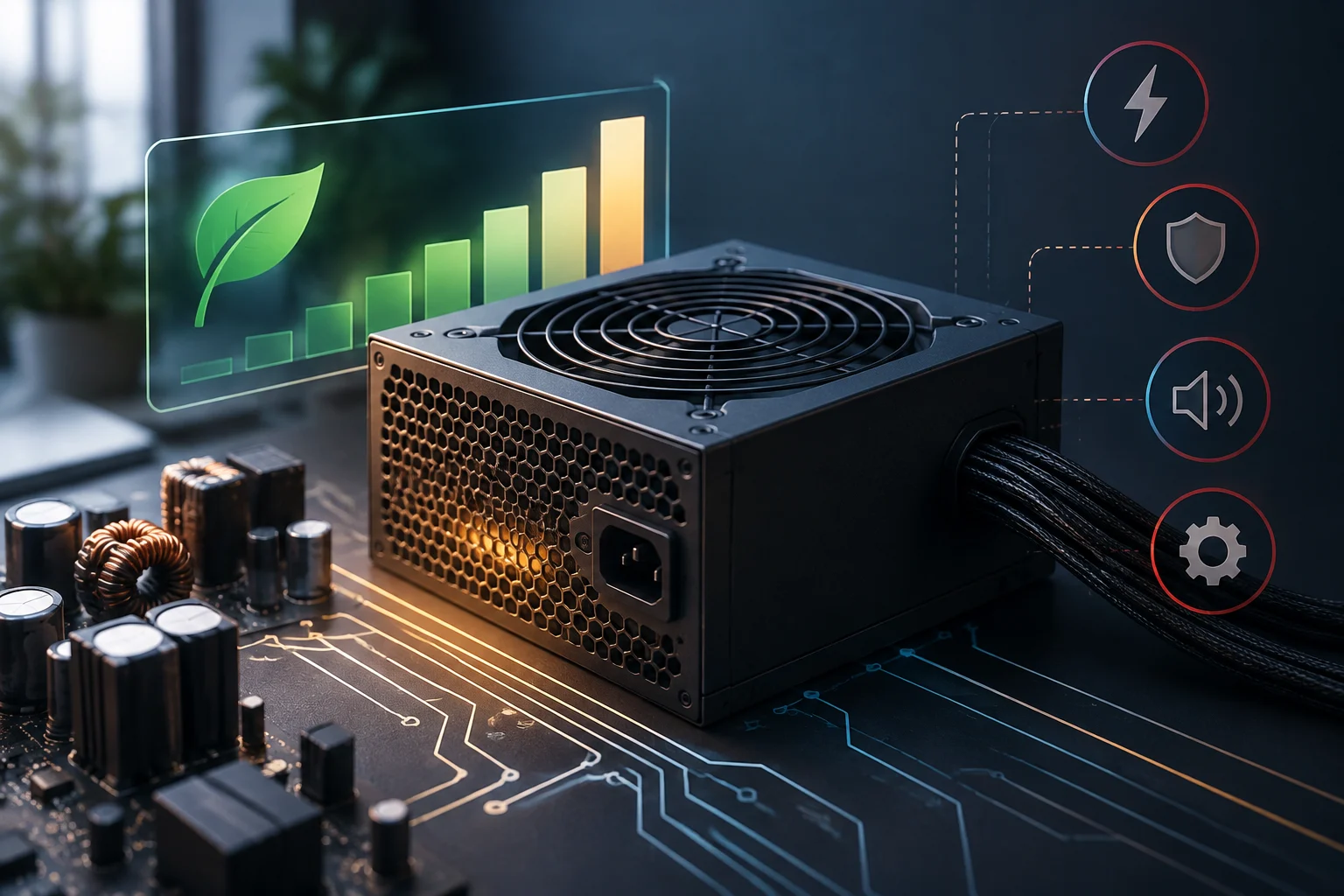
The label describes one specific dimension: efficiency
80 PLUS is an efficiency certification program for power supplies. Its purpose is to assess what proportion of the energy a power supply draws from the electrical grid it delivers to computer components, rather than losing, primarily as heat. Certification offers a useful reference for comparing that aspect, but it should be understood as a limited measure, not an overall rating of the product. The program documentation and database of certified power supplies are published by CLEAResult, which administers the 80 PLUS site. (80 PLUS FAQs; database of certified power supplies).
Put simply, if a computer needs a certain amount of power and its power supply is less than 100% efficient, the supply has to draw more power from the wall outlet to deliver what the system needs. The difference does not automatically indicate a defect: converting alternating current to direct current and regulating it involves losses. Higher efficiency means less energy is lost for the same output, under the conditions in which efficiency is measured. It does not mean that the power supply delivers more rated power, nor that a computer will always use a fixed amount less electricity.
The certification also does not, by itself, answer every common question people have before buying. It does not determine what wattage is appropriate for a particular configuration, whether a model regulates its outputs well in different situations, which protections it includes, or how much noise it makes. These are questions about the power supply, but they are distinct from efficiency. Keeping them separate helps avoid a common misunderstanding: treating a higher 80 PLUS level as a general guarantee of technical superiority.
What the program provides, and how to understand its scope
80 PLUS organizes information about power supplies that have been certified and provides resources and FAQs to explain the program. Its database makes it possible to check whether a model is listed as certified—a more specific check than relying only on a commercial claim printed on a box or included on a retailer’s product page. To identify a product carefully, check the exact model name and, where available, the specific variant: a product family may include units with meaningful differences. (CLEAResult: certified 80 PLUS power supplies; program resources).
Efficiency levels are interpreted in relation to the program’s criteria and the applicable test conditions. They should not be read as a promise that a unit will produce the same result at every load, temperature, mains voltage, or system configuration. In other words, the label summarizes a result obtained under a particular method; it is not a continuous measurement of every possible usage scenario. To learn which points and requirements apply to a particular certification, consult the program documentation rather than inferring them from the level’s name alone.
The FAQ page is a starting point, but it does not replace checking the information for the relevant model. The certification database can help verify that a model is listed, while the program resources can guide interpretation. If a product page includes efficiency figures, check that they refer to the same variant and to comparable conditions. A single figure without context has limited value when trying to anticipate everyday performance.
Rated power is not an efficiency figure
Efficiency is usually expressed as the relationship between input power and output power. Rated power, by contrast, refers to the power supply’s stated capacity to deliver power. These are different quantities: an efficiency-certified unit is not automatically validated for every processor, graphics card, or combination of components. Choosing a wattage requires estimating the system’s expected power use and checking how the power supply’s capacity is distributed, as well as considering connection requirements and the manufacturer’s specifications.
It is also important not to confuse the advertised total figure with the capacity available on the rails that power the main components. Intel’s technical documentation for ATX power platforms sets out specific design guidelines for PC power supplies. It is a relevant reference for platform requirements, but it does not turn 80 PLUS certification into a comprehensive assessment of each individual unit. (Intel, ATX 3.0 Multi-Rail Design Guide, ATX12V 3.1 Specific Guidelines).
The practical takeaway is straightforward: size the power supply for the system and its needs, not according to its efficiency level. Check the rated wattage and detailed specifications for the exact model, along with the connectors required by the motherboard and graphics card. If the system includes components with significant power spikes, also check that the technical documentation applicable to the platform addresses that kind of demand. 80 PLUS does not replace those calculations or checks.
Protections, noise, and build quality require other kinds of testing
An efficiency label does not establish which electrical protections a power supply includes or the conditions under which they operate. Nor does it, on its own, describe component quality, output stability, or resilience under different loads and temperatures. Answering those questions requires manufacturer specifications and, when an independent assessment is wanted, tests of the specific model using a published methodology and results. If a feature is not mentioned in the 80 PLUS summary, that does not prove the power supply lacks it; it simply means the label should not be treated as evidence for it.
Noise is another example. A power supply may dissipate less energy under the conditions of an efficiency test, but that provides no basis for claiming that it will be quieter in a buyer’s computer. Sound depends, among other things, on how the unit is cooled and how it behaves under load. A useful assessment requires comparable acoustic measurements or a clear description of the test conditions; the 80 PLUS category is not a noise scale.
Electrical safety and compliance with applicable standards are also separate from efficiency. The Intel document cited above covers power-supply design guidelines for ATX platforms; it should not be presented as a safety certification or proof that a specific product meets every requirement. A responsible assessment combines evidence: efficiency certification when that dimension matters, manufacturer documentation for specifications and protections, and transparent independent tests for observed performance.
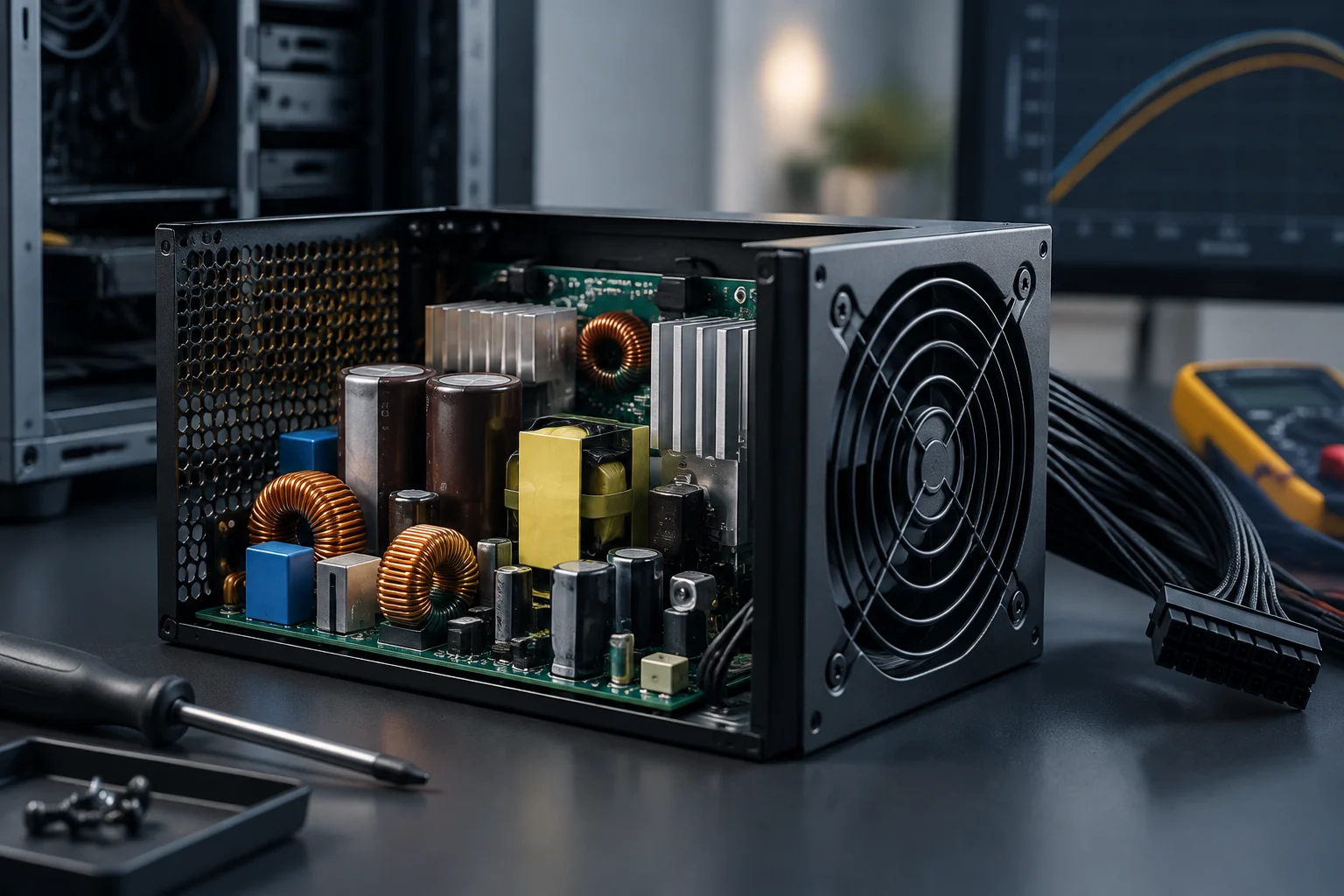
A practical comparison before buying
When comparing two models, do not start by assuming that the higher level settles the whole decision. First confirm that the product pages refer to the exact models and variants; then separate information that answers different questions. CLEAResult’s database can verify whether a product is included in the 80 PLUS program, while Intel’s guide helps put technical platform requirements into context. Neither source replaces the manufacturer’s product information for the connectors and specific features of an individual product. (80 PLUS database; Intel ATX guide).
A checklist helps prevent one figure from dominating the choice:
- Efficiency: Check whether the model is listed in the program, and treat its certified level as an efficiency measure, not an overall quality rating.
- Capacity: Compare rated power with the actual requirements of the system’s components.
- Connections: Verify that the specific variant includes the connectors needed by the motherboard and graphics card.
- Protections and specifications: Look for explicit manufacturer information; do not infer these from 80 PLUS.
- Independent tests: Prioritize reviews of the exact model that explain the method, conditions, and performance and noise results.
- Model identity: Compare model numbers and variants, not just the name of a product family.
The conclusion: useful, as long as you do not ask it to measure more than it does
80 PLUS can help distinguish certified power supplies and compare their efficiency according to the program. That information is useful, but its value depends on respecting its limits: it does not determine the right wattage for a computer, describe protections on its own, predict noise levels, or replace full tests of stability or construction. The certification answers one specific question, not every question that matters when choosing a power supply.
So the most useful interpretation is not “this label proves the power supply is good,” but “this label tells me something about efficiency; now I need to check the rest.” Looking up the model in the official database, reviewing its technical specifications, and comparing independent tests with an explicit methodology can provide a more complete assessment. Efficiency matters, but it is not a complete evaluation of the power supply.
The evidence used here documents the 80 PLUS program and an ATX platform guide. It does not include independent test results for specific models or a comparison of acoustic measurements. This analysis therefore sets out what can be said about the label, but does not rank brands, name winners, or recommend a particular unit. For an actual purchase, verification should continue with the exact model and sources that measure the features that matter to you.