The recent announcement is not a speaker
The practical question for anyone considering buying a Bluetooth speaker is whether Auracast has reached that category through a specific product launch. The available information supports a cautious answer: the recent announcement identified here is for television headphones, not a speaker. On January 22, 2026, Sennheiser presented the RS 275 TV Headphones set, which includes the BTA1 transmitter and Auracast features. This establishes that a product related to the technology was announced, but it does not demonstrate the launch of an Auracast speaker or its commercial availability in any particular market.
It is useful to distinguish three things that are often conflated in headlines or product listings: a feature described by the Bluetooth SIG, a product that a brand announces as compatible, and the actual sale of that model in a particular region. A general explanation of Auracast establishes what the technology is intended to do; it does not confirm that a specific speaker includes it. And a launch announcement alone is not enough to conclude that the product is already being sold everywhere.
The limited conclusion, then, is this: there is a verifiable recent announcement of personal audio with Auracast, but no equivalent confirmation of a Bluetooth speaker in the sources cited. That is not the same as claiming that no compatible speaker exists on the market: supporting that claim would require a broader, more up-to-date search of products and markets.
What Auracast does
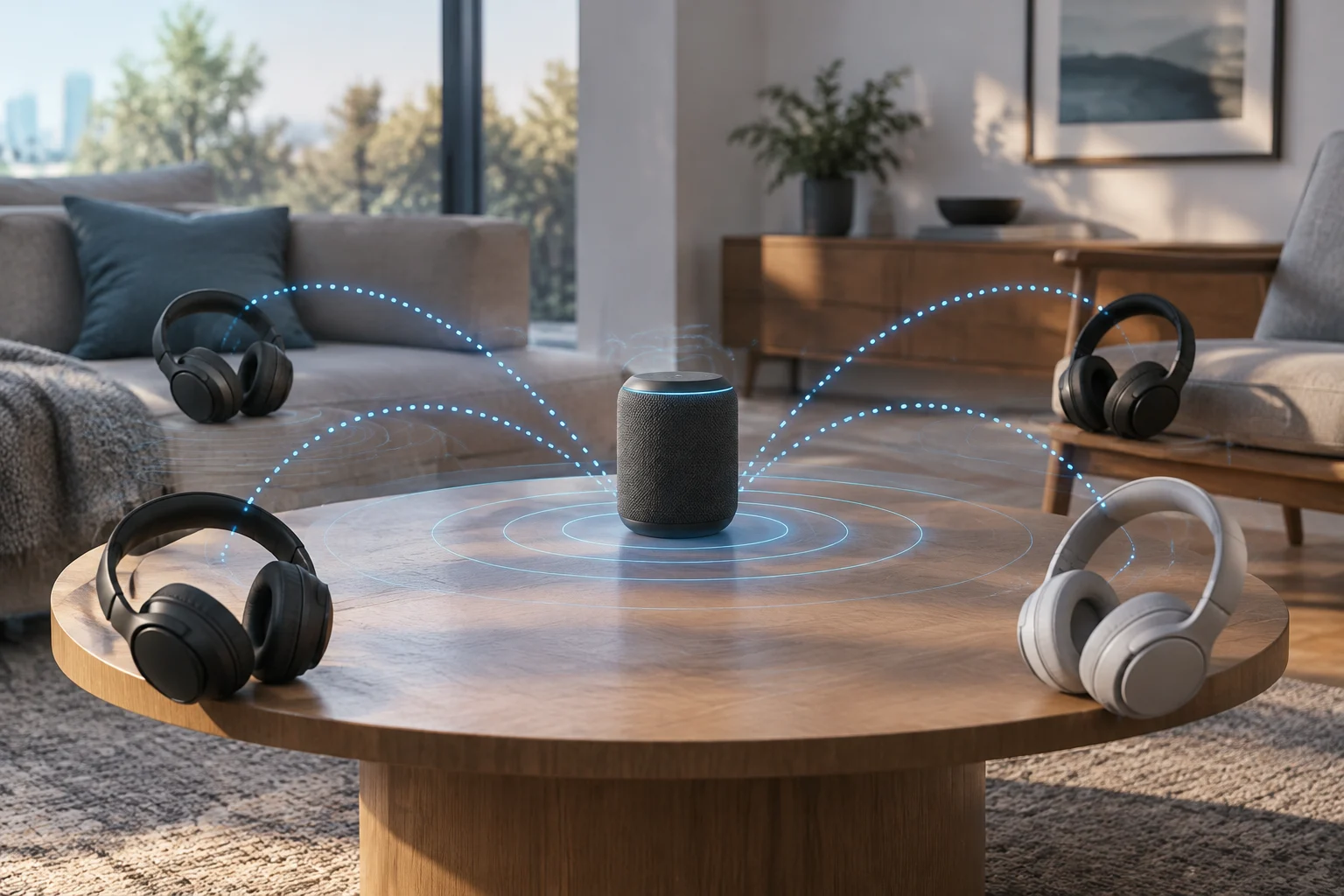
Auracast is a Bluetooth LE Audio feature that lets a transmitter broadcast an audio stream that multiple compatible devices can receive. Instead of establishing the typical individual connection between a phone and a single speaker, the idea is that different people can join the same broadcast using their own receivers. The Bluetooth SIG presents the feature as a way to share audio and enable broadcasts in public or domestic spaces.
The important distinction is that broadcast describes a way of distributing a signal, not a guarantee that any nearby Bluetooth device can play it. The transmitter must offer the feature, and the receiver must also be compatible. In addition, the way a broadcast is discovered and selected depends on the implementation: it may require an app, an interface on the device itself, or another assistance method. A product listing that simply says “Bluetooth” is not enough.
The Bluetooth SIG describes uses such as listening to a shared source as a group or receiving audio broadcast in public places. These are examples of what the technology can make possible, not a promise that every existing venue is already equipped for it. Compatibility must be checked at both ends of the transmission, rather than inferred from a generic Bluetooth version listing.
What the Sennheiser product establishes
Sennheiser’s January 2026 press release identifies the RS 275 TV Headphones as a set of headphones and a BTA1 transmitter. The company attributes Auracast capabilities to the transmitter and presents it for use with televisions. This supports describing it as an announced product with Auracast and as a way to bring the feature to a personal listening experience at home; it does not support describing it as a speaker or as proof that televisions transmit Auracast natively.
The distinction matters because a transmitter connected to a television can create or facilitate a broadcast without the television’s built-in speaker, or a separate Bluetooth speaker, being the Auracast transmitter. The announced equipment is focused on headphones and individual or shared listening through compatible receivers. The announcement broadens the conversation about Auracast, but it does not answer the question of which speakers to buy.
Sennheiser had also previously announced Auracast features in its MOMENTUM True Wireless 4 headphones and an update to its Smart Control app with an Auracast assistant. These earlier announcements show the technology appearing in consumer audio products and tools, but they are not speaker announcements either. Coverage of a brand’s feature should be read with attention to the specific model and function, not automatically transferred to other product categories.
What it could do in a speaker
In a compatible speaker, broadcasting to multiple receivers could let a group listen to the same source through compatible headphones, for example while someone uses a speaker or television as the transmitter. It could also let a speaker receive a public broadcast, provided the manufacturer has implemented the receiving function. These scenarios fit the logic of Auracast, but they are not confirmed features of a specific speaker model in the available sources.
Before considering this capability when buying, it is worth checking a few specific points in the model’s documentation:
- Whether the product is an Auracast transmitter, a receiver, or both. The word “compatible” without this distinction may not be sufficiently informative.
- What additional devices are needed: a phone, an app, an external transmitter, or other equipment.
- How a broadcast is selected and whether the brand explains the process for the intended use.
- Whether the manufacturer documents compatibility with the receivers you already own.
- In which country and when the product is offered, separately from the date it was announced.
Announcement, availability, and buying decision
The date of a press release is not a universal availability date. In this case, Sennheiser’s source confirms that the RS 275 set was announced on January 22, 2026; the information provided is not enough to establish availability in every country, local pricing, or sales conditions. Nor should the announcement of a headphone set be turned into evidence of a compatible speaker range.
For anyone comparing speakers, the practical recommendation is to treat Auracast as a feature that must be checked model by model, not as an attribute that can be inferred from “Bluetooth LE” or a generic product listing. Look for the function on the manufacturer’s official page and verify the role the device plays in the transmission. If receiving group audio is important, also check that the headphones or other receivers available to you are compatible.
In short: the technology provides a way to share audio among compatible devices, and announcements exist for personal audio products that incorporate it. The cited evidence does not confirm a recent launch of an Auracast speaker, so it does not justify presenting this as news of a new speaker category. The open question is which manufacturers will announce specific speaker models and when those models will reach each market; without a primary announcement and availability information, that should not be taken for granted.