There is no confirmed recent development here
The idea of looking for a recent change in creative tools runs into a specific limitation: the available sources do not document a dated update to an editing program or a recent announcement that would support a claim that the way it attaches or displays credentials has changed. The C2PA specification consulted presents version 2.4 and lists technical mechanisms, but that page alone does not prove that a particular application has recently introduced a feature. For that reason, this article does not present a product update as news. Instead, it explains what the standard can provide and what is worth checking before trusting a credential.
This distinction matters to anyone publishing images. A feature described in a standard is not necessarily available in every editor, service, or file format. And an application’s ability to read metadata does not necessarily mean it preserves that metadata when exporting, adds it to a new image, or displays every detail. Without dated official documentation for a specific tool, it is not possible to claim that a verifiable recent change has occurred. The scope of the available evidence therefore sets a clear limit: it supports an explanation of the standard, not a claim about recent product behavior.
What a C2PA credential records
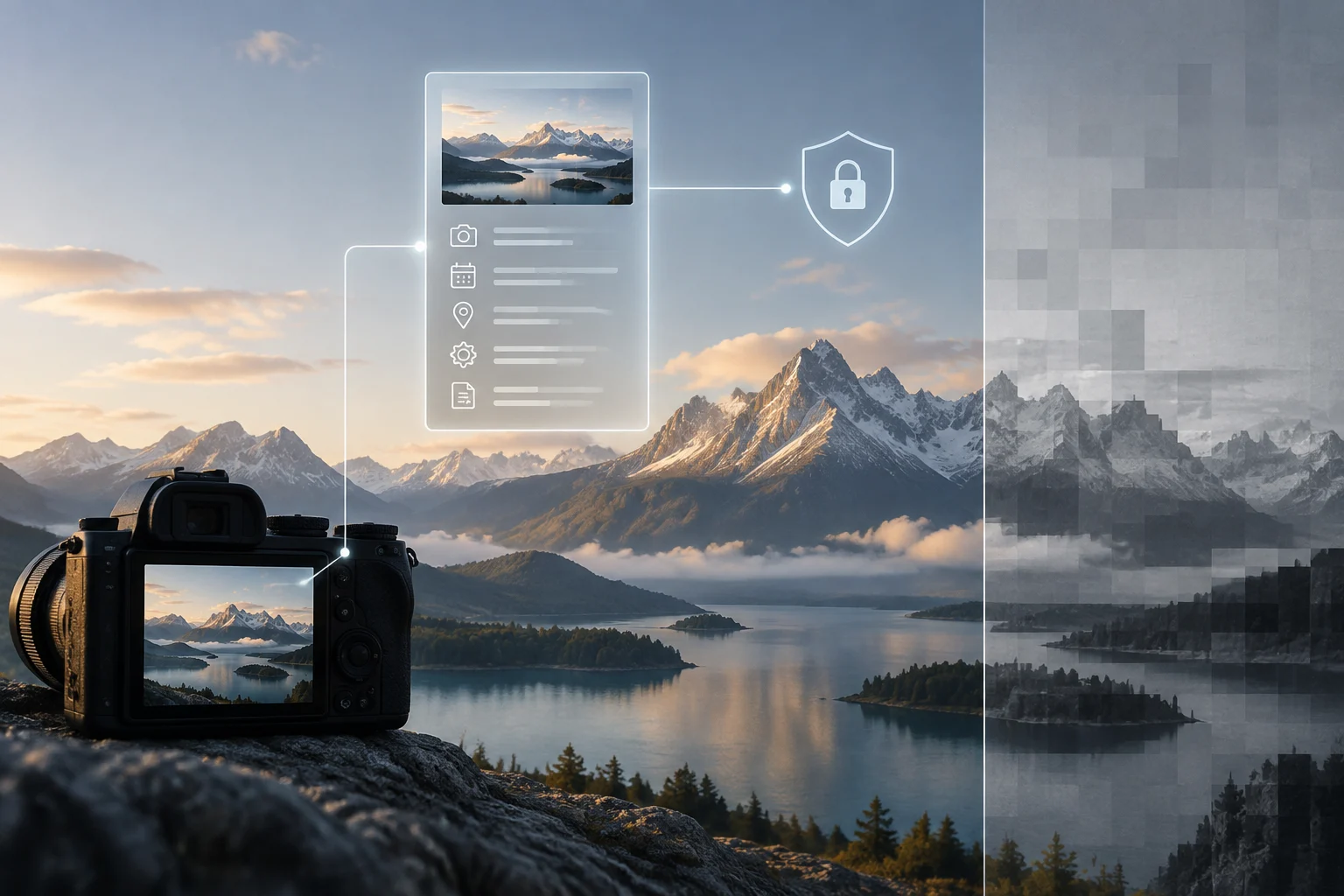
C2PA is a technical specification for associating provenance information with digital content. Rather than treating an image as an isolated file, it provides for a structured record that may include assertions about the content and its processing, along with data that binds the record to the asset. The specification organizes these elements through claims, assertions, and binding mechanisms; it also allows for data to be embedded in a file or stored externally. This architecture can describe a declared history of content. It does not automatically judge whether the depicted scene is true.
Depending on the tool and workflow, a credential can help answer questions such as who claims to have created or modified a file, what actions were recorded, and whether the data are associated with the asset being examined. The key is to distinguish a declaration that can be technically verified from the truth of what it says. A valid signature or binding may support the conclusion that certain information was associated with a file in a particular way. It does not, by itself, turn a description of a scene into a proven fact, nor does it guarantee that the person named in the record is known to the person viewing the image. The record should therefore be read as information about an asset and its declared history, not as an automatic verdict about the events shown.
A signature is not a certificate of truth
Credentials are most useful when read as available provenance evidence, not as a universal manipulation detector. They can help inspect a record of actions or check whether information is linked to a file, but interpretation depends on what data the record contains, who issued them, and what each action means in the context of the application. The standard defines a technical structure; evaluating the identity, authority, or reliability behind a declaration requires additional context. A record can be meaningful and still leave important questions unanswered about the circumstances in which an image was made or edited.
There is also a difference between the integrity of a record and the truth of what is depicted. A technically valid credential does not prove that a photograph shows an event exactly as it happened, that its caption is correct, or that every relevant editing step has been included. A credential does not replace editorial verification or visual and contextual assessment. Treat its data as one piece of evidence: when a decision has significant consequences, cross-check dates, locations, authorship, and other details against independent sources. Even when a record appears intact, readers should consider what it actually asserts and what it leaves outside its scope.
Absence, loss, and compatibility
Failing to find a credential does not prove that an image is false or that it was generated with artificial intelligence. No credential may ever have been created; alternatively, the system receiving the image may not read it, or the file may have passed through a process that did not preserve associated data. C2PA documentation allows for both embedded information and external storage, so the way a credential can be consulted may depend on the file and the service being used. Not seeing one in an application is not enough to diagnose what happened.
For the same reason, do not assume that every creative tool attaches or preserves credentials, or that two applications present them in the same way. Before drawing conclusions, identify the program and version, review its official documentation, and check specifically what happens when opening, editing, and exporting the format in question. The sources available here do not make it possible to reliably list which particular editors offer those features or under what conditions. Publishing a compatibility list without that verification would create a misleading impression of coverage. Compatibility is not a single yes-or-no property: it can depend on the application, version, file type, workflow, and the way a receiving service handles the result.
Practical checks for creators and readers
For image creators, the prudent approach is to check the whole workflow, rather than relying on a single checkbox or a general promise of compatibility. The editor’s documentation should clarify whether it can generate credentials, what information it records, and whether the chosen export preserves them. If the file passes through a publishing platform, it is also worth checking the downloaded or reshared result: an intermediate step may modify the file or change how its data are presented. Testing the final output matters because the working file and the version an audience receives may not behave alike.
For someone receiving an image, these checks help put the information in context:
- Consult the original file, when possible, and use a tool that reports whether it found credentials and what link it establishes with the content.
- Read the assertions precisely: distinguish claimed authorship, recorded actions, and information about the file from any conclusion about whether the scene is true.
- Seek independent context if identity, date, or location matters; a credential cannot answer those questions on its own.
- Do not turn absence into an accusation: a file without credentials does not reveal why they are missing or who produced it.
The result is a narrower expectation, but a more useful one: C2PA can provide a structure for examining provenance information and its technical relationship to an asset. It does not guarantee that every program writes or reads that information, that the history is complete, or that the content is authentic in a journalistic sense. It can help people ask better questions about an image; it is not a reason to stop asking them.