The evidence changes the focus of the story
The starting premise was that the supplied sources did not confirm recent developments. However, the research includes Samsung and Google publications dated July and August 2026 announcing new foldable devices. There are therefore verifiable announcements that support reporting product news; it would not be accurate to present the lack of evidence as a general conclusion about the industry. The evidence changes the framing, but it does not answer every question a reader might have about these phones.
The distinction matters: a manufacturer’s publication can confirm what that company announces, but it is not an independent assessment and does not prove that a product is already available in every market. Nor is a model name enough to establish its complete specifications. In this article, the announcements themselves are the documented facts; their implications for the market and for Android need to be treated cautiously. Separating those points keeps the report within what the cited material supports.
Samsung announces three models for its Z family
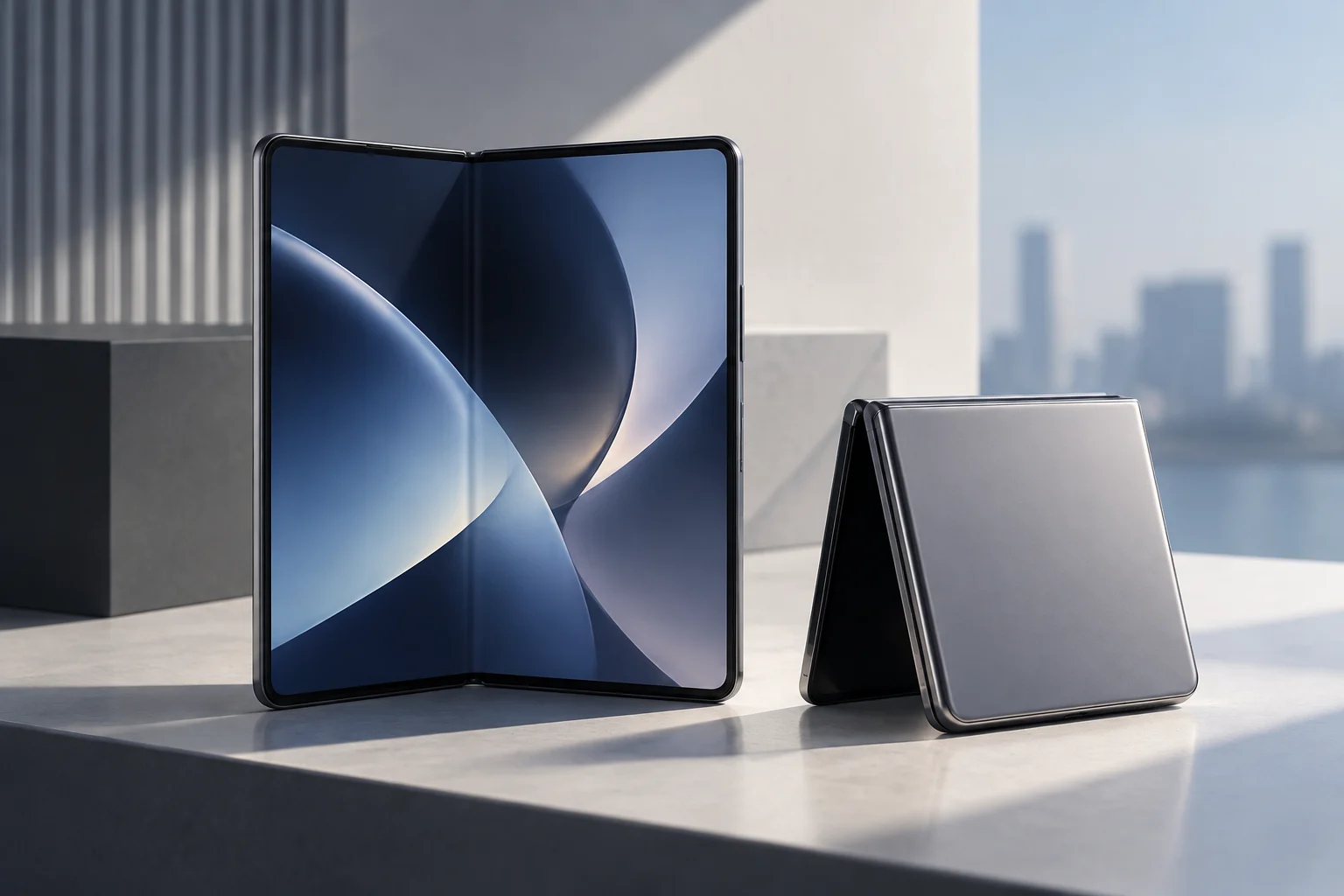
Samsung published a Galaxy Unpacked presentation in July 2026 identifying three devices: Galaxy Z Fold8 Ultra, Galaxy Z Fold8 and Galaxy Z Flip8. The source confirms that the company presented them as part of that event, but the material available here supplies no specific information about price, country-by-country availability, weight, dimensions or technical configuration. We do not add those figures or infer that all three models will be sold in Spain. Naming a device is not the same as publishing a complete product specification.
The company’s post is a primary source for its own product announcement. It is not independent evidence of performance, durability or image quality. That distinction also helps clarify the headline: a commercial product announcement has been made, but the cited sources do not provide enough evidence to compare the three phones or say which would be the best purchase. A retailer listing, by contrast, would at most document an offer or a retail category at the time it was checked; it would not amount to an official manufacturer announcement.
Google introduces the Pixel 11 Pro Fold
On 12 August 2026, Google published a presentation of the Pixel 11 Pro Fold and described it as its latest foldable. In the same description, the company refers to a thinner and lighter design, a new main camera and improved intelligence tools. These are features announced by Google: the source provided here includes no measurements, camera data, test results or quantified comparison with the previous generation. The wording can be reported as Google’s description, but not converted into independently verified results.
Another Google publication from the same day places the Pixel 11 Pro Fold within a broader presentation of Pixel 11 devices. This supports the conclusion that the foldable announcement was part of the company’s product communication, but it does not establish sales dates or terms in each market. The announcement does not show that the phone is immediately available in Spain, and promotional language such as “thinner” should not be treated as a measurable improvement without comparable dimensions.
A new product does not mean Android has changed across the board
The Android sources supplied do show that Google includes foldable devices in its developer documentation and in its categories for form-factor optimization. There is also a Google publication about Android 17, but the available excerpt does not describe a feature specifically for foldables. It would therefore be excessive to attribute a particular foldable-phone innovation to Android 17 based only on a headline or a general description of productivity, gaming and security. The distinction is between what the documentation covers and what it actually confirms.
The difference between an operating system and a device is practical. A manufacturer can announce changes to a phone’s design, camera or tools without implying a new Android feature for every foldable. Conversely, guidance on building adaptive apps does not prove that the announced devices include a particular capability. The 2023 coverage of app redesigns for foldables provides historical context about adaptation work; it does not confirm a software development in 2026.
How to read the sources and their limits
When checking a story of this kind, it helps to separate three questions: who made the announcement, what was stated explicitly, and what information is still missing for the announcement to be useful to a buyer? Official pages answer the first question and identify what each company communicated. The third would require, for example, local sales pages or official specification sheets giving prices and availability. Commercial pages included in the research cannot replace that documentation if they show only a category of foldable phones.
The time frame also needs to remain visible. The research contains publications dated 2026, but it is not a complete selection of announcements from every manufacturer or an exhaustive review of every market. These materials can therefore confirm specific announcements, not establish that Samsung and Google are the only manufacturers with news or describe the industry as a whole. The absence of a detail in the sources consulted does not prove that the detail does not exist; it means that it cannot be verified from the cited material.
What can be stated, and what remains unresolved
The editorial conclusion is narrower than a claim about the entire sector: the official sources supplied contain Samsung and Google announcements concerning foldables in 2026. Android documentation also addresses adaptive development, but the material available does not by itself substantiate a new Android feature exclusive to these models. Keeping those points separate avoids confusing a hardware announcement with a platform-wide update, while still recognizing the product news that the sources do confirm.
Before turning an announcement into a buying guide, prices, sales dates, configurations and complete specifications would need to be checked on official pages for each market. Comparing real advantages over previous generations would require comparable data; assessing user experience or durability would require independent testing. Until then, the most useful approach for readers is to distinguish what each brand has announced from what still requires local documentation or external corroboration.