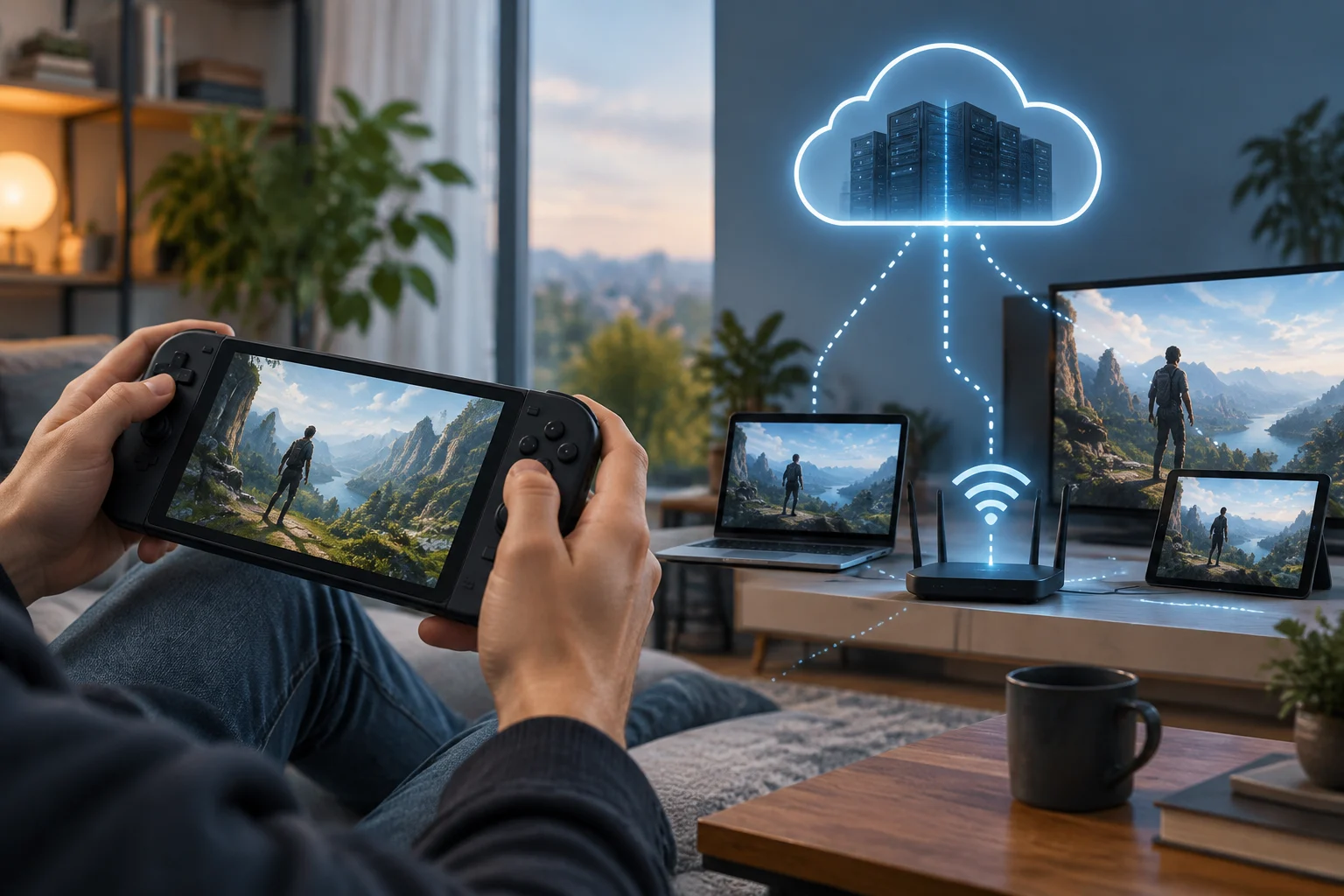
These are not two equivalent devices
A handheld console that runs games on the device itself and a cloud gaming service may share a screen and controls, but they do not rely on the same infrastructure. In the first case, the game is processed on the hardware; in the second, the service runs it on servers and streams image and sound to your device. That difference changes what you need to verify before paying: hardware and game compatibility on one side, and connectivity, access to the service and terms of use on the other. It is useful to distinguish where the game actually runs, rather than judging only by the size or shape of the screen. A portable-looking product does not, by itself, tell you whether it runs games locally or depends on a remote service.
Nor does choosing one necessarily rule out the other. A console can offer installed games and, in some cases, connected features; a compatible phone, computer or handheld device may act as a screen for playing through streaming. It is therefore worth comparing the specific way you plan to play, rather than assuming every portable device works like a traditional console or that every cloud service supports every device. Xbox publishes an official list of compatible devices, while NVIDIA maintains its own requirements for GeForce NOW; consult the information for the exact device and service you intend to use. Compatibility information can change, so check the current official documentation rather than relying on a general description or an older list.
Installed games: more independence from the internet, not universal compatibility
Playing an installed title means that each frame does not depend on a continuous stream from a server. That can matter when travelling or in places with an unreliable connection, because the game is not being delivered as a live video stream throughout the session. However, “installed” does not guarantee that every game will work without internet, that a library can be transferred between console generations, or that all features remain available offline. Activation, updates, multiplayer modes and each game’s policies can impose different requirements. Check them title by title, especially if offline play is an important reason for choosing a device. A game may have distinct requirements for initial setup and for later play.
Cross-generation compatibility also needs attention. Nintendo, for example, maintains a dedicated page explaining Nintendo Switch game compatibility with Nintendo Switch 2. This is a useful reminder, not a rule that applies to every brand: a compatibility list may identify exceptions or limitations. Before choosing a console, look up the platform’s official documentation for games you already own as well as those you plan to buy. Check the specific edition and any stated restrictions instead of inferring support from a familiar series name. The name of a franchise or the appearance of a cartridge is not enough to confirm that it will work. When a title matters to your decision, verify its compatibility directly rather than treating compatibility as a general feature of the console family.
Cloud gaming: the device is only one part of the requirement
With streaming, the service and the connection are part of the experience. Xbox describes cloud gaming as a way to play through compatible devices and provides instructions for setting up handheld devices. NVIDIA, in turn, publishes system requirements for GeForce NOW. It is not sensible to turn a speed figure or a requirement for one platform into a guarantee for another: the particular service, home network, distance from and load on servers, device and connection conditions all matter. A device that meets a basic requirement may still be affected by how and where it is connected, so check the complete set of requirements rather than one specification in isolation.
Check three things before subscribing or buying an accessory. First, confirm that the device and operating system appear on the service’s current list. Second, establish whether access to the game you want is included in your plan or requires an additional purchase: catalogues, rights and terms are not identical across services. Third, check that the service is available in your country and that your account meets its conditions. A general product page may not answer every individual case, so it is worth reading the help pages and the details for the specific game as well. Do not assume that a service’s broad availability means every title or feature is available to every account. Technical compatibility is not the same as access to every game. Check both questions before you commit to a plan or accessory, and revisit the official information if your intended device or account differs from the examples shown.
Latency, image quality and data: questions specifications cannot answer on their own
Streaming quality depends on more than the maximum speed advertised by your internet provider. Connection stability, network congestion and the device’s responsiveness can affect image continuity and the time between an action and its response. A fast but unstable connection can cause problems; a shared home network can also perform differently depending on the time and what other people are doing online. These are general considerations, not the results of a test of any particular service or device. A headline speed therefore cannot, by itself, predict how a session will feel in your home or in the places where you plan to play.
If latency or visual quality is decisive, look for independent tests that identify the service, device, game, region and network conditions. Check whether results come from a wired or Wi-Fi connection, an isolated session or a shared network, and whether observations are repeated measurements or one-off impressions. Do not apply figures from one test to all users. Data traffic also deserves a practical check: review the limits on your mobile or home plan, and do not assume streaming uses the same amount of data as local play. The relevant allowance and the way you use the service matter to your own costs. Without data from a comparable test, it is not possible to claim which option delivers a better picture or lower latency for a particular person.
A checklist before you buy
To reduce surprises, start with your games and your usual situation, not an isolated specification. Write down which titles you want to play, where you usually play and whether the experience needs to work when a reliable connection is unavailable. Then compare the official pages for the device, service and games: a positive answer from one of those sources does not automatically settle the others. Checking each one separately makes it easier to spot a missing condition, such as a required operating system, an account restriction or a title that is not in the catalogue. This is especially useful when several products or services are involved.
Before deciding, check: 1) compatibility of the device and operating system; 2) availability of the service in your market; 3) whether you need a subscription, a separate purchase or both; 4) whether the titles you care about run as installed games or are streamed, and what specific requirements they have; 5) data limits, network stability and coverage where you will play; 6) the controls, accessories and connection method required; and 7) account, catalogue and compatibility restrictions that could change. If the manufacturer does not specify a condition, treat it as something still to confirm, not as a guaranteed feature. Keep the answers together so that a claim about the device is not mistaken for confirmation about the game or service.
The decision is often simpler when expressed as a priority: installed games favour use that does not depend on a constant stream, while the cloud may let you play on different compatible devices without those devices running the game locally. Neither option is universally better. The practical criteria are the combination of your library, connection, recurring cost and place of use; make the purchase only after checking all four for your situation. If one of those factors remains unclear, resolve it with current official information before paying rather than assuming the missing detail will not matter.