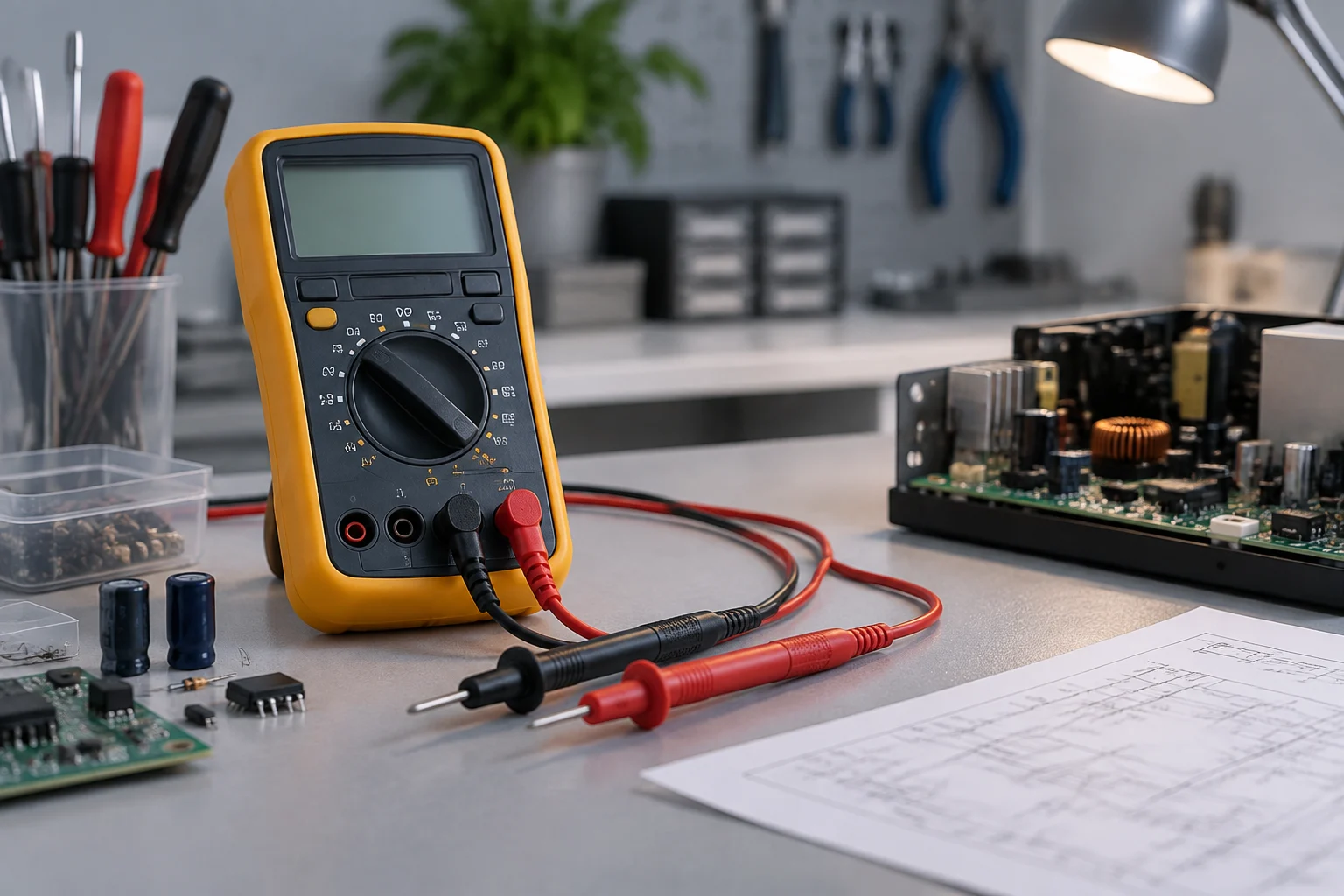
Start with the environment, not the feature list
Before comparing displays or modes, decide where and what you will measure. Checking a low-voltage electronic board is not the same as inspecting an isolated battery or working on an electrical installation connected to the mains. The task determines both the functions you need and the foreseeable risks. An instrument intended for low-energy circuits should not be assumed suitable for measuring in electrical panels or power outlets just because its selector includes AC volts. In those environments, the rated voltage and measurement category stated by the manufacturer are part of the selection, not optional details. IEC 61010-2-033 addresses particular requirements for handheld multimeters capable of measuring mains voltage, within the safety framework for measuring equipment.
For someone starting out in low-voltage electronics, it is usually more useful to look for a device whose instructions clearly describe DC voltage, resistance, and continuity measurements, along with easy-to-read input limits. Also consider whether the instrument is designed for the specific task, accepts the necessary test leads, and has a manual that explains procedures and restrictions. Measurements on energized circuits, especially mains installations, can involve hazards that buying a device with more features does not remove. This guide does not replace training or local safety rules: it sets out criteria for comparing specifications; it does not authorize work on hazardous circuits or recommend interventions on equipment connected to the mains.
Functions: voltage, resistance, continuity, and current
Voltage measurement lets you compare the potential difference between two points. For basic electronics, check that the multimeter covers the values and signal type you expect, such as DC from a battery or power supply. Make sure the selector distinguishes DC and AC when both are relevant, and read the maximum limit that applies to each input. A multimeter’s ability to measure voltage does not mean it can do so in every circuit or condition. The specifications and manual should state how to connect the leads and which input to use; an incorrect connection can damage the instrument or create a hazard.
Resistance and continuity are related functions, but they are not interchangeable. Resistance measurement displays a resistance value under the measurement conditions; continuity provides a practical indication of whether there is a sufficiently conductive electrical path according to the instrument’s threshold. A beep alone does not prove that a component works correctly, nor does it identify where a fault lies. To measure resistance or continuity, the circuit must be de-energized, and capacitors must be handled in accordance with the applicable instructions. Measuring a component in-circuit can produce altered results because of other electrical paths. Fluke describes these functions and the limits on interpreting them in its continuity and resistance guides, but the documentation for the model you choose should govern the procedure.
Current measurement requires extra care when comparing instruments. Unlike voltage measurement, measuring current usually requires inserting the multimeter in series with the circuit and using the appropriate current input. Check the current limit, permitted duration, and input protection in the manual; a large number printed on the dial is not enough. If your intended use does not require current measurement, there is no need to make that function your primary buying criterion. For occasional electronics work, a straightforward, well-documented selection may be more appropriate than a device with numerous modes you do not know how to use.
Range, resolution, and accuracy are not the same
The range is the interval of values an instrument can measure in a particular mode. Some multimeters select the range automatically; others let you choose it manually. Auto-ranging makes everyday operation easier, while manual selection can be useful when you want to control the interval, but neither option by itself guarantees a correct reading. Before buying, check the ranges available for the functions you will actually use and whether the instrument clearly indicates when a value exceeds the measurable maximum.
Resolution describes the smallest increment that can be displayed on a scale or range. Seeing more digits does not automatically mean measuring more accurately. Specified accuracy expresses the permitted error under stated conditions and may be given as a percentage of the reading plus a number of counts; read both parts and the conditions attached to the specification. Keysight’s buying guide treats digital multimeter characteristics as technical criteria that can be compared, but the digit count alone cannot tell you which instrument is suitable. Also check whether the specifications give data by function and range rather than making a general, context-free claim.
Response to changing signals and reading stability also matter, although their importance depends on the task. The requirements may be modest when locating a depleted battery or checking continuity; measuring changing signals or comparing nearby values calls for closer attention to specifications and measurement method. Do not infer accuracy that the manufacturer does not publish, and do not compare figures obtained under different conditions as if they were equivalent. A sound purchase starts by identifying the quantity to be measured, deciding what practical resolution is needed, and confirming that the stated range and accuracy cover that case.
Measurement categories and safety: read the whole label
CAT categories classify the intended use of measuring equipment according to the electrical environment and the transient conditions for which it is designed. They are not a general quality scale, nor a promise that every measurement within the printed voltage is safe. IEC 61010-1 sets general safety requirements for electrical measuring, control, and laboratory equipment; IEC 61010-2-033 adds particular requirements for handheld multimeters intended to measure mains voltage. Read the category and voltage together, always in relation to the point in the installation where the measurement will be made.
As a buying guide, a higher category does not automatically make an instrument suitable for every task: rated voltage, test-lead configuration, instrument condition, protections, and the manufacturer’s instructions also matter. Nor should a marking printed on the case be confused with independently verified certification. Fluke explains the practical relationship between categories and applications; the relevant standards reference is the IEC publication, while product-specific information comes from the product documentation. If the label or documentation is ambiguous, the prudent choice is not to use the instrument in that environment until the issue has been clarified with the manufacturer or a competent person.
Safety also depends on the test leads. Check that insulation is not cut, cracked, exposed, or loose, and that connectors fit properly. Fluke provides guidance on inspecting test leads, but a visual inspection does not establish that the instrument is in good internal condition or replace the checks or maintenance specified in the manual. Do not use damaged accessories or combine them with the multimeter on the assumption that they share its rating. Protection of the measurement setup is limited by its least suitable component and configuration.
Ergonomics, accessories, and useful documentation
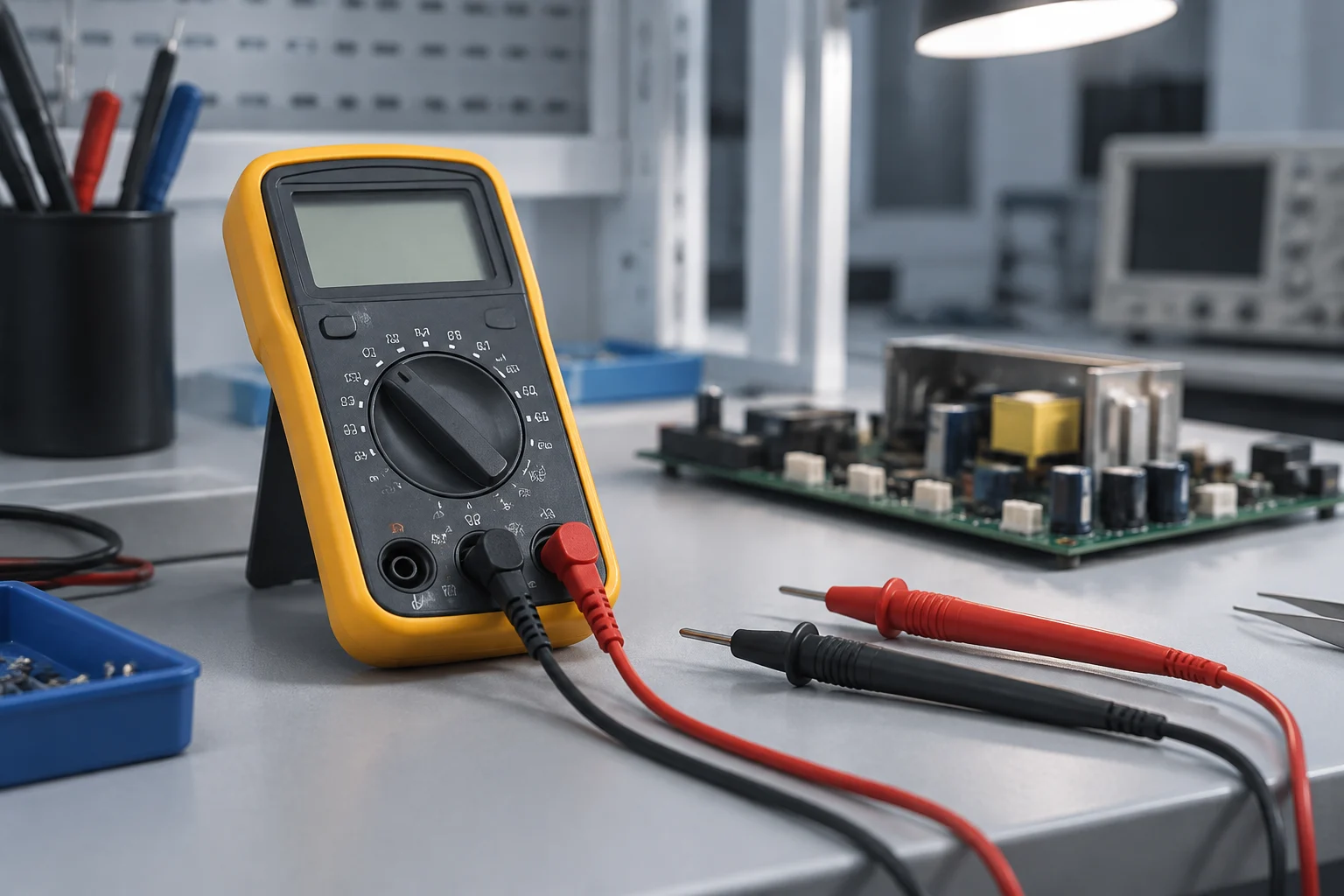
Display readability, access to the selector, stability on a bench, and clearly identified inputs all affect everyday use. A simple multimeter can reduce confusion when its functions are clearly marked and its manual explains the connections; additional functions add value only when they are needed and you know how to interpret their results. Also check whether the supplied test leads are appropriate for the test points you commonly encounter and whether the manufacturer identifies compatible accessories. Do not assume that a replaceable probe inherits the instrument’s classification.
The manual is an important part of the purchase. Look for maximum limits by input and function, instructions for replacing the fuse, warnings about current and resistance measurements, and details of compatible test leads. Audible continuity can be convenient, but check whether there is a defined threshold and what the indication means; a beep is not an automatic diagnosis. If you will use the device frequently, also consider the availability of replacements and documentation in a language you understand. Sales information may omit restrictions that do appear in the manual, so it is worth consulting both documents before deciding.
Do not confuse a low price with savings if the documentation is incomplete, or a high price with suitability. This guide does not recommend a specific model because uses, regions, and safety requirements vary, and the sources available here do not allow an up-to-date comparison of products, prices, or market availability. To choose between instruments, prepare a comparison of their official specifications and manuals, using exactly the same function, range, and conditions. If you cannot confirm a critical specification, treat it as unknown, not as an implied capability.
Checklist and limits of at-home diagnosis
Before buying, define the working environment and the quantities you will measure; confirm that the multimeter covers the required ranges and distinguish auto-ranging from resolution and accuracy. Verify the category and voltage stated for the intended use, protected inputs, compatible test leads, and safety instructions. Make sure the manual is available and explains how to configure each function. This sequence helps rule out unsuitable instruments without treating one isolated feature—such as many digits, a beep, or a maximum current figure—as a synonym for quality.
Before each measurement, consult the manual, inspect the condition of the leads, and select the correct function and input. For resistance and continuity, follow the instructions for de-energizing the circuit; do not measure mains-connected circuits if you lack the training and suitable equipment. A reading can guide a check, but it does not necessarily identify the cause of a fault: parallel components, intermittent connections, load conditions, and configuration errors can change the result. Continuity in particular indicates an electrical relationship limited by the instrument’s method and threshold, not that the entire system is operational.
The boundary between a basic check and a hazardous intervention depends on the equipment and environment, not just on a user’s subjective experience. If mains voltage, high voltage, high-energy batteries, fixed installations, or uncertainty about the procedure are involved, stop and consult a qualified person. The cited standards help explain the safety framework, but do not by themselves certify a model or replace product documentation, local regulations, or training. In short: choose a multimeter based on its actual use, verify its limits against manufacturer sources, and treat safety as an essential part of its specification.