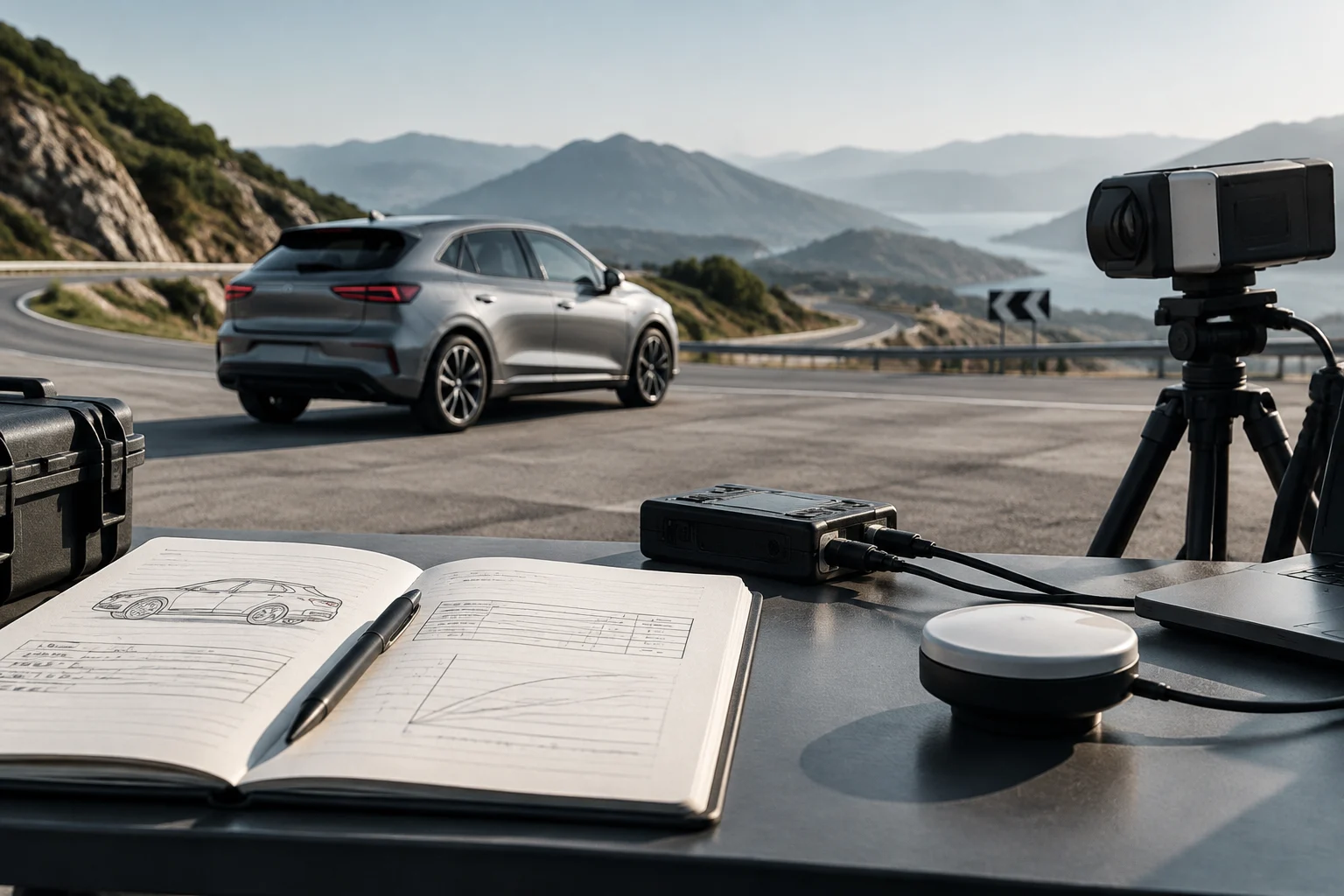
A review brings together different kinds of information
A car review often presents several kinds of information on the same page: technical data, observations about driving and, sometimes, figures obtained during testing. Their appearance together does not mean they come from the same source or can be verified in the same way. The reader’s first task is to identify what kind of claim is being made and who is responsible for it.
This distinction also helps you read with appropriate expectations. A figure should be traceable to a specification sheet or a procedure; an impression, by contrast, communicates how the person conducting the test perceived a situation. There is no need to dismiss either one, but it is important not to let one stand in for the other when drawing conclusions.
Publications themselves take different editorial approaches. Motor.es describes its review section as analysis that goes beyond the specification sheet and includes driving and measured fuel consumption; coches.com presents reviews and comparisons with opinions and assessments of the best and worst aspects. These descriptions help explain what each section offers, but on their own they do not confirm the method used in every article. Motor.es and coches.com are starting points, not guarantees that all their content has the same scope. Look for the method in the specific review rather than inferring it from the section label alone. It helps to separate three layers: what the manufacturer states, what the publication records and what the driver or writer interprets. This avoids turning an impression—for example, that a car feels agile—into a measured property, or treating an official figure as a result observed on a particular route.
Specifications: check the version, market and source
A specification sheet is useful for establishing which vehicle is being described, but only if it is identified precisely enough. The same commercial name can refer to different powertrains, trim levels, model years or configurations depending on the market. So before comparing power, mass, battery capacity or equipment, check that both specifications refer to genuinely equivalent versions. Otherwise, a difference attributed to the model could simply result from comparing different variants.
Look for the source of each item of data. A specification published by the manufacturer is an official statement from the brand; a figure reproduced in a review may repeat that information, but that does not turn it into an independent measurement. If the article does not link to the technical documentation, the figure may still be useful as a guide, although it is harder to trace its version and context. Manufacturers’ press pages can document their announcements and vehicles, but you need to confirm that the page refers to the model and market you are considering. Attribution matters even when several pages repeat the same number: repetition does not change who originally published it.
One straightforward check is to note the full version name, the model year if specified and the market. If any of these details is missing, do not assume that the figure refers to the car sold in your country. In the event of a discrepancy, keep both references and look for the documentation for the specific variant before concluding that one source is wrong. A matching name does not prove a matching configuration. Recording these details as you compare also makes it easier to return to the source if a different figure emerges later.
Measurements: what you need to interpret a figure
A test figure is useful for comparison when you understand what was measured and under what circumstances. For fuel consumption, for example, it matters whether the figure comes from an official type-approval test, an editorial route or a more general description of use. These are not interchangeable quantities: a regulated test figure belongs to a defined framework, while a road measurement reflects a particular route and set of conditions. A figure on its own may look precise, but without these details it does not fully explain how it was obtained.
To assess a measurement, look for at least the exact vehicle, the quantity and unit, the method or route, and any relevant conditions documented by the publication. In a fuel-consumption test, speed, elevation changes, temperature, traffic, load and air-conditioning use may all matter. For acceleration or braking, the procedure, the vehicle’s condition and whether the measurement was repeated are also important. If those details are not provided, the figure is not automatically invalid, but it is less comparable. Distinguish between a result that informs you about that particular test and one that can be transferred directly to another route.
Do not mix type-approval values and editorial results as though they were the same measurement. If the article does not clarify where a value comes from, the prudent approach is to state that uncertainty explicitly rather than assigning a method based on guesswork.
Impressions: useful observations, not universal measurements
Words such as “comfortable”, “quiet”, “easy to position” or “not very agile” communicate the reviewer’s driving experience. They can help you anticipate which aspects might matter in everyday use, but they depend on the route, version, expectations and editorial criteria. They are not universal facts about all drivers, nor do they replace an instrument reading. Their value lies in directing attention to a feature the reader can assess according to their own needs.
A good reading does not dismiss impressions; it puts them in the right category. Ask whether the article explains the context for an assessment—road type, duration, occupants or load—and whether it distinguishes a specific observation from a general conclusion. A comfort assessment on a smooth road does not necessarily describe the car on uneven pavement; a comment about rear-seat space may depend on the position of the front seats. Context does not turn perception into an objective measurement, but it does make clear which experience is being described.
It is also worth checking whether the article supports its conclusions with observable details. “The system responds quickly” is more informative when the writer describes a specific situation than when it appears as an unsupported compliment. Even so, it remains an editorial assessment. A review can be informative without being a laboratory measurement, and recognising that limit lets you make use of it without demanding an objectivity it does not promise. Reading such statements as clues rather than verdicts leaves room for another person, under different conditions, to have a different experience.

Comparing articles without creating a misleading ranking
Comparing two reviews does not mean placing their figures in columns and choosing the more favourable one. First check that the units, versions and conditions match. Then distinguish test results, official data and opinions. A comparison between two road-consumption results is only indicative if the routes and methods are sufficiently similar; otherwise, the difference may reflect the test as much as the car. Before ranking results, also check that the same word or unit is being used for the same quantity.
Editorial presentation also varies. Some pages group reviews and analyses; others combine opinions, comparisons and selections of advantages and disadvantages. Therefore, the format of a section does not prove that two articles used the same protocol. Read the specific methodology of each piece, not just the page label or section title. If a methodological detail is missing, treat it as unknown—not as proof that both publications worked in the same way.
When creating your own comparison, record differences rather than hiding them. If a review does not specify a condition, note it as unknown. If a figure comes from the manufacturer’s specification sheet, attribute it to the brand. If it is an impression, retain its subjective character. This prevents a table from presenting as equivalent items that were not measured in the same way. When there is not enough information for a fair comparison, the right conclusion may be that there is insufficient basis to name a winner. A careful comparison can also identify missing data instead of forcing a ranking.
A practical checklist before deciding
Before using a review to guide a purchase, you can check the following points. Going through them in this order helps prevent a striking figure from displacing more basic questions, such as which version was tested or where the number came from:
- Identity: Are the model, version and market specified precisely enough?
- Source: Does the article distinguish what the brand states from what the publication measured?
- Method: Does it explain the unit, route or procedure behind the figure?
- Context: Does it describe conditions that could affect the result?
- Assessment: Are impressions presented as observations rather than universal facts?
- Comparability: Do the articles use sufficiently similar variants and methods?
This checklist does not turn an editorial review into a controlled test, nor does it resolve information the publication has not provided. It does help you calibrate how much weight to give each part: identified specifications describe a version; a contextualised measurement supports cautious comparison; an impression offers qualitative guidance. If any of these elements is incomplete, the answer is not to fill the gap with assumptions, but to narrow the scope of the conclusion. That way, a review can contribute to a decision without presenting its data as more conclusive than it is.