The label is for comparison, not an exact bill forecast
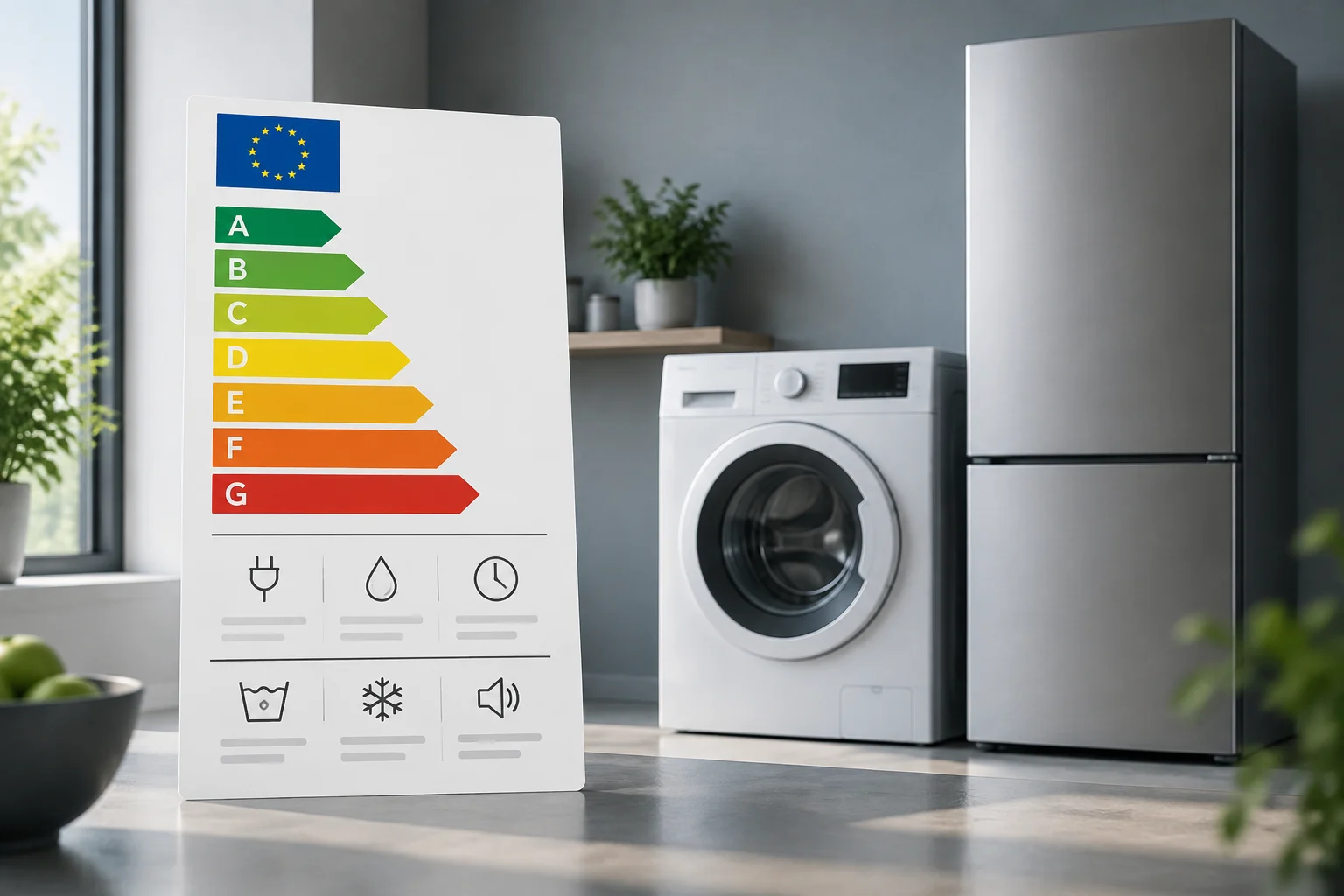
The European energy label summarises standardised data to make it easier to compare products in the same category. For washing machines and refrigerators, the current scale runs from A to G: A identifies the most efficient class on the scale, and G the least efficient. It is not a universal quality rating, and it does not allow you to compare a refrigerator directly with a washing machine. First compare appliances in the same category and with features that meet similar needs. European Commission: revised energy label.
The scale was rescaled to leave room for future improvements and make the differences between classes more meaningful. For that reason, a letter on an old label should not simply be treated as equivalent to the same letter on a current label: the system changed, and classes are assigned according to the requirements for each product category. The label provides a common point of comparison, but it does not replace checking dimensions, capacity, functions or price. European Commission: explanation of the scale change.
The label also includes a QR code that leads to the European EPREL register, where you can consult the product sheet for the registered model. When shopping online, look for the label and product information on the sales page; in a physical shop, check the label on the displayed appliance. If the marketing name is not enough to identify the exact model, use the manufacturer’s full reference and cross-check it against the product sheet. The model’s identity matters: two appliances in the same range can have different capacities or features. EPREL, European Commission.
Washing machines: read energy use alongside the reference programme
For a washing machine, the label’s electricity-use figure is expressed in kilowatt-hours per 100 cycles and is linked to the Eco 40-60 programme. It is not the consumption for a year or for every programme available. To estimate the electricity used in practice, consider how many cycles you will run and the price per kilowatt-hour; even then, the result is only indicative, because households do not all use the same programme, temperature or load. European Commission: washing machines.
Capacity, expressed in kilograms, helps you assess whether the drum suits your usual loads. A large capacity does not in itself mean lower consumption: how the machine is used and whether it is loaded appropriately matter. The label also gives water use per cycle for the reference programme, the duration of that cycle, the spin-drying efficiency class and the noise level during spinning. These are separate pieces of information; it is not useful to reduce the choice to a single letter.
To compare two models, note their consumption per 100 cycles and their capacity, and check that you are comparing the same type of appliance under the same labelling framework. Then consider whether the cycle duration and noise level are acceptable for the location and times when you plan to use it. If you need a washer-dryer, do not assume that its label and figures are equivalent to those of a conventional washing machine: check the product category and the data that apply to the combined appliance. European Commission: washer-dryers.
Refrigerators: annual energy use, volume and noise all matter
For refrigerators and freezers, the label shows electricity consumption in kilowatt-hours per year. This unit gives an indication of standardised annual consumption, but it does not guarantee that the appliance will use exactly that amount in every home. The figure is most useful when comparing models in the same product category with similar volumes and configurations. European Commission: refrigerators and freezers.
The label also separates the volume of the compartments and shows the noise level, expressed in decibels, alongside its airborne acoustical noise emission class. Usable volume is more informative than external size alone: it helps you check whether there is enough room for the food you store and compare different configurations. In models with both refrigeration and freezing areas, check each compartment rather than looking only at the total volume.
A lower annual consumption figure may be attractive, but it is not enough to conclude that a model will be the most suitable choice for every home. If it offers more capacity than you need, has an impractical layout or does not fit the available space, the energy difference may not make up for those drawbacks. Also check the dimensions and installation conditions specified by the manufacturer: the available space, required ventilation and the appliance’s location all form part of the decision, even though they are not summed up by the efficiency letter.
What can change actual energy use at home
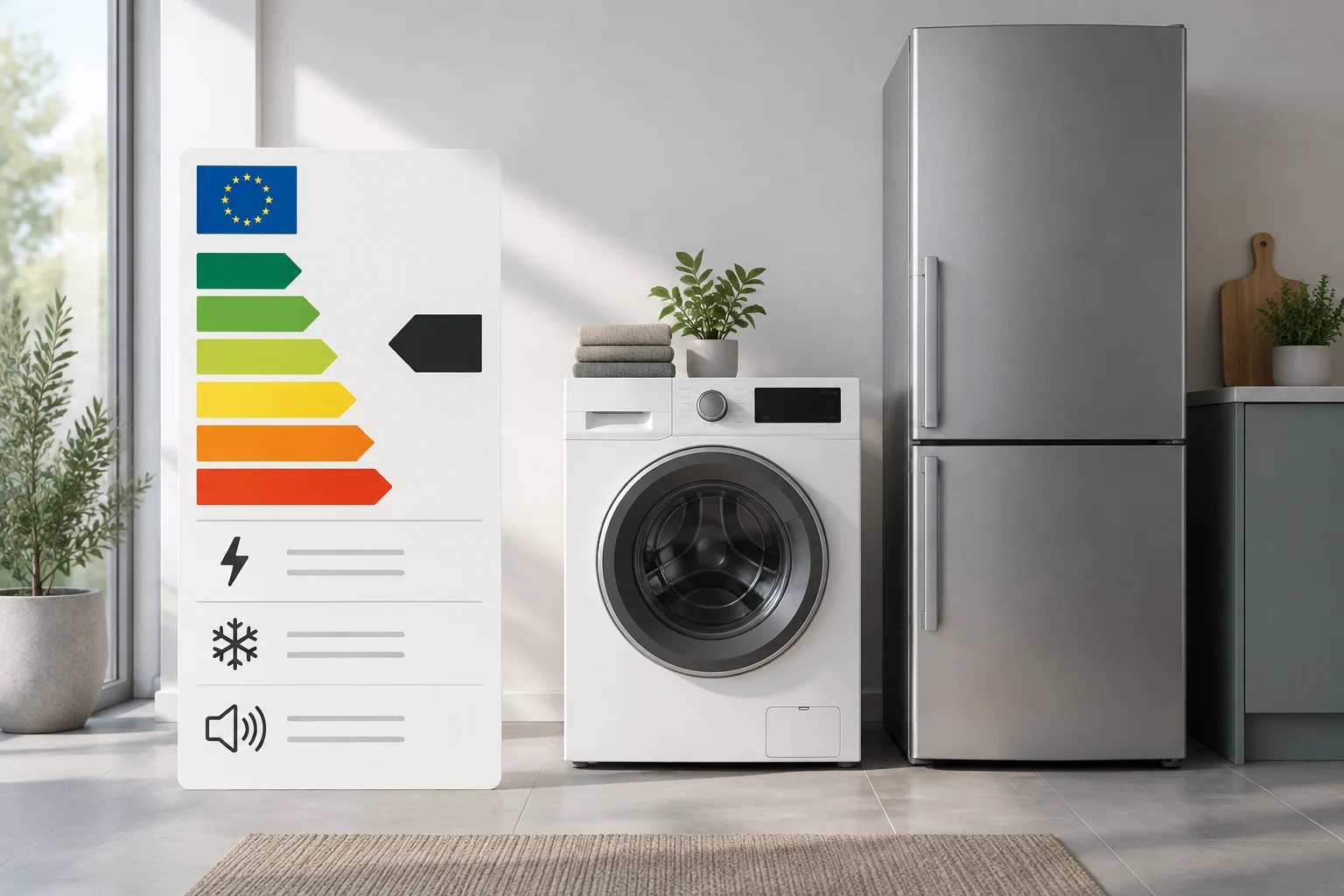
Label figures are obtained under defined test conditions, designed to make products comparable on a consistent basis. Household use does not always reproduce those conditions. For a washing machine, the selected programme, temperature, load size and washing frequency can make a difference; for a refrigerator, installation conditions and how it is used can matter. It would therefore overstate what the label provides to treat it as a promise of an exact individual consumption figure.
To turn a label reference into a practical estimate, separate the measured data from assumptions about your household. For a washing machine, for example, you can multiply the consumption per 100 cycles by the number of cycles you expect to run and divide by 100. For a refrigerator, the figure is already stated per year, but it remains a standardised reference, not a guaranteed meter reading. If you calculate costs, make clear what electricity price you are using and remember that it can change.
The label also does not sum up all ownership costs, food-preservation quality, ease of repair or reliability. Those aspects require additional information and, where relevant, specific manufacturer documentation. Energy efficiency and suitability for your home are related but distinct questions: the first helps you compare consumption on a common basis; the second depends on whether the appliance suits your space, loads and real routines.
A quick check before deciding
Use the label as an initial filter, then cross-check the product sheet for the exact model. EPREL is the European register for consulting information about products subject to energy labelling; the manufacturer’s product sheet and manual can clarify measurements, installation and features that do not appear in the visual summary. If a retailer displays different values or an old label, check that the model reference matches and that the information relates to the current labelling rules. EPREL, European Commission.
Before buying, go through these points:
- Identification: exact model and variant, not just the family or series name.
- Comparison: same category and, for refrigerators, reasonably equivalent volumes and configuration.
- Washing machine: kWh/100 cycles, water per cycle, capacity, duration and spin noise.
- Refrigerator: kWh/year, volume of each compartment, dimensions and noise.
- Suitability: available space, ventilation and installation conditions specified by the manufacturer.
- Cost: purchase price and an energy estimate based on explicit assumptions, not a guarantee of a future bill.
The useful conclusion is not that the highest class is automatically the best purchase, but that the label lets you compare products against a common reference. First choose an appliance that fits your capacity needs, space and use; then compare its efficiency and other relevant data. This makes good use of standardised information without mistaking it for an exact prediction of consumption at home.