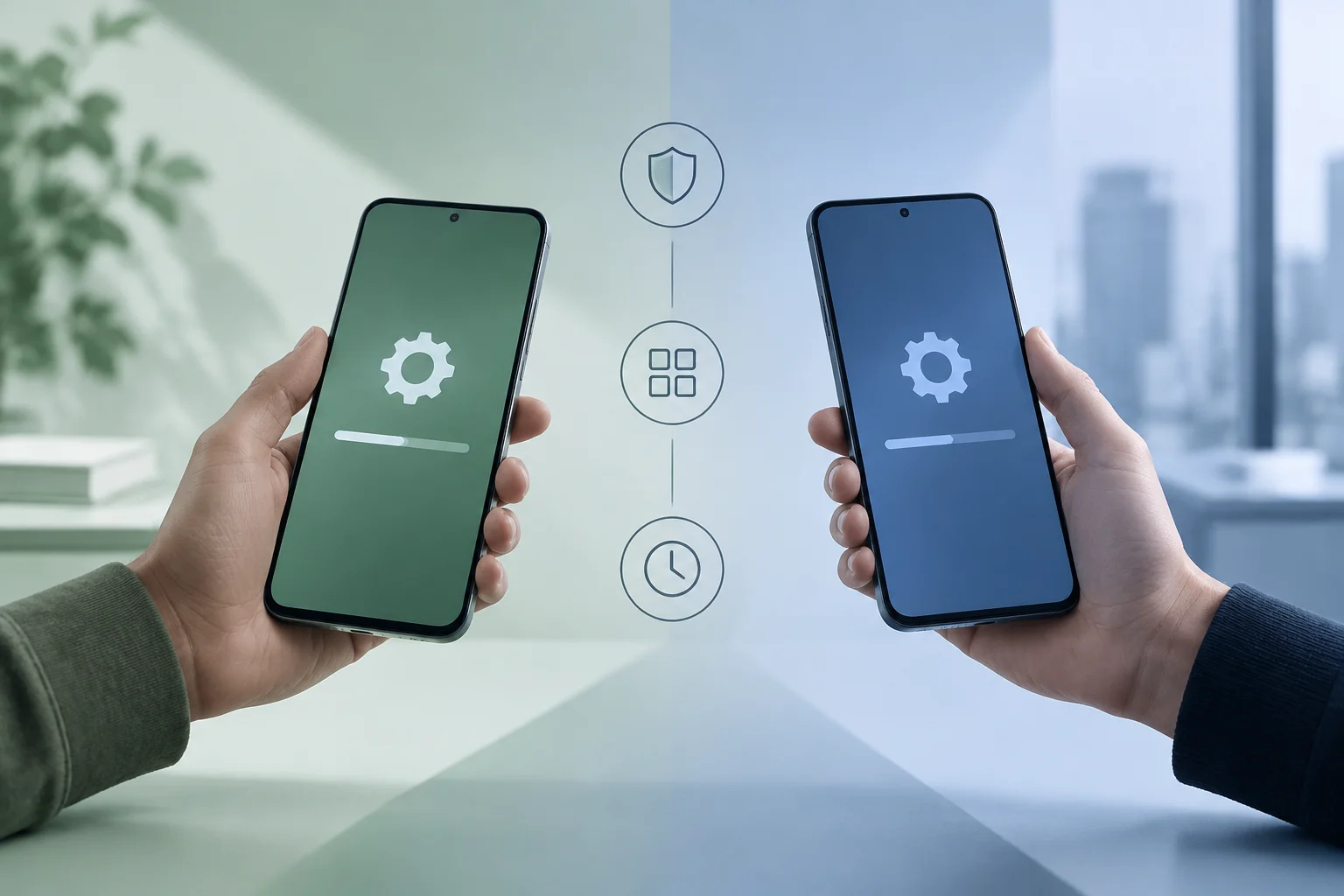
There Is No Single Measure of Support
When comparing two phones, “gets updates” sounds like a simple answer, but it can mean several different things. A major update changes the operating-system version; a security update fixes vulnerabilities; and a new feature may arrive only on certain models, even when they share the same version. It is unhelpful to compress these three things into a single number of years without explaining what the figure includes and which models it applies to. A statement about update support should therefore identify the kind of update being discussed, rather than treating every software change as equivalent.
It also matters who publishes and delivers each component. For iPhone, Apple documents software updates and publishes information about its security releases. For Android, Android documentation describes platform requirements and tools, but the specific support policy depends on the manufacturer and model. As a result, comparing “Android” with “iOS” as though each had one universal policy can lead to a misleading conclusion. The operating-system name alone does not tell a buyer what a particular phone’s manufacturer has promised, or how that promise is put into practice.
What Support Duration Means
For a buyer, the useful duration of support is the period during which their model continues to receive the updates it needs, not simply the time since a new version was announced. It is worth checking the commitment for major versions separately from the commitment for security patches, as well as any conditions that limit coverage. A policy may count from the phone’s launch, its first sale, or another milestone. If the starting point is not specified, there is no sound basis for comparing timelines. A headline number can conceal these differences, so the wording and scope of the policy matter as much as the number itself.
At Apple, deployment documentation explains how software updates are managed on its devices, while its security releases page can be used to check specific releases. Those pages make it possible to verify that security information is available, but they do not replace an explicit statement about how many years each model will continue to receive support. The existence of an update history is not, by itself, a guarantee of a defined future support period. When comparing phones, keep evidence of past releases distinct from a stated commitment about future coverage; one does not automatically establish the other.
Android Requires Looking at the Brand and Model
Android is a platform used by products from different manufacturers. A useful comparison should therefore identify the exact phone, its variant, and the market where it is sold; the next step is to find the official support policy that applies to that model. A statement about one phone family should not automatically be applied to every model from the brand. Nor is it enough to know the latest Android version available: that does not tell you which version a particular device will receive, or for how long. Model-specific information is essential because a platform-wide description cannot establish an individual product’s coverage.
Android Enterprise documentation shows that, in managed environments, system updates can be subject to management policies. This does not, on its own, describe the schedule for every consumer phone, but it does help distinguish system availability from the decision to install an update on a managed device. For a personal-phone comparison, consult the manufacturer’s page and look for dates, covered models, versions, and conditions, rather than extrapolating from an enterprise policy or from a different phone. The relevant evidence is the policy that names, or clearly covers, the product being considered.
A New Version Does Not Reach Everyone in the Same Way
The announcement of a version and its availability on a phone are different milestones. Apple may announce an iOS version and later document updates and their distribution. On Android, manufacturers may publish schedules and releases for their own devices. In either case, a general announcement does not prove that every model, carrier, or market can install the update at that moment. To find out whether it is available already, check the specific device and the date of the source. A rollout can be described at a general level while its availability still needs to be verified for an individual phone.
You should also distinguish receiving an update from being able to use all its new features. A feature’s compatibility may depend on the model, its capabilities, or regional settings, and release notes do not always mean that availability is identical across all eligible devices. To assess a feature, check its compatibility list and any published conditions. If that information has not been verified, it is better to say that the feature was announced than to claim that all users already have it. This wording preserves the difference between a stated feature and confirmed access on a particular device.
A Practical Method for Comparing Two Phones
Before making a decision, record the phone’s brand, full commercial name, variant, and market. Then consult the manufacturer’s official support pages and note separately the commitment for major versions, the security commitment, and any published end date. Also check which version is available now and when the pages you consulted were updated. Dates matter: a policy revised after launch may not describe the conditions that applied when the phone was originally sold. Keeping these details together makes it easier to compare the same aspects of each phone rather than relying on a broad claim.
A short checklist can reveal differences without turning them into a misleading score:
- Coverage: Does the policy explicitly name the exact model or family?
- Scope: Does it refer to system versions, security patches, or both?
- Schedule: Does it state a start date, a duration, or a frequency?
- Conditions: Are there differences by market, carrier, or variant?
- Features: Is the new feature available on that model, or only on part of the range?
- Verification: Is the page official and up to date, and does it distinguish a promise from availability?
What the Available Information Allows Us to Conclude
Official documentation can establish what each platform and manufacturer announces or describes; by itself, it is not an independent comparison of how well their update programs perform in practice. To say which company meets its timelines more reliably would require a study of comparable models, their launch dates and the dates each patch was received, as well as shared criteria for defining “support.” Without that set of data, it is not responsible to declare an overall winner or turn one model’s policy into a conclusion about an entire brand. Descriptions of policies and evidence of actual delivery answer different questions.
For that reason, the most useful comparison starts with two specific phones and separates promises, availability, and compatibility. The sources here explain why those distinctions matter, but do not include complete support policies for specific commercial Android models. The conclusion must be limited: the operating-system name is not enough to determine how long a phone will be supported; the answer requires checking the official policy for its model and verifying the updates published for that device. A careful comparison should make clear what is documented and what remains unverified.