“Live” does not mean real time
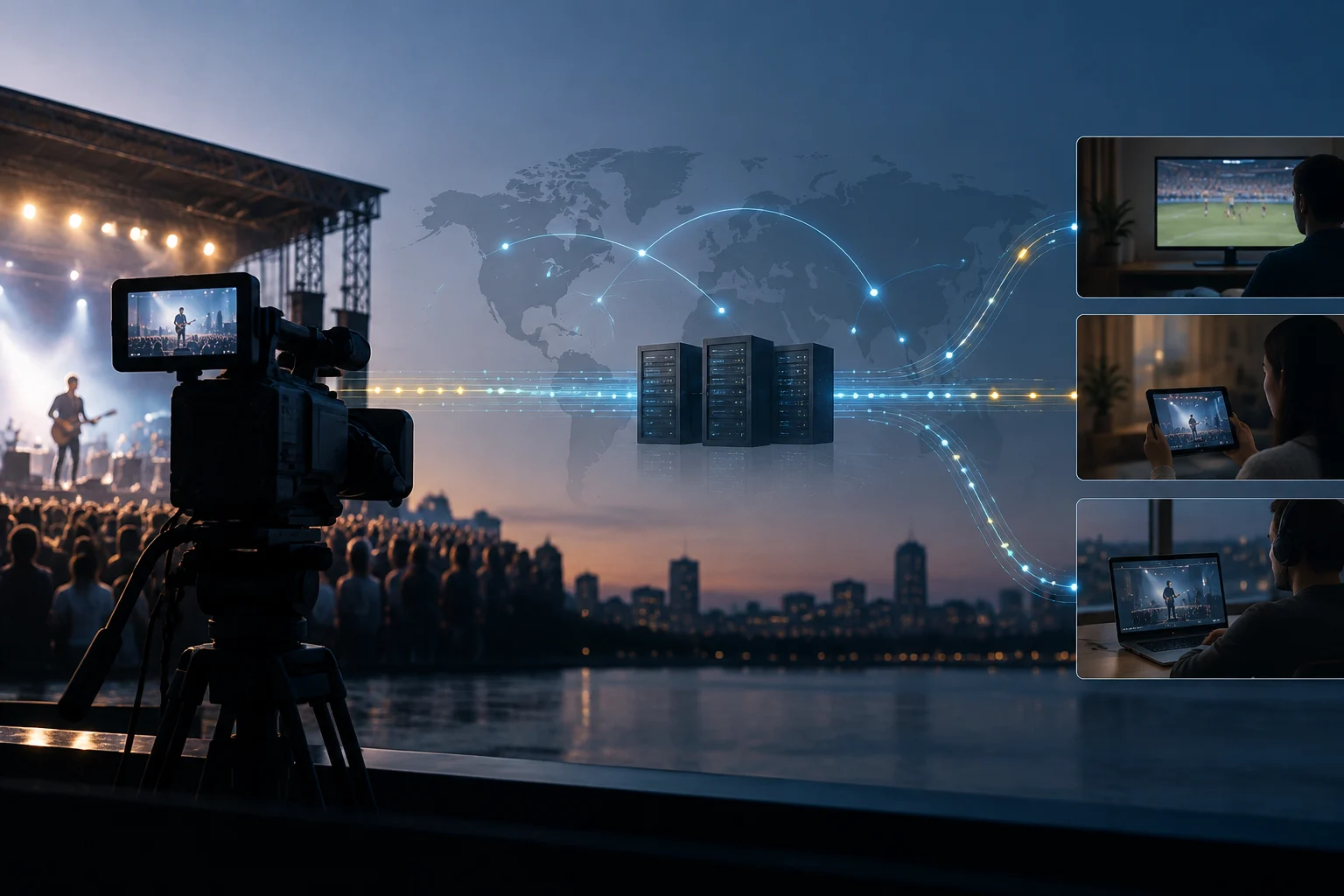
In a live broadcast, the image viewers receive originates while the event is happening, but it may arrive with a delay. Between capture and playback, the content passes through stages such as encoding, transmission, distribution, and the player’s wait before displaying it. So, a service describing a broadcast as “live” does not tell you how long it will take to reach each viewer. The term identifies the type of content; it does not guarantee universally instantaneous synchronization.
Apple documents a technical session about Low-Latency HLS. This establishes that the company discusses that mode in its technical documentation, but it does not allow us to infer the delay of a particular broadcast or guarantee that every service using HLS implements it. A technology’s name, by itself, is not a measurement of the final result.
What a latency figure means
Latency should be expressed as an interval between two defined moments, not as a standalone label. A useful comparison specifies where counting begins—for example, capture—and where it ends—for example, playback on the viewer’s device. It should also state how the result was obtained, under what network and playback conditions, and whether it represents a single measurement or a distribution of values. Without those details, two published figures may describe different things even if both are presented as “latency.”
The sources verified for this article do not include a reference supporting a particular classification of latency levels. The practical recommendation, therefore, is to check what each provider measures and under which conditions. Before comparing, look for the measurement’s start and end points, the protocol, and the test context. If those details are missing, the rigorous approach is to treat the figure as incomplete, rather than fill in the gaps with an assumption.
Resolution, bitrate, and adaptation are not synonyms
Resolution describes image dimensions; bitrate describes the amount of encoded data per unit of time. They are not interchangeable: visual results also depend on encoding, content, and playback conditions. A scene with a lot of motion may have different requirements from a more static scene. Therefore, a label such as “high definition” does not, by itself, reveal how much bandwidth a broadcast requires or predict how it will respond to a variable connection.
With adaptive streaming, the player can choose among versions encoded at different resolutions or bitrates, and switch between them as available conditions change. A broadcast’s encoding options and settings can affect the balance between quality, resources, and latency; that relationship depends on configuration and is not a universal description of every player’s behavior. Adaptive also does not mean that the image always stays at the highest resolution: behavior depends on the service, player, and connection.
What can be said about data use
Data use depends on how much data is transferred during playback, so viewing time and the effective data rate are relevant to an estimate. As a general calculation, multiply the average observed rate by playback time, making sure to use compatible units and specify the period involved. This is an estimate for the conditions observed, not a figure that applies to every broadcast. The selected quality, changes in rate, and service configuration can mean actual use differs from a general estimate.
The available sources provide no basis for claiming that all live streaming uses a fixed percentage more data than video on demand. Knowing the resolution alone is not enough either: reliable information about the effective data rate and the viewing time would be needed. To calculate your own use, check your device’s or provider’s usage statistics and note the period and quality used; present the result as an observation of that particular case, not as a universal prediction.
How to check a claim about quality or delay
When evaluating a service’s claim, look for technical documentation explaining the protocol and delivery options, as well as a published measurement that describes its method. Apple publishes documentation about tools for HTTP Live Streaming (HLS), which can help explain aspects of that technology. That documentation is not, by itself, independent evidence of every platform’s performance across all networks.
A reasonable comparison should keep the event, device, connection, and timing reference point as constant as possible. It should also distinguish observed latency from image resolution or stability. One stream may prioritize continuity and adjust quality when conditions change; another configuration may aim for a shorter delay. No single figure can summarize quality, delay, and data use all at once. If the provider publishes no method, conditions, or limitations, the useful conclusion is that the claim cannot be verified with the available information.
Limits of this guide
The evidence received allows us to point to Apple’s technical documentation, but it does not include comparable measurements for specific platforms or a primary table of data use by resolution for particular services. Accordingly, this guide does not attribute delay in seconds, minimum speeds, data rates, or quantified advantages to any provider. This caution does not prove that such figures do not exist; it means they are not supported by the research available for this article.
For a practical decision, prioritize information from the specific service and check whether it defines its terms. If you need to reduce data use, consult your device’s or connection’s quality settings and data counter; if delay concerns you, ask the provider what interval it measures and how it verified it. The answer can still be useful even if it does not give one figure: it can identify the conditions considered and the aspects left unmeasured. Without a published method, there is no sound comparison.