
Three figures that should not be confused
When assessing electricity storage, a single figure is rarely enough. Power indicates the maximum rate at which a facility can charge or deliver electricity and is usually expressed in megawatts (MW). Stored energy describes an amount, normally in megawatt-hours (MWh). The relationship between the two makes it possible to calculate a theoretical duration: if a facility delivered its nominal energy at constant power, the MWh/MW ratio would give the number of hours. That is not a guarantee that the facility will actually operate for that length of time; it is an interpretation of the stated quantities.
For example, a hypothetical facility rated at 100 MW and 400 MWh would have a nominal duration of four hours. That calculation alone says nothing about the energy it can deliver under specific conditions, losses, the power available at the end of discharge, the initial state of charge or operating constraints. Calculated duration is a descriptive indicator, not proof of performance. Red Eléctrica’s page dedicated to storage data allows users to consult aggregated information about the system, but it does not replace the technical specification or commissioning record for each facility. (Red Eléctrica: storage)
To compare projects, it is useful to record charging power and discharging power separately, alongside energy capacity and the duration claimed by the developer. If only a figure in MW is provided, the amount of energy stored cannot be inferred. If only a figure in MWh is given, the rate at which that energy can be delivered is unknown. And if a duration is published without explaining the underlying power and capacity figures, the comparison is incomplete. The expression long duration should not be treated as a universal quantitative category either, unless an explicit definition applies to the projects being compared.
What it means for a project to be at an advanced stage
The words announcement, award, construction, connection and operation are not interchangeable. An announcement expresses an intention or a plan; an awarded grant confirms an administrative funding decision subject to certain conditions. Neither milestone, on its own, demonstrates that a facility has been built, connected or is delivering electricity to the grid. Likewise, a project’s appearance in a planning portfolio does not mean that it has entered service.
Evidence related to commissioning and actual connection is needed before a project can be described as connected—not merely an application or authorisation. Red Eléctrica publishes information and frequently asked questions about commissioning new facilities, which provide a starting point for identifying the relevant procedure. But a general procedure page does not establish the status of a specific project: that requires documents or data that can be identified with the individual facility. (Red Eléctrica: frequently asked questions about commissioning)
A useful scale for labelling evidence
- Announced: a statement from the developer or an authority describes an initiative.
- Funded or awarded: a resolution or announcement confirms that funding has been granted, without implying that all subsequent milestones have been completed.
- Under construction: project-specific evidence shows that works are under way.
- Connected or undergoing tests: specific documentation exists concerning connection or commissioning, with the relevant scope and date.
- Operational: an appropriate source confirms that the facility is in service; to claim that it is also delivering energy, evidence supporting that operation is needed.
This scale is an editorial verification tool, not a single official classification. The date of an announcement, the date of connection and the date of commercial operation may differ. Each status should therefore include a date and a source: an old news item is not enough to assume that a project remains at the same stage.
Cross-checking registers, announcements and documents
The strongest cross-check begins with an unambiguous identification of the project: its name, location, developer and, where available, administrative or grid identifier. The developer’s claim can then be compared with different sources suited to different questions. The developer may provide the declared technical configuration; an authority may document a decision or grant; and the grid operator may provide system data or information about the connection process. These sources have different scopes and should not be treated as though they answer the same question.
Red Eléctrica maintains data pages on installed capacity, generation and storage. They are useful for understanding the information categories published by the operator and for tracking system indicators. However, an aggregated figure does not, on its own, confirm that a particular project is connected: moving from a system-level figure to an individual case requires a verifiable link between the record and the facility. It is also worth checking the period, unit, coverage and update date before drawing conclusions. (Red Eléctrica: storage data; Red Eléctrica: installed capacity)
What to look for in each document
- Identity: a consistent name, location and responsible entity.
- Status: a precise verb—applies, receives a grant, starts construction, connects or enters service—and an associated date.
- Quantities: MW and MWh separately, clarifying whether the power figure refers to charging, discharging or both.
- Scope: the whole project, a phase, a unit or a portfolio of initiatives.
- Traceability: the original document, register or dataset that can be revisited to check the claim.
A second independent source can help identify errors or changes, but it does not replace the primary document when the aim is to prove a milestone. Conversely, two pages repeating the same press release do not necessarily amount to two independent confirmations. The quality of a cross-check depends on the independence and relevance of the evidence, not on the number of links.
What grant announcements can—and cannot—tell us
Public calls and award decisions help describe priorities, support instruments and selected projects; they should not automatically be turned into figures for capacity already in operation. In May 2025, MITECO announced a €700 million call for different forms of storage, including standalone batteries, thermal storage, pumped storage and facilities hybridised with renewable generation. The announcement said that the call would open for applications and described an expected number of facilities and amount of power. That was a programme-related expectation, not an accounting of equipment connected to the grid. (MITECO, 30 May 2025)
In October 2025, the Ministry announced an allocation of €840 million to 143 projects; in December, it published the definitive outcome of another allocation of €818 million to 126 projects. These are relevant administrative milestones, but the amounts describe funding and the number of selected projects, not MW or MWh already available to the system. The announcements also refer to different dates and procedures: they should not be added together as though they represented one cohort, nor should the number of projects be interpreted as the number of operational facilities. (MITECO, October 2025; MITECO, December 2025)
Careful reading preserves the source’s verb: call for applications, select, allocate or fund. To state that a specific project was built or entered service, it must subsequently be followed through project-specific documentation. Nor is it enough for an announcement to state an expected power figure: it is necessary to check which group it refers to, whether the figure is storage power or generation power, and whether it represents a forecast, authorised capacity or an operating facility. A grant is evidence of public support; it is not, by itself, evidence of operation.
What a technical specification makes it possible to compare
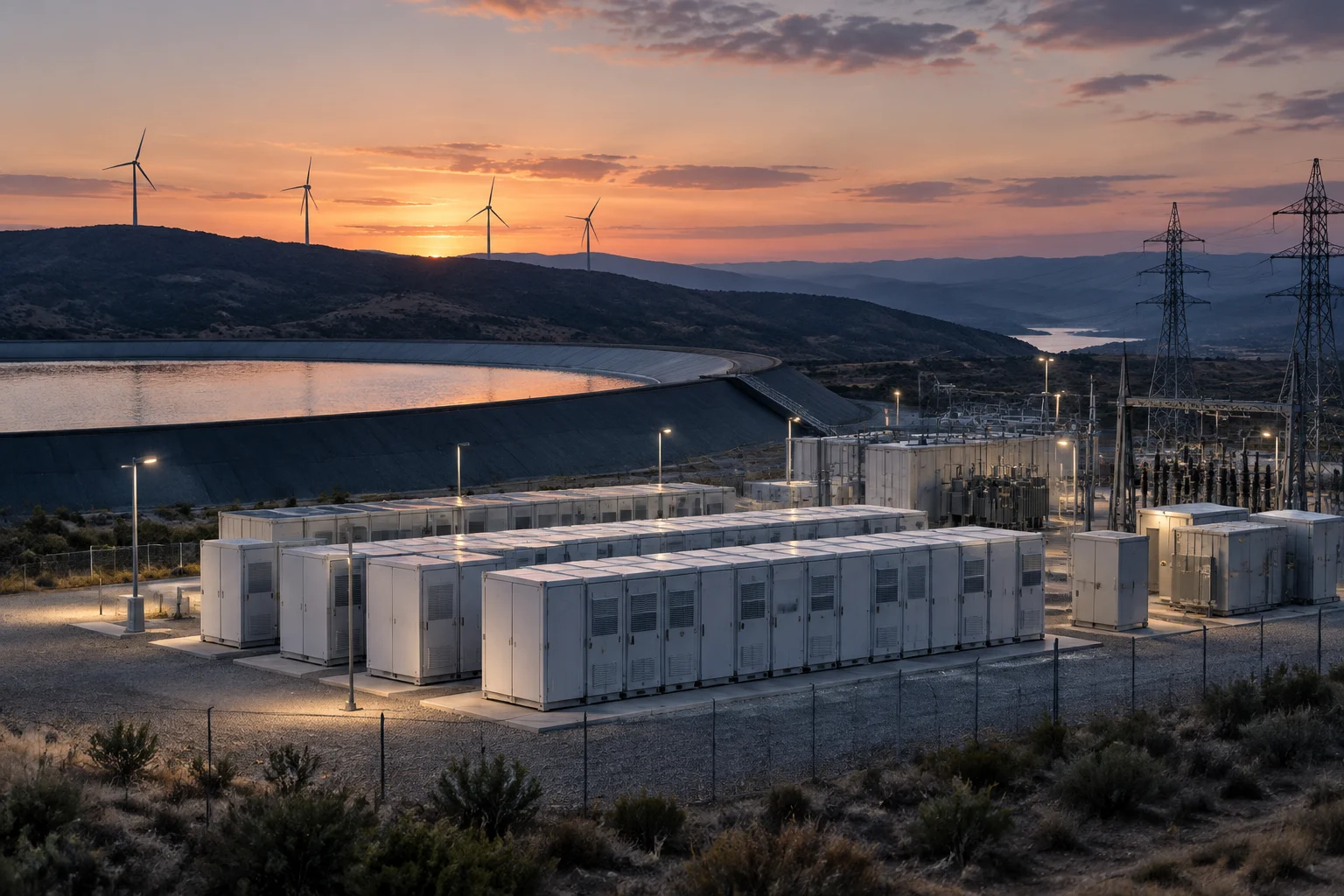
A useful technical specification combines power and energy with information explaining what they mean in practice. It is important to check whether power refers to charging, discharging or both, whether capacity is nominal or usable, and the conditions under which it is stated. A duration calculated using MWh/MW can help organise projects with comparable data, but it does not, by itself, describe efficiency, degradation, availability or operational flexibility. If those aspects do not appear in the documentation consulted, they should remain unknown rather than be filled in by assumption.
Technology matters too, but naming it is not enough to make a comparison. A battery, a thermal system and a pumped-storage plant store energy through different processes. MITECO’s 2025 call expressly mentions those forms as well as storage hybridised with renewable generation; their inclusion in the same support policy does not mean they share technical parameters or that an aggregated figure can be used to compare them directly. Assessing a particular facility requires knowing the stated solution and the scope of the published metrics. (MITECO: storage call)
ENTSO-E’s TYNDP 2024 project collection includes a map section dedicated to storage. It can help locate European planning information, but its identification as a project collection should not be read as certification that each initiative has been built or entered service. Before citing a project entry, check what status it describes, who supplied the data and the date to which they relate. A project included in a planning tool may be at a different stage from another project shown in the same tool. (ENTSO-E: TYNDP 2024 storage projects)
Conclusion: state only what the source establishes
The clearest way to report on storage is to keep four questions separate: what power the project declares, how much energy it can store according to its specification, what duration follows from those figures, and what evidence exists about its status. An MW figure does not replace an MWh figure; a calculated duration is not a measurement; an approved grant is not a connection; and an aggregated statistic does not necessarily identify an individual asset. Each figure should be accompanied by its unit, scope, date and source.
The sources consulted make it possible to describe Red Eléctrica’s data pages, general commissioning procedures and MITECO grant announcements, as well as an ENTSO-E project tool. On their own, they are not enough to compile a verified inventory of individual long-duration facilities currently in operation, or to quantify that deployment. This does not mean that no operational projects exist: it means that their number or capacity should not be asserted without specific, current evidence that makes it possible to identify them. Distinguishing a lack of evidence in this review from evidence of absence prevents a limited search from being turned into a conclusion about the entire system.
For a reproducible review, keep a record for each project with its name and identifier, stated technology, MW, MWh, calculated duration, substantiated stage, document date and primary links. If evidence of connection is missing, label that aspect as unverified; if energy capacity is not published, do not calculate a duration. This allows readers to distinguish quickly what has been announced, what has been documented and what remains unproven, without letting a striking figure or technology label do the work of verification.