Launch Context: 2025 as a Hinge Year
The year 2025 marked an inflection point in mobile photography with the simultaneous presentation of the Google Pixel 10 Pro and the Apple iPhone 17 Pro. Both manufacturers agreed to elevate video specifications beyond simple resolution, integrating professional color profiles and high refresh rates that were previously exclusive to cinema cameras.
This convergence is not accidental. The pressure from content creators and professionals using the mobile phone as a primary tool has forced manufacturers to compete in post-production flexibility rather than megapixels. The result is an ecosystem where capture and editing are integrated more fluidly than ever before.
Analysis of Official Video Specifications
The technical sheet of the iPhone 17 Pro confirms the ability to record in 4K at 120 fps with support for Dolby Vision HDR and professional video modes that include ProRes and Apple Log 2. This combination allows a wide tonal range ideal for color grading, something that previous models did not offer so completely.
For its part, the Pixel 10 Pro XL specifies a video recorder capable of reaching 8K at 30 fps and 4K at 24, 30, and 60 fps, as well as 1080p at 120 and 240 fps. Although the 4K at 120 fps specification does not appear explicitly in the summarized list from the secondary source, the Android ecosystem trend and the presence of 10-bit HDR suggest similar capability in the current generation Pro models.
The 10-bit Log Profile: New De Facto Standard
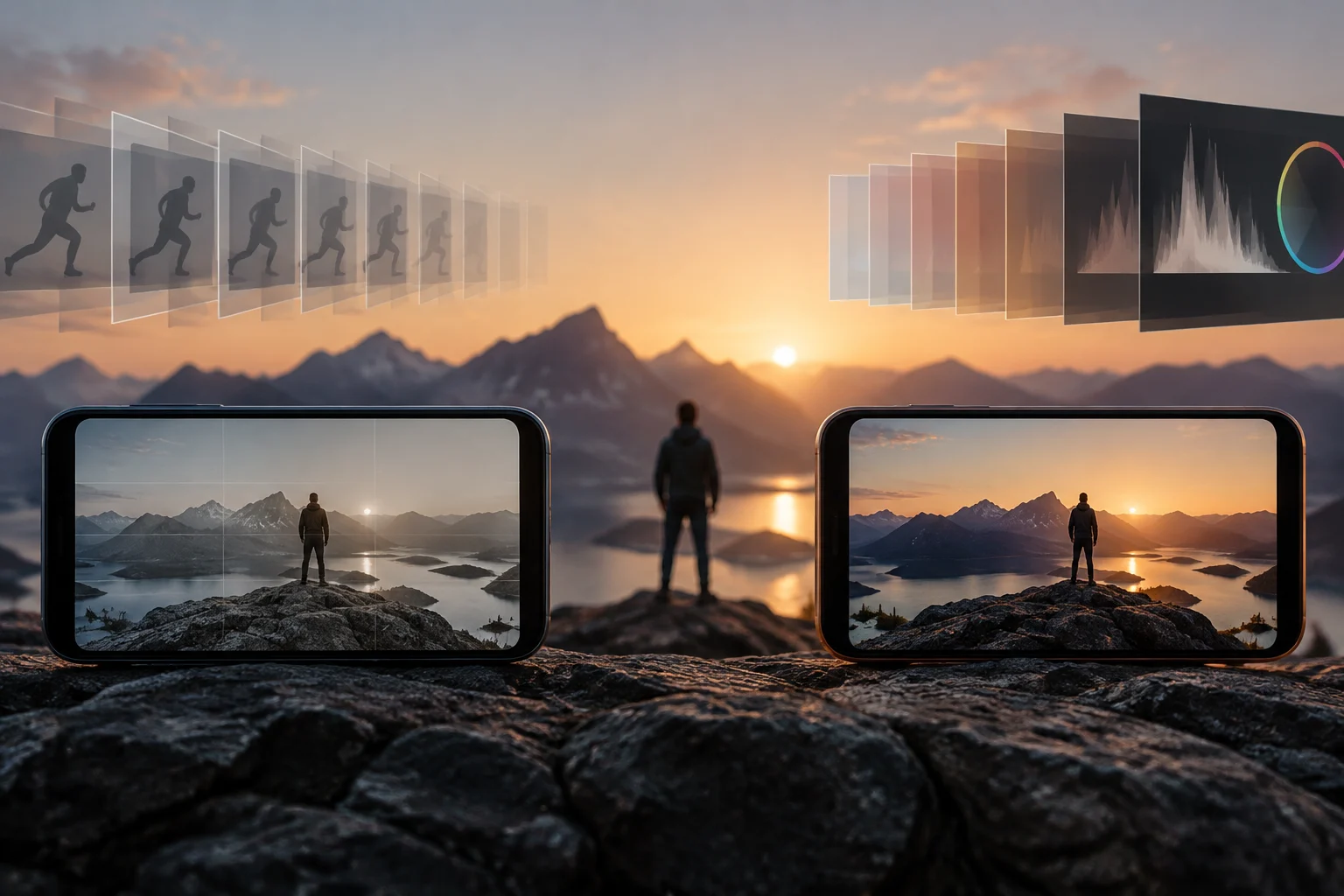
The implementation of the 10-bit Log profile is the most significant change for the professional workflow. Unlike standard HDR, Log captures a greater amount of information in shadows and highlights, allowing details to be recovered in post-production that would otherwise be lost.
This standard is not exclusive to Apple. Manufacturers like Oppo have already integrated in their flagships, such as the Find X8 Ultra, the ability to record 10-bit 4K video at 120 fps. This indicates that the industry is adopting 10-bit Log as a basic requirement for any device aspiring to be considered a professional capture tool.
Technical Comparison with 2024 Models
When comparing with 2024 models, such as the iPhone 16 Pro Max, a qualitative leap is observed in stability and simultaneous recording capacity. The iPhone 17 Pro introduces improvements in the Fusion camera system and greater efficiency in video processing, which translates to fewer artifacts and better noise management in low-light conditions.
In Google's case, the transition from the Pixel 9 Pro to the Pixel 10 Pro brings improvements in the Tensor G5 processor and thermal management, allowing longer recording sessions without quality degradation. The difference is not only in the raw specification, but in the performance consistency during prolonged recordings.
Practical Implications for the Professional User
The increase in bit rate and resolution has a direct impact on storage and battery. Recording in 4K at 120 fps with a Log profile consumes significantly more space than standard recording. Users must consider storage expansion or the use of external units to not interrupt their work sessions.
To manage this flow, devices like the Verbatim SnapBack Ultra Slim SSD offer a practical solution. With a USB 3.2 Gen 2x2 interface and write speeds of up to 1900 MB/s, it allows direct recording of ProRes 4K video at 120 fps from the iPhone, preserving the smartphone's internal storage and facilitating file transfer to the editing station.
Recommended Workflows and Tools
To make the most of these new capabilities, it is recommended to use professional camera applications that offer manual control over exposure, ISO, and white balance. Tools like ProCamera allow access to advanced functions that the native application does not always expose, giving the photographer finer control over capture.
Post-production editing must be done in software that natively supports Log and HDR profiles. The combination of 10-bit Log capture and editing in a compatible environment guarantees that the final image maintains the fidelity and dynamic range captured at the moment of recording, closing the cycle of a professional mobile workflow.