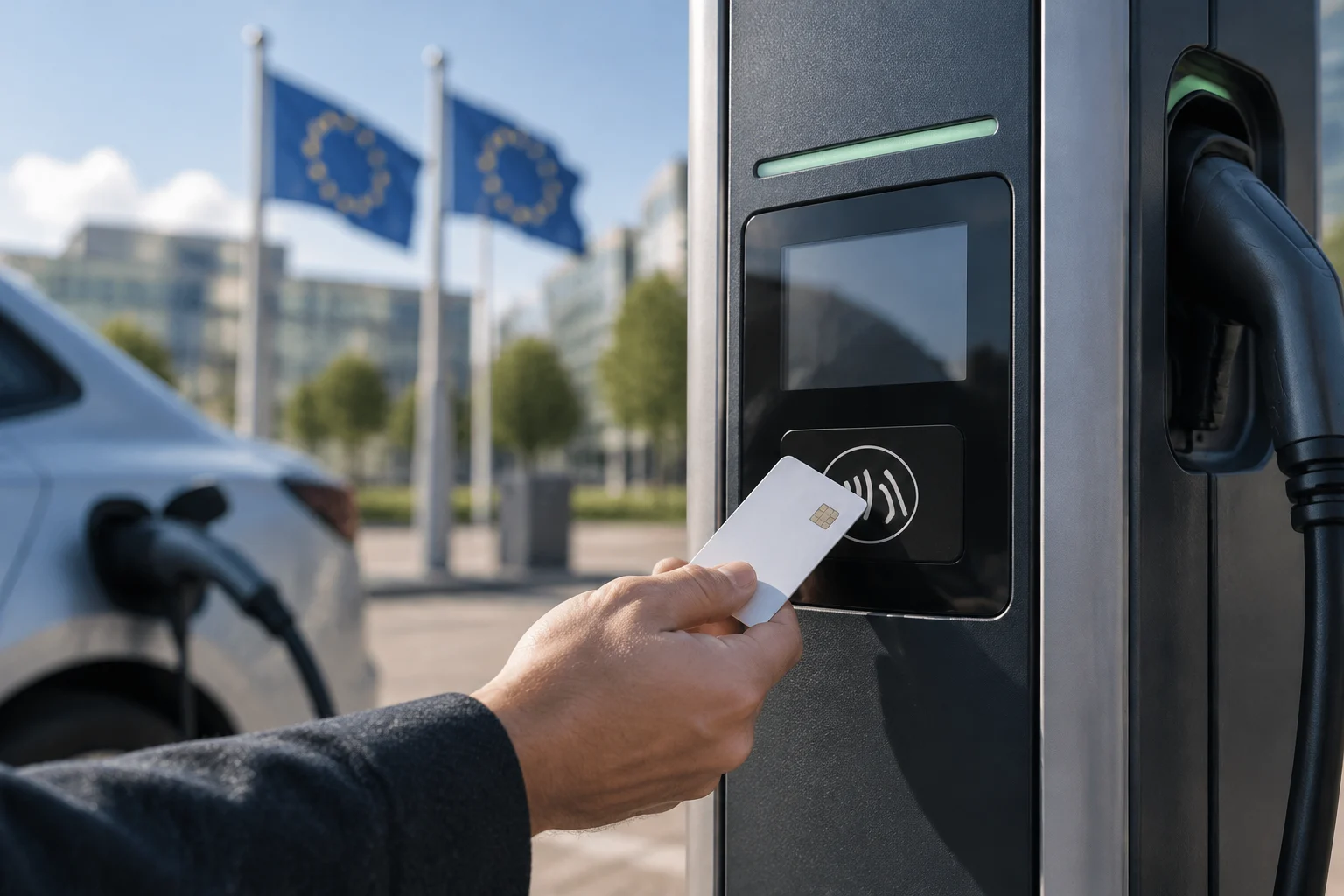
What a driver should be able to do when arriving at a public charger
Uncertainty when using a public charging point is not just about whether a parking bay will be free or whether the connector will be compatible. It also matters whether charging can be started without first signing up with a company, which payment methods are accepted, and how much the energy will cost. The European Alternative Fuels Infrastructure Regulation, known as AFIR, addresses some of these questions through requirements on access and transparency. It does not, however, turn every station into an identical service, nor does it guarantee that a particular charger will be operational when someone arrives.
The essential distinction is between ad hoc payment—starting and paying for a charging session without first establishing a contractual relationship with a provider—and services offered through cards, apps or customer accounts. The regulation provides for both routes: using an app or contract can remain an option, but, in cases covered by the ad hoc payment rules, it should not be the only option available. Having an account or an app should not be confused with the requirement to provide an access option without a contract. AFIR Regulation, Article 5
For drivers, this points to a practical check: establish whether the point is publicly accessible, look at the payment instructions displayed, and review the price before starting the session. A station may contain several charging points with different power ratings or arrangements; the fact that one option is shown on one unit does not mean it is identical on every other unit. Nor can the legal text be taken to mean that every location accepts cash, or that a particular bank card will work in every circumstance: the rule concerns specific payment methods and conditions, not a guarantee of permanent technical availability. Read the information for the point you intend to use, rather than assuming the experience will be the same throughout the station.
AFIR: the scope of payment requirements
Regulation (EU) 2023/1804 establishes requirements for operators of publicly accessible charging points. These include the possibility of charging on an ad hoc basis without the user having to conclude a contract with the operator or a mobility service provider. The requirement concerns access to the service under the terms of Article 5; it does not mean that contracts, tariffs for registered customers or apps are prohibited. What matters is that these arrangements do not remove the required ad hoc alternative at installations covered by the rules. An app may therefore be a valid and practical way to start a session, but the existence of that option alone does not answer whether access without a contract is also offered.
The specific way this alternative is provided depends on the power of the charging point and the applicable provisions. For charging points rated at 50 kW or more, the Regulation provides for a payment terminal that enables a payment transaction, such as a payment-card reader or a contactless device capable of reading payment cards. For points rated below 50 kW, it provides for a secure and widely used payment method in the Union, such as an online payment through a dedicated QR code. AFIR therefore does not require a physical card reader at every charger, regardless of its power rating. The distinction between the two groups prevents the terminal requirement for points rated at 50 kW or more from automatically being applied to lower-power points.
The rule also distinguishes between new installations and some infrastructure already deployed. The provisions of Article 5 apply to publicly accessible charging points deployed from 13 April 2024; for public points rated at 50 kW or more installed before that date, the Regulation provides for compliance with the ad hoc payment requirements by 1 January 2027 at the latest. The installation date and power rating are key facts when determining which payment method should be expected. Seeing a charger in a public car park is not enough to establish which transitional deadline applies to it, and the Regulation does not mean that every older unit must immediately have the same terminal as a new one. Payment methods should be assessed in light of both facts, not merely the unit’s appearance or location. Official AFIR Regulation text in the BOE
Transparency: what price information must be available
The advertised cost is another important part of the charging experience. AFIR requires the price charged by operators of publicly accessible charging points to be reasonable, transparent and non-discriminatory. Users must be able to find out the price information before starting a session, and the price must be communicated clearly. In practice, this makes it easier to compare charging offers, but it does not establish a single European tariff: amounts may vary between operators, locations and service conditions. The requirement concerns how the price is presented and the characteristics it must meet, not a requirement for every point to charge the same amount.
The tariff structure also matters. Where price components are applied per kilowatt-hour, per minute of occupancy or per session, Article 5 provides that those components must be communicated to the user before charging begins. A price advertised only as an attractive headline figure may not be enough to make an informed choice if it does not explain which unit is charged or what additional charges apply. Distinguish the cost of energy from other items and read the information for the method you have chosen; a tariff for registered customers may differ from the ad hoc option. Checking the details before starting helps establish which unit is used to calculate the charge, although it cannot by itself predict the final amount if that depends on the energy or time billed.
Transparency does not answer every commercial question. These AFIR requirements do not set a common maximum amount per kilowatt-hour, nor do they allow us to claim that the lowest price is always obtained by paying without a contract. The final cost cannot be inferred solely from a charger’s rated power either: the price and total amount depend on the tariff applied and the energy or time billed. If prices are shown in an app, through a QR code or on the equipment itself, the Regulation focuses on ensuring that the necessary information is available before the session starts; it does not impose a single interface throughout Europe. The means of accessing the tariff may therefore vary, but the relevant information must be available before charging begins. AFIR Regulation, Article 5
Point data and availability: public information helps, but does not certify compliance
The European payment rules should not be confused with tools that show where chargers are or what their status is. The documentation consulted for this article includes the Ministry for the Ecological Transition’s announcement of the REVE map in April 2025, which presented it as a tool providing dynamic information for electric mobility. That information can be used to describe the map’s announced purpose, but it does not show that every point is listed, that its data reflect every change immediately, or that each charger’s payment method or price has been checked. Publishing information about infrastructure is not, by itself, an audit of transactions or a certification of compliance with AFIR.
The REVE map may help drivers plan and consult infrastructure data, but the ministerial announcement does not prove that payment methods are available at every location at the time of consultation, or that an operator’s displayed price has been checked against every required component. Seeing a point on a map and checking its legal compliance are two different things. REVE map announcement
The official documents cited here make it possible to describe the regulatory framework and the announced purpose of the tool, but the available research does not provide verified terms of use for specific operators or records of payment sessions. It would therefore be unjustified to give examples of networks, claim that they accept or reject a particular method, or generalise about their compliance. Availability data may become outdated; a station listing also cannot replace checking the conditions displayed at the point or the records of an actual charging session. Maps are consequently useful for orientation, but they are not enough to resolve a question about what happened during a particular charge.

Useful checks before starting a session
The rules are most useful when translated into specific questions. Before charging, a driver can confirm that the point is publicly accessible, identify its power rating and read the instructions for starting and paying. If the only visible option seems to require registration, check whether another method is indicated on the unit itself or through the operator’s official information channel. Power helps explain what kind of payment solution AFIR provides for, although it does not by itself reveal the deployment date or whether a transitional period applies. Considering these details together helps avoid mistaking a visible feature of the equipment for the full set of applicable requirements.
A short checklist can reduce confusion without turning a casual inspection into a legal assessment:
- Identify the point: check whether it is publicly accessible and what power rating is stated on the unit or in the operator’s listing.
- Read the payment options: distinguish ad hoc payment from an app, card or customer contract.
- Check the price before starting: identify the billing units and any components charged for energy, time or the session.
- Keep relevant information: if a problem arises, retain the point identifier, date, payment instructions and details of the advertised tariff.
- Distinguish a technical fault from the rule: a terminal failing once does not by itself prove systematic non-compliance; documenting the case helps support a specific enquiry or complaint.
These checks do not replace the legal text or determine by themselves whether a unit complies. Article 5 sets out the applicable requirements, but the material consulted does not provide a series of inspections or transaction results that would allow compliance across the entire network to be measured. This methodological limitation matters: the requirement is documented, but compliance at every individual station is not established by the sources available here. To describe a case accurately, it is useful to separate what was observed—for example, the payment method displayed—from any regulatory conclusion that might follow.
What the rules establish and what is still needed to assess compliance
The short answer is that AFIR requires ad hoc payment options at covered public points and links the payment method to power, with a payment terminal solution for points rated at 50 kW or more and a secure, widely used payment method for lower-power points. It also requires transparency and advance communication of relevant price components. The Regulation does not impose a single tariff, eliminate customer arrangements or allow us to assume that every charger is operational or that every method will always work. It therefore sets requirements and expectations, but does not make every individual experience automatic proof of compliance or non-compliance.
The answer about the network’s actual state is more limited. To establish whether a particular station complies, it would be necessary to know at least whether it is public, its power rating and deployment date, its signage and available payment methods, and the tariff information visible before a session starts. Assessing a general pattern would also require systematic, comparable checks over time, with clear criteria and records of the cases observed. Without such evidence, it is not valid to turn a legal obligation into a claim of universal compliance or widespread non-compliance. The information gathered here explains the framework and its limits, but does not provide a practical assessment of the entire network.
Drivers can use AFIR as a framework for knowing what to ask and what information to look for. If a payment method fails, the distinction between a temporary outage, insufficient information and the absence of the required option may matter; resolving the issue will require keeping details of the case and contacting the appropriate channels. The cautious conclusion is not that the rules guarantee frictionless charging, but that they set specific expectations that can be checked at each point.