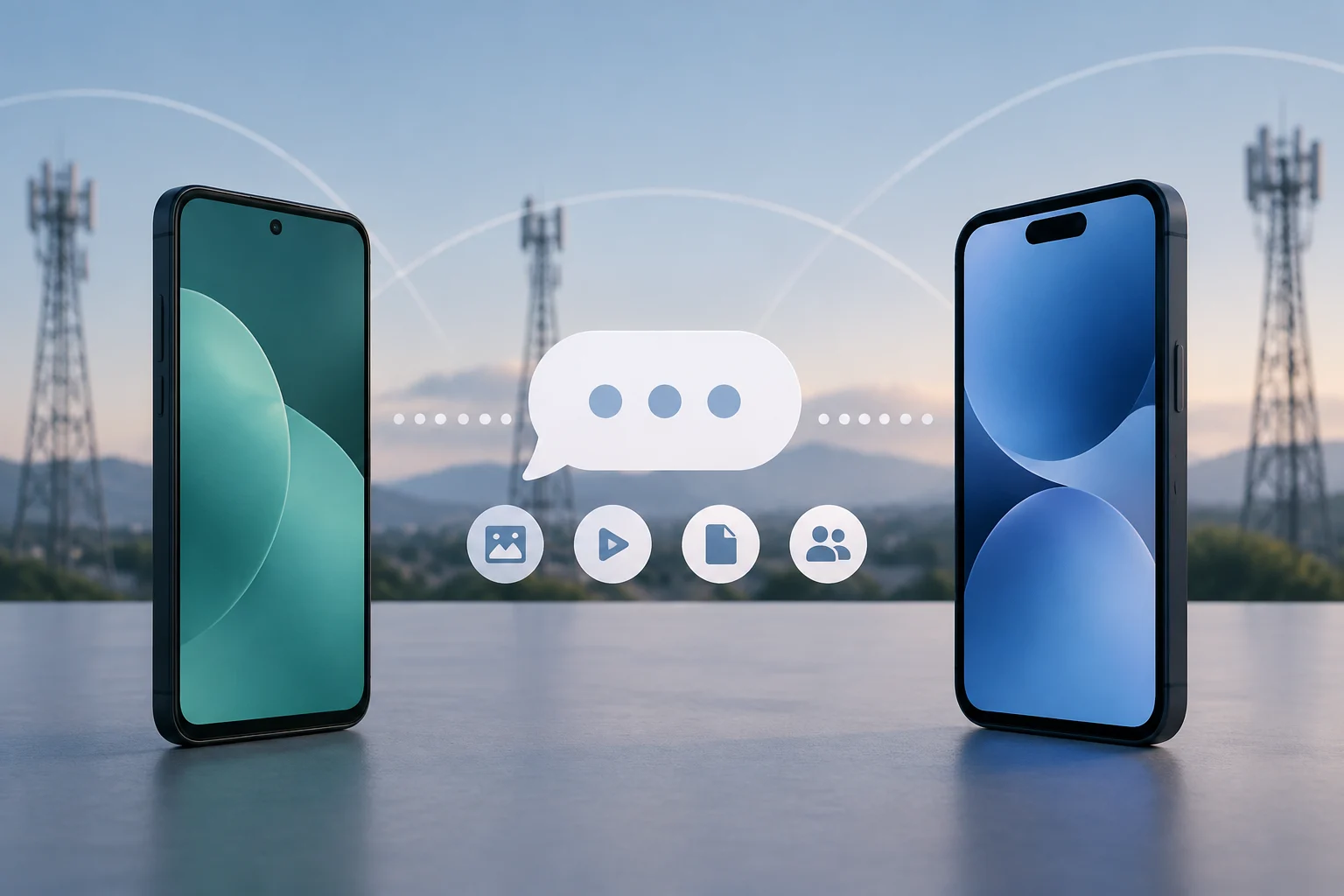
RCS is not an app, but a way of messaging
RCS, short for Rich Communication Services, is a messaging standard that can enable a richer set of features than those traditionally associated with SMS and MMS. It relies on carrier infrastructure and services, as well as on how the operating system and messaging app implement it. That is why an internet connection on both phones is not enough, nor is seeing the word RCS in both users’ settings: the service must be available and enabled at each end of the conversation.
The GSMA describes RCS and its Universal Profile as a common foundation for carriers and manufacturers to implement interoperable messaging features. That shared foundation matters, but it does not promise that every app will present the same options or that every feature will be enabled in every country. The standard defines capabilities; the actual experience also depends on who provides them and how they incorporate them. GSMA
What to expect when messaging between Android and iPhone
Apple provides instructions for enabling RCS on iPhone and notes that availability depends on the carrier and region. This is a practical indication that compatibility cannot be inferred from the phone model alone. At the other end, Android also needs the service to be available on the device, in the messaging app and through the relevant carrier. The documentation gathered here does not support a claim that RCS is enabled for every possible combination of phone, app and provider. Apple
If both users have RCS working, the aim is for their exchange not to be limited to the basic capabilities of SMS/MMS. However, the fact that the standard includes a capability does not by itself prove that it is enabled in a particular conversation. “RCS” should not be taken as a guarantee that every advanced feature will work the same way on Android and iPhone. To find out what a specific setup offers, check the current information from Apple, the Android messaging app in use and the carrier for each line.
Features: distinguish what is shared from what is possible
RCS is often described as enabling richer exchanges than conventional text messaging. However, the sources available for this comparison do not provide a verifiable, feature-by-feature matrix showing which capabilities are shared between the iPhone Messages app and each Android app. For that reason, we do not present a universal list of features—such as those for files, typing indicators or delivery confirmations—as confirmed for every conversation between the two systems.
The GSMA explains the role of the Universal Profile as an interoperability framework, while Apple points to service availability across carriers and regions. Taken together, these sources warrant caution, not an assumption of equivalence: a shared profile can facilitate interoperability, but it does not prove that every implementation exposes exactly the same options. The prudent way to compare is to verify the particular feature that matters rather than extrapolate from a demonstration, a version of the standard or someone else’s experience.
Carrier, region and settings matter
Apple says RCS must be enabled in Messages settings and that its availability depends on the carrier and region. Its support page on activation is more useful than a general statement about iPhone: it helps explain why two people with similar phones may not see the same options if they use different lines or markets. It also means that feature availability may change when service settings or carrier support change. Apple
RCS availability should not be confused with mobile data coverage, and a feature should not be assumed available merely because the phone lets you turn on a switch. The documentation consulted here does not provide a complete, up-to-date, comparable list of carriers and capabilities for every country. Accordingly, the market and carrier are part of compatibility, not secondary details. If an option does not appear, checking the region and the carrier’s guidance is more reliable than concluding that the device is generally incompatible.
Encryption and other equivalences not to assume
Interoperable messaging does not show that encryption, privacy or data handling is identical to that of a conversation between two phones in the same ecosystem. Nor does the evolution of the standard alone establish which version each carrier or app uses. The GSMA publishes information about profiles and their evolution, but the material considered here does not make it possible to verify a general end-to-end encryption guarantee for every RCS exchange between Android and iPhone. GSMA
If a message requires a specific level of protection, consult the current documentation for both systems and for the service handling the conversation. It is not safe to infer the level of protection solely from a bubble’s colour, the RCS label or the presence of a messaging feature. This limitation does not mean RCS lacks security mechanisms; it means that the available evidence does not support a universal claim covering every combination of platforms and carriers.
Useful checks before relying on RCS
Before relying on a feature between Android and iPhone, check both sides of the conversation separately. On iPhone, review Messages settings and Apple’s page for your region; on Android, consult the messaging app and its provider’s instructions. Then confirm with each carrier that RCS is supported for your line. Even if the option is enabled, that still does not confirm that every capability is available to the recipient.
As a quick guide, check that (1) both phones support RCS; (2) the service is enabled for each line and region; (3) the feature you need is explicitly listed in current documentation; and (4) what happens if the conversation falls back to SMS/MMS. The pages consulted do not certify an identical set of features for every Android–iPhone pairing. The useful conclusion is narrower: RCS can expand cross-platform messaging, but actual compatibility is determined by feature, device, carrier and market.