
1. Find out who is selling you the phone
Before comparing price or appearance, establish who the legal seller will be. An online shop may involve a platform, a retailer offering the product, and a different company that ships or refurbishes it. Look for the company’s legal name and contact details on the product page, during checkout and in the terms of sale; save a copy of the offer. The decisive reference is the seller named in the purchase, not necessarily the most prominent name on the website. Check that the information identifies a business you can contact if something goes wrong, rather than assuming that the platform itself is responsible simply because it hosts the listing.
Distinguish a sale by a business to a consumer from a transaction between private individuals. The consumer protections described here apply to consumer relationships within their scope; do not assume you will have the same complaint routes if you buy from a private individual. If the platform only acts as an intermediary, find out which party is responsible as the seller and where you must direct a complaint. The EU’s own guide to guarantees explains consumer purchases from traders; it does not automatically make every website that hosts an advertisement the seller. This distinction matters when you need to ask for a repair, raise a concern about the description or pursue a remedy.
Ask for the invoice or purchase confirmation to identify both the phone and the seller. Also keep the original description, listing photographs, condition grade, total price and any replies you receive about the battery, repairs or defects. If the offer changes or disappears, those records help establish what was offered to you at the time of purchase. If the seller does not make clear who will contract with you, do not pay until you have resolved that question. A clear record is useful even when everything goes smoothly: it lets you compare the delivered device with the specific product and terms you chose.
2. Turn the condition label into specific defects
Terms such as “like new”, “excellent”, “Grade A” or “refurbished” do not necessarily describe the same standard from one retailer to another. Do not compare those labels as though they formed a shared grading scale. Ask for specific details: marks on the screen or casing, replaced parts, damage that does not affect use, the condition of buttons, cameras, speakers and connectors, and which accessories come with the phone. A verifiable description is worth more than an undefined grade. A useful answer should make it possible to understand what the device looks like and what its stated condition means for everyday use, rather than simply repeating a marketing term.
Also ask what has and has not been tested. A functional check may cover calls, charging or cameras, but it does not necessarily amount to a thorough inspection of every component. Find out whether the device has been repaired, whether original or compatible parts were used if the seller can confirm that, and whether any known defects remain. Ask about the scope of the checks rather than interpreting the word “tested” as proof that every feature was examined. If an important answer is given over the phone or in a chat, ask the seller to confirm it in writing before you buy, so that the description is not left as an informal assurance.
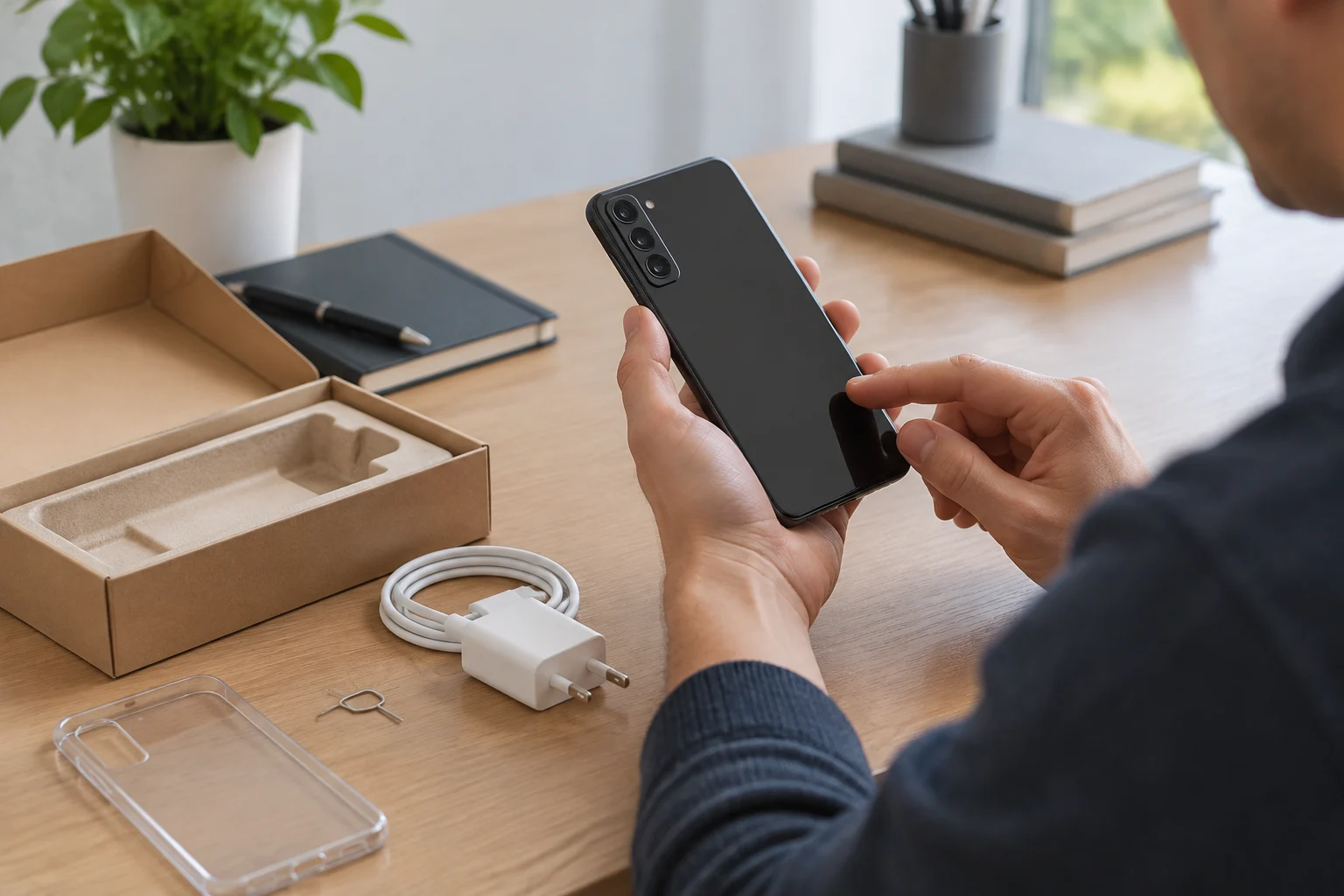
When the phone arrives, compare it with the description and promptly record any difference: take dated photographs, keep the packaging and accessories, and make a note of the problem. Do not assume that a condition label removes the seller’s responsibility for what was promised. At the same time, a cosmetic mark clearly disclosed before purchase is not the same thing as a hidden defect or an advertised feature that does not match the product. The specific offer and the evidence of it matter more than the category’s sales name. Preserve the listing and any messages so you can show which marks or limitations were disclosed and which were not.
3. Assess the battery without relying on one number
The battery is a critical point, but the word “checked” does not tell you how long it lasts or how it was assessed. Ask whether the seller gives a maximum-capacity figure as a percentage, when it was measured, which tool was used and what threshold the seller applies. If those details are not provided, treat the figure as a commercial statement, not an independent measurement. The capacity shown by the operating system or by a tool may not be equivalent to a standardised test of real-world battery life. The percentage alone also does not explain the test conditions or what the seller regards as acceptable performance.
Ask separately whether the battery has been replaced and whether that replacement has its own coverage. Also ask the seller to state what it considers acceptable operation and what happens if the battery life proves far below what you expected. There is no universal battery life that can be inferred from the model alone: use, software, temperature and the wear of the individual unit all have an effect. A precise promise—with a method, threshold and remedy—is more useful than the phrase “battery in good condition”. Make sure you know whether the statement relates to measured capacity, a functional check or an estimate, rather than treating those as interchangeable.
If you do not get a clear answer, include that uncertainty in your decision and compare the offer with a new phone or another listing that publishes explicit criteria. Do not interpret a high figure as a guarantee that the phone will retain that battery life for a particular period; that will depend on what was agreed and on the applicable conditions. Consider whether the price still makes sense without a defined battery commitment, rather than paying extra on the assumption that the battery has a condition the seller has not described. Do not pay a premium for a battery condition the seller does not define.
4. Check compatibility, locks and practical useful life
Confirm the exact model, regional variant and storage capacity. A product-family name can cover different versions; ask for the model number shown in the settings or documentation and compare it with the manufacturer’s information. Check that it supports the mobile bands and technologies you need with your operator, especially if the device comes from another market. An advert saying “unlocked” is not enough if it does not clarify whether that refers to the SIM, a previous account or management restrictions. Check the details that apply to the actual variant rather than assuming that two phones with the same family name will work in the same way.
Ask explicitly whether the phone is network-unlocked, whether the account linked to the previous owner has been removed and whether the device can be set up from scratch. To avoid surprises, ask for confirmation that it is not subject to an activation lock, business management or outstanding finance that would prevent you from using it. Also check that you will receive a reset device and can install the updates available for that model. Do not assume that future updates will be available simply because the phone powers on and works properly at the point of sale. Ask about what can be confirmed for that precise model, not what might be expected from the brand in general.
Repairability and support also affect value. Find out whether the manufacturer publishes support dates or periods, and whether parts and technical service are accessible for the specific variant. The EU rules applicable to smartphones and tablets introduce durability, repair and labelling requirements for products within their scope, but this does not by itself establish the specific terms for a refurbished unit or replace the need to check the listing and ask the seller. Those general rules should not be treated as confirmation of the condition, repair history or future support for the individual phone. Compare the specific model, not just the brand or generation.
5. Separate withdrawal, legal guarantee and commercial cover
For a distance purchase from a trader, consumer rules provide for a right of withdrawal under the conditions set by law. Check who pays return postage, how to make the request, what deadline the seller states and whether any exceptions might be relevant to that transaction. Do not confuse a voluntary “easy returns” policy with the legal right: the former may offer additional terms, but should not be presented as a substitute for rights that apply. Read the conditions before checkout so you know how to act if you change your mind and do not assume the return process is the same for every seller or purchase.
A legal guarantee and a commercial guarantee are different things. The legal guarantee comes from legislation and is claimed from the seller; a commercial guarantee is additional cover offered by the seller or manufacturer, with its own scope and conditions. For second-hand goods, Spanish law allows the seller and consumer to agree a shorter period than the general one, but not one shorter than a year. Ask in writing which period applies to this unit and who handles the repair or other solution. Keep separate the legal rights that apply to your purchase and any additional promise advertised by the retailer or manufacturer; a commercial promise does not change the identity of the seller responsible for the legal guarantee.
Do not rely on a headline such as “two-year warranty” or “full warranty”. Check when the period starts, what it includes and excludes, how to report a lack of conformity and whether transport costs apply. Keep the invoice and all correspondence. The EU guide summarises the framework for consumer purchases in the EU, while the consolidated text published by the BOE allows you to consult current Spanish legislation; in a specific dispute, the outcome may depend on the facts, the contract and the applicable rules. Make sure you understand whether a warranty statement refers to statutory rights, extra commercial cover or both, and retain the wording you saw when you purchased the device.
6. Compare the total cost and make a final decision
The advertised price is not always the total cost of the purchase. Add delivery, essential accessories, possible return costs and any expense related to a battery or repair that you already expect. Compare the phone with a new device with similar capabilities, not only with the launch price of an older model. Also consider how much support and storage you need. A refurbished phone may be a reasonable option if the price difference compensates for wear and uncertainty, but no saving percentage by itself guarantees a good purchase. The comparison is more useful when it includes the exact condition, what is included, the available support and the terms that would apply if something is wrong.
Before paying, mark each point as confirmed, pending or unknown. If an essential issue remains pending—such as the seller’s identity, a lock, the battery or the return period—ask for clarification or rule out the offer. Your decision should be based on documented, comparable terms, not on an attractive label or a discount that does not account for risk. If you are comparing multiple listings, apply the same questions to each one: that makes it easier to see whether a lower price is accompanied by less information or a different level of protection.
Checklist
- Who is named as the seller, and who should receive a complaint?
- Which cosmetic and functional defects are described, and which accessories are included?
- What verifiable battery information is provided, and exactly what does it mean?
- What are the model and variant; is it network-unlocked and can it be set up?
- Which updates, parts or service can be confirmed for that model?
- What are the withdrawal, return and legal or commercial guarantee terms?
- What is the total cost compared with a comparable new or refurbished alternative?
If the seller answers clearly and records the relevant points, you will have a stronger basis for comparison. If they avoid specifics, treat that lack of information as part of the offer’s risk: potential savings do not remove uncertainty. Keep the answers alongside the original listing and purchase documents, so that you can refer to the same details later if the delivered phone does not match what was described.