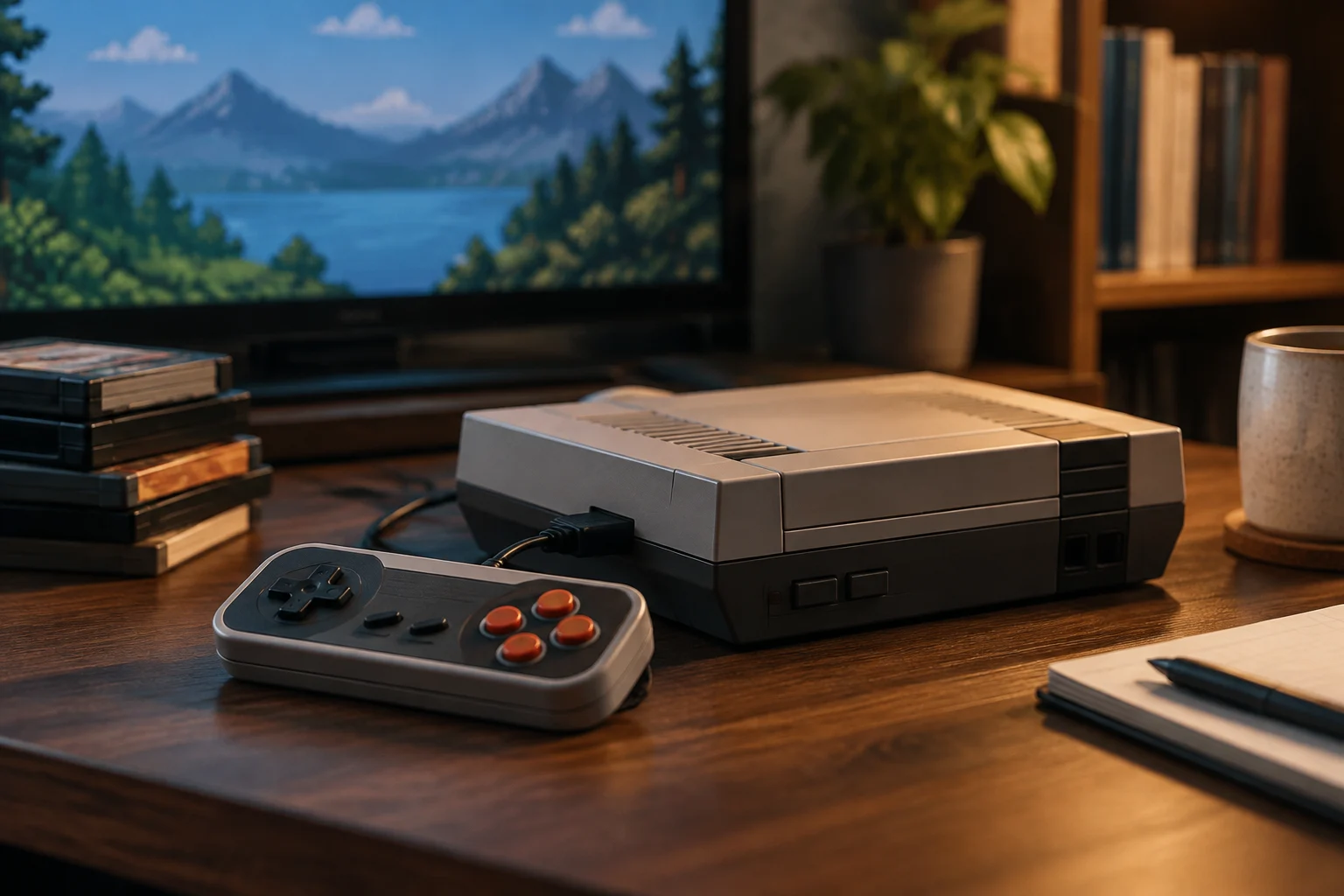
A big number does not describe a console
Retro-console advertisements often emphasise the number of games and the option to connect the device to a television. That information may work as an initial selling point, but on its own it does not tell you which titles the device contains, how they run or what features it offers. For example, a TikTok post has the claim “with 6,000 games” in its title; a video title, however, does not verify the contents of a particular unit or the terms governing its catalogue. The video listing is no substitute for a complete inventory of the contents or technical documentation from the seller.
The important distinction is between what an offer advertises and what can be checked. Assessing a particular model requires, at a minimum, its name and model number, an identifiable specification sheet and sales terms attributable to the seller. The available research includes advertisements and retailer pages, but no primary documentation confirming the contents or performance of a specific console. It is therefore not possible to conclude here that a particular model has an exact number of games, works well or includes licensed titles. A headline figure may describe a promotion, but it cannot establish what a buyer will actually receive. Treat it as a claim to investigate rather than as a complete description of the product. Ask whether the seller can link the advertised figure to a precise model and provide information that can be checked independently.
Ask for catalogue details and the origin of the games
Before buying, request a list of titles that lets you distinguish specific names from a total number. Also ask whether the catalogue is installed, whether it can be expanded or updated, and what happens if a memory card or file stops working. If the seller does not provide those details, the advertised quantity does not tell you whether the games you want are included or what proportion of the catalogue interests you. A useful list should make it possible to identify titles, not merely repeat an aggregate figure. Clarify whether the list describes the exact version being sold and whether it is available before purchase, so that you can compare the offer with your own needs rather than relying on a broad label.
A game’s presence on a card or in the console’s storage does not in itself prove that the distributor is authorised to offer it. Conversely, an incomplete description alone is not enough to conclude that a catalogue is illegal: that determination requires information about rights, territory and method of distribution. Ask the seller to identify who publishes or distributes the titles and what documentation supports the offer. If there is no verifiable answer, treat the catalogue as an unconfirmed feature, not as an authorised library. This guide does not assess the legality of specific advertisements. The distinction matters because technical access to a game and permission to distribute it are separate questions; a product description should not be taken as evidence of either one unless it supplies relevant, checkable information.
Check hardware, compatibility and connections
Look for a specification sheet linked to the exact model, rather than a generic category page. It should clarify what is in the box and specify, where relevant, the processor, memory, storage, screen or video output, power supply, controllers and connections. For television use, check which output is provided, what resolution the manufacturer supports and whether the necessary cable is included. It is also worth confirming whether the controllers are wireless, what battery life the manufacturer claims and whether they can be replaced. These details affect how the device can be used and what additional equipment may be required, so they should be associated with the precise model being offered, not inferred from photographs or from a similar product.
The word “compatible” needs context: ask which systems or formats are supported, whether compatibility is limited to a particular selection and which software version is required. Do not extrapolate the capabilities of an original console to a modern device that says it emulates it. Technical documentation about a historical console, such as Rodrigo Copetti’s analysis of Nintendo DS architecture, describes that system; it does not establish that a third-party retro console can run its games or do so faithfully. That analysis is a reference on DS architecture, not proof of compatibility for a current product.
Before paying, compare the specification sheet with the product name and model on the box. Keep a copy of the description, specifications and promised contents. If the seller cannot associate those details with a specific reference, comparisons with other devices will be unreliable. Ask for clarification before checkout if the listing leaves a connection, accessory or compatibility point unclear, and retain the answer alongside the product information.
Warranty, returns and support are also part of the purchase
Identify who sells the product, from which country and whom you should contact if it arrives faulty or stops working. Check the return terms, the claims procedure and whether technical support or downloadable documentation is available. A retailer page can help locate an offer, but it is not the same as a manufacturer’s warranty and does not demonstrate that spare parts or updates are available. Make sure the seller’s identity and the route for raising a problem are clear before ordering, rather than assuming that a marketplace or product page will provide support itself.
In Spain and the European Union, the legal guarantee for consumer goods is a regulated right; the details depend on the applicable rules and the circumstances of the purchase. Official European guidance explains the general framework for guarantees, while the European Consumer Centre in Spain provides information for consumers. Consult Your Europe and the European Consumer Centre page to review the relevant information. Do not confuse the legal guarantee with an additional commercial promise, and confirm which terms apply to your particular purchase. General information can help frame questions, but it does not settle the details of an individual transaction.
If something goes wrong, keep the invoice, order confirmation and communications with the seller. Rules can vary depending on where the retailer is established and the type of transaction; it is therefore unwise to infer a specific legal outcome from a product description or a general information page alone. Keep relevant documents together so that you can refer to the exact offer and the seller’s statements if you need to pursue the matter.
A meaningful comparison needs concrete evidence
To compare models, use the same criteria: an identifiable model, complete specifications, a detailed catalogue, an explanation of compatibility, box contents, total price, and warranty and return terms. Separate statements made by the manufacturer or seller from independent checks. An editorial guide or video can suggest questions to ask, but it does not replace product documentation or a verifiable test of the catalogue. A fair comparison depends on equivalent details for each option; a large game count on one listing cannot be weighed reliably against another product’s specifications if the information is missing or refers to a different version.
A simple list helps identify what is missing before you decide:
- Is the model and hardware revision unambiguously identified?
- Does the seller provide verifiable specifications and a game list?
- Does the listing explain which systems, formats and connections are actually supported?
- Are the responsible seller, returns, warranty and support clearly stated?
The available evidence does not make it possible to recommend a specific model or confirm the advertising figures in particular advertisements. That is a deliberate limitation: without primary specifications and precise references, there is no solid basis for a ranking. If the seller responds with checkable information and consistent documentation, you can assess the offer for what it actually includes, instead of deciding on the basis of a striking number alone. This approach also makes it easier to spot unanswered questions before committing to a purchase and to preserve the information that informed your decision.