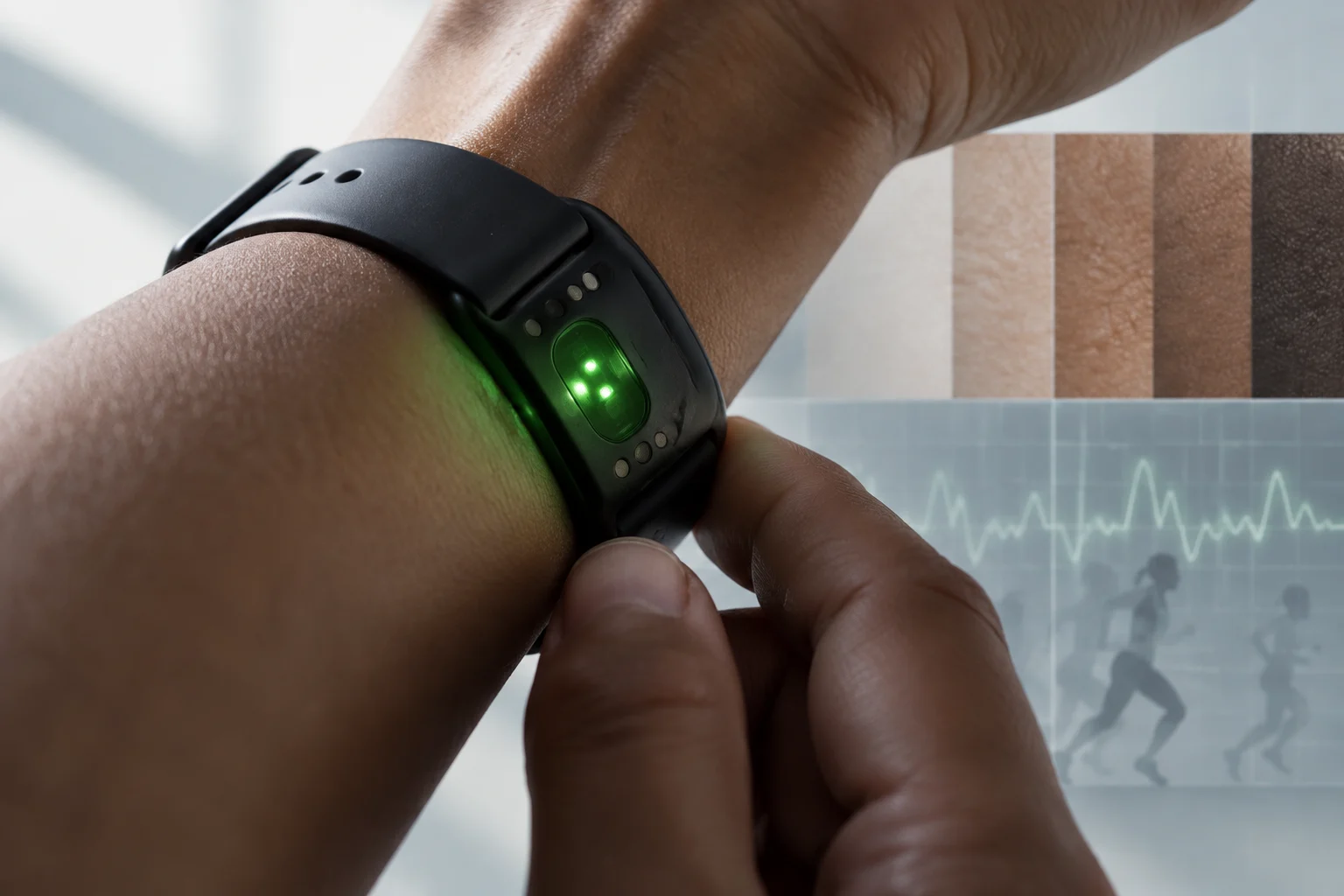
Anatomy of Sensors: PPG and Accelerometry
Most health wearables rely on two primary technologies: photoplethysmography (PPG) and accelerometers. PPG uses LEDs, typically green light, to measure changes in blood volume in capillaries, allowing for heart rate estimation and, in some cases, oxygen saturation. Accelerometers, on the other hand, measure linear acceleration to count steps, detect exercise intensity, and analyze sleep architecture.
The accuracy of these sensors is not absolute but contextual. While PPG is sensitive to ambient light and melanin absorption, accelerometers can be affected by the type of movement and the device's location on the body. Understanding these physical limitations is the first step to avoid overinterpreting data that the device presents as health metrics.
The Skin Tone Bias in Optical Measurement
One of the most consistent findings in recent literature is that skin tone influences PPG accuracy. Melanin absorbs the green light emitted by sensors, reducing the useful signal and increasing noise. Independent studies have documented that users with darker skin tones (Fitzpatrick types IV-VI) present mean heart rate errors between 2 and 4 beats per minute (BPM) higher than those with lighter tones, especially during intense exercise.
This gap is not uniform. At rest, the difference is smaller, but it increases significantly with physical activity due to peripheral vasoconstriction and movement. Research published in Frontiers in Digital Health and Cureus confirms that, although manufacturers have improved algorithms, the bias persists and is a critical factor to consider when evaluating the reliability of heart rate data in diverse populations.
Regulatory Framework: Medical Device or Wellness?
The distinction between a wellness wearable and a medical device is fundamental to understanding what legal guarantees exist. The FDA (U.S. Food and Drug Administration) has updated its guidelines to clarify which wearable functions require approval as a medical device. For example, detecting atrial fibrillation or measuring blood pressure usually requires rigorous clinical validation, while step counting or calorie estimation are considered wellness functions.
In the European Union, the MDR (Medical Device Regulation) framework applies similar criteria. A wearable that only offers physical activity information is not subject to the same controls as one that diagnoses or monitors clinical conditions. Users must verify if the specific function they use has the corresponding certification, as the absence of this does not necessarily imply the data is useless, but that it is not validated for clinical use.
Error Factors: Movement, Fit, and Temperature
In addition to skin tone, other physical factors degrade the signal. Arm movement during exercise generates artifacts that algorithms must filter, which can introduce transient errors. The fit of the strap is also crucial: a strap that is too loose allows ambient light to enter and reduces optical contact, while one that is too tight can alter local circulation.
Skin temperature and humidity also affect conductivity and the optical signal. In extreme cold conditions, vasoconstriction reduces peripheral blood flow, making measurement more difficult. To minimize these errors, it is recommended to keep the device clean, properly adjusted, and avoid using it in areas with tattoos or scars that interfere with the optical signal.
Independent Validation: What Studies Say
Studies comparing wearables with reference clinical devices (such as electrocardiograms or finger pulse oximeters) show mixed results. Resting heart rate usually has high accuracy (mean error < 5 BPM), but heart rate variability (HRV) and oxygen saturation (SpO2) present larger error margins. An analysis of 30+ studies published in 2024-2025 indicates that accuracy varies significantly between brands and models, with no clear leader in all metrics.
It is important to highlight that manufacturer validation is often performed under controlled conditions and with specific populations. Independent studies, such as those conducted by Duke University or published in npj Digital Medicine, often find greater discrepancies in real-world environments. Therefore, wearable data should be interpreted as long-term trends, not as point clinical measurements.
Practical Recommendations for the User
To get the most value from a health wearable, it is recommended to follow these guidelines: 1) Contextualize the data: do not make medical decisions based on a single reading; look for patterns over weeks. 2) Verify the fit: ensure the strap is firm but comfortable, and that the sensor is in direct contact with the skin. 3) Know the limitations: understand that SpO2 and HRV are estimates, not diagnoses. 4) Compare with reference: if you have access to a clinical device, perform periodic comparisons to calibrate confidence in the wearable.
Finally, manufacturer transparency regarding validation methods and test groups is a quality indicator. Users should be skeptical of absolute accuracy claims and remember that wearable technology is a wellness tool, not a substitute for professional medical care.