What the available information allows us to say
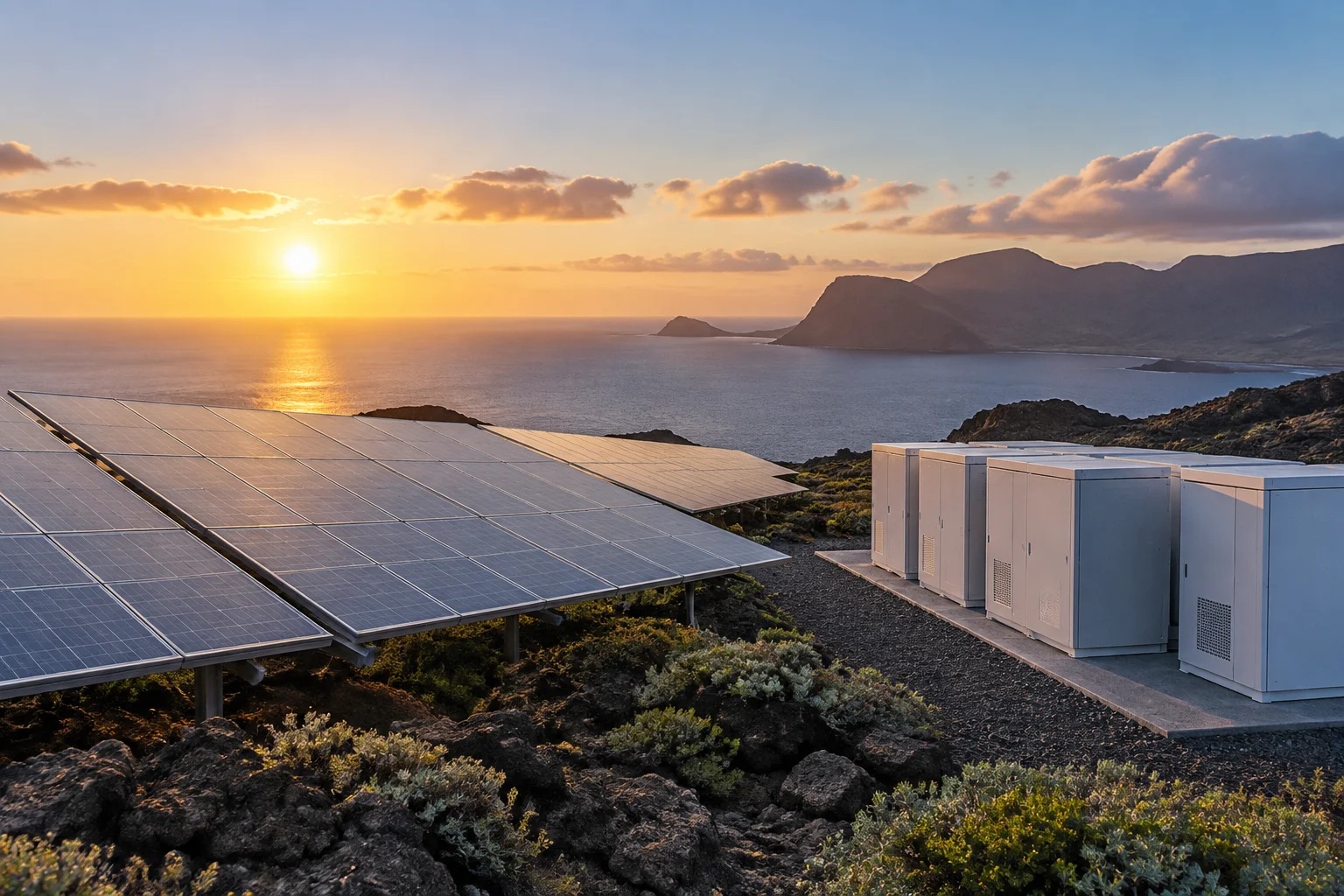
A September 2025 bulletin from the Canary Islands Energy Observatory is the available reference for a project that, according to the research material, is presented as funded through Next Generation funds and intended to supply electricity 24 hours a day using solar power and batteries. This describes an announced objective; by itself, it does not show that the installation has been completed, is operating, or is delivering energy continuously. Source: Canary Islands Energy Observatory bulletin.
The available extract does not identify where the system is located, who operates it, which users it supplies, or its power ratings and capacities. Nor does it provide a commissioning date, hourly records, incident reports or an independent assessment. It is therefore not possible to present the case as a proven success or calculate its performance. The absence of these details from the extract does not prove that they do not exist; it means they have not been substantiated by the evidence assembled here. This distinction sets the scope of the review: it describes what the consulted documentation supports, rather than claiming that no further information exists elsewhere.
This distinction matters when reading announcements about energy innovation. An institutional description may document a project’s stated purpose, but it is not equivalent to an operational report. The IDAE programme page on innovative renewable energy is an institutional reference for consulting the aid framework; its existence also does not prove this particular project’s implementation or results without project-specific documentation. Source: IDAE. These levels of evidence should be kept separate: the announcement reports an intention, while monitoring documents would need to show what was installed and what service it provides.
What does “electricity 24 hours a day” mean?
In an off-grid system, this expression may mean that the design aims to meet demand at every hour of the day without relying on an external electricity-grid connection. To do so, solar generation must cover consumption when the sun is shining and also charge storage so that energy can be shifted to hours without generation. The phrase expresses a service goal, not an availability metric, unless it is accompanied by a definition and operating data. Interpreting it therefore requires knowing both what counts as service and the period over which it is assessed.
The distinction between power and energy helps explain the design. Power, usually expressed in kilowatts (kW), describes the instantaneous rate at which electricity is generated or consumed. Energy, expressed in kilowatt-hours (kWh), indicates how much is produced, stored or used over an interval. A battery with a given energy capacity does not, by itself, guarantee that it can meet any power peak: its charging and discharging power, state of charge and system losses also matter. These are technical criteria for assessing any installation, not specifications attributed to the Canary Islands case. In other words, capacity indicates an amount of energy, while power affects how quickly that energy can be supplied or absorbed.
The promised service must also be specified. It might mean supplying a community’s entire consumption, only priority loads, or a particular facility; and continuity might refer to a design objective or to the service actually observed. Without defining users, loads and time period, “24 hours” is too ambiguous to compare projects. In particular, it does not say what happens during several days of low solar production, maintenance or a breakdown. Defining the scope would show which demand is considered covered and prevent a limited service for certain uses from being read as a universal supply.
The data needed to assess system sizing
The first element is the demand the system is intended to cover: total consumption, hourly variation, power peaks and critical loads. An aggregated annual figure is not enough to establish whether the system can respond to periods of high demand. It is also useful to know whether the project plans to manage consumption—for example, by shifting uses to solar hours—because that changes the profile that generation and batteries must meet. Demand is not just a total: its distribution over time determines when energy is needed and at what power.
The second element is generation and storage: installed photovoltaic power, measured output, the nominal and usable capacity of the batteries, maximum charging and discharging power, and conversion losses. Nominal capacity is not necessarily the energy available to the user; operational limits and the system’s own consumption may apply. Without these data, it is impossible to infer how many hours of autonomy the storage provides or whether it is sufficient for the anticipated consumption pattern. Separating nominal from usable capacity avoids treating all the energy listed in a battery specification as available.
A clear assessment should bring together, at a minimum, the following items, stating whether they are design values or actual measurements: demand and generation over comparable intervals; energy stored and delivered; and energy not served. The period analysed and weather conditions also matter, since one sunny day alone cannot characterise the system’s response during less favourable periods. Comparing data collected over equivalent intervals helps relate production to the consumption it was meant to meet. The available material contains no such figures, so a quantitative table for the project cannot be completed without inventing data.
Backup, autonomy and measured continuity
The phrase “solar and batteries” does not rule out other backup sources. The system might include them, or rely on an external connection, but the available evidence cannot confirm either possibility. Assessing the promise requires knowing what happens when storage is depleted or a component stops working: whether backup exists, when it comes into service and what share of demand it supports. The backup source changes the meaning of a claim about solar supply, although it does not necessarily diminish the project’s value. Without clarification, it is impossible to know which resources help maintain service when generation or the battery is insufficient.
Continuity requires observed indicators and an explicit time window. For example, a report could record interruptions, their cumulative duration, energy not supplied and the percentage of demand met; these indicators would help distinguish equipment availability from the service users actually receive. The report would need to explain how planned outages, maintenance work and external failures are counted. Without common definitions, two availability percentages may not be comparable. Stating the calculation method also helps readers understand what each result includes and which service experience it describes.
A short trial period may establish that the system works under certain conditions, but not necessarily that it maintains service throughout the year. Conversely, a one-off interruption does not by itself describe annual performance. The conclusion must match the period and scope of the data: commissioning shows that operation has begun, not that continuous service has been verified over a representative cycle. The span covered by the records is therefore not a minor detail; it determines what kind of conclusion they can support.
How to follow the case without confusing an announcement with a result
The starting point is the cited Observatory bulletin, followed by project-specific documents that the responsible administration may publish. The Canary Islands Ministry of Ecological Transition and Energy maintains an energy information portal; identifying the agency does not replace finding a project file, resolution, case record or report that clearly identifies the action. Canary Islands Government Energy portal. Precise identification is necessary to link any later document to the case described, rather than to general information about the sector.
To check its status, look for documents that distinguish stages: award or funding, implementation, acceptance of works, commissioning and operation. Each establishes something different. An awarded grant supports the fact that funding was approved, not that the installation is complete; an inauguration or commissioning reports a milestone, but does not necessarily provide an operating series. Assessing results requires later data with an identifiable period, methodology and measurement owner. Reading the stages separately avoids turning an administrative or technical milestone into a claim about continuity that would still require operational evidence.
An independent review would be useful if it could examine operating records, calculation criteria and the scope of service, rather than merely repeat figures from the announcement. It could also clarify whether the data cover all users or only a subset. Until such documentation is available, the most rigorous wording is that a project has been described with the aim of supplying electricity 24 hours a day using solar power and batteries, while its location, detailed design and performance are not verified by the consulted extract. This conclusion acknowledges the stated objective while making explicit which aspects remain impossible to confirm.