
What is a perovskite solar cell?
A photovoltaic cell converts part of the incident light into electricity. In perovskite cells, the light-absorbing material belongs to a family of compounds with a crystal structure called perovskite; in solar research, metal-halide materials are studied in particular. The term does not refer to one chemical recipe or a specific commercial product: composition, the layers around the absorber and the device architecture can vary between studies. So, the fact that two papers use the word “perovskite” does not mean they are evaluating identical materials. DOE
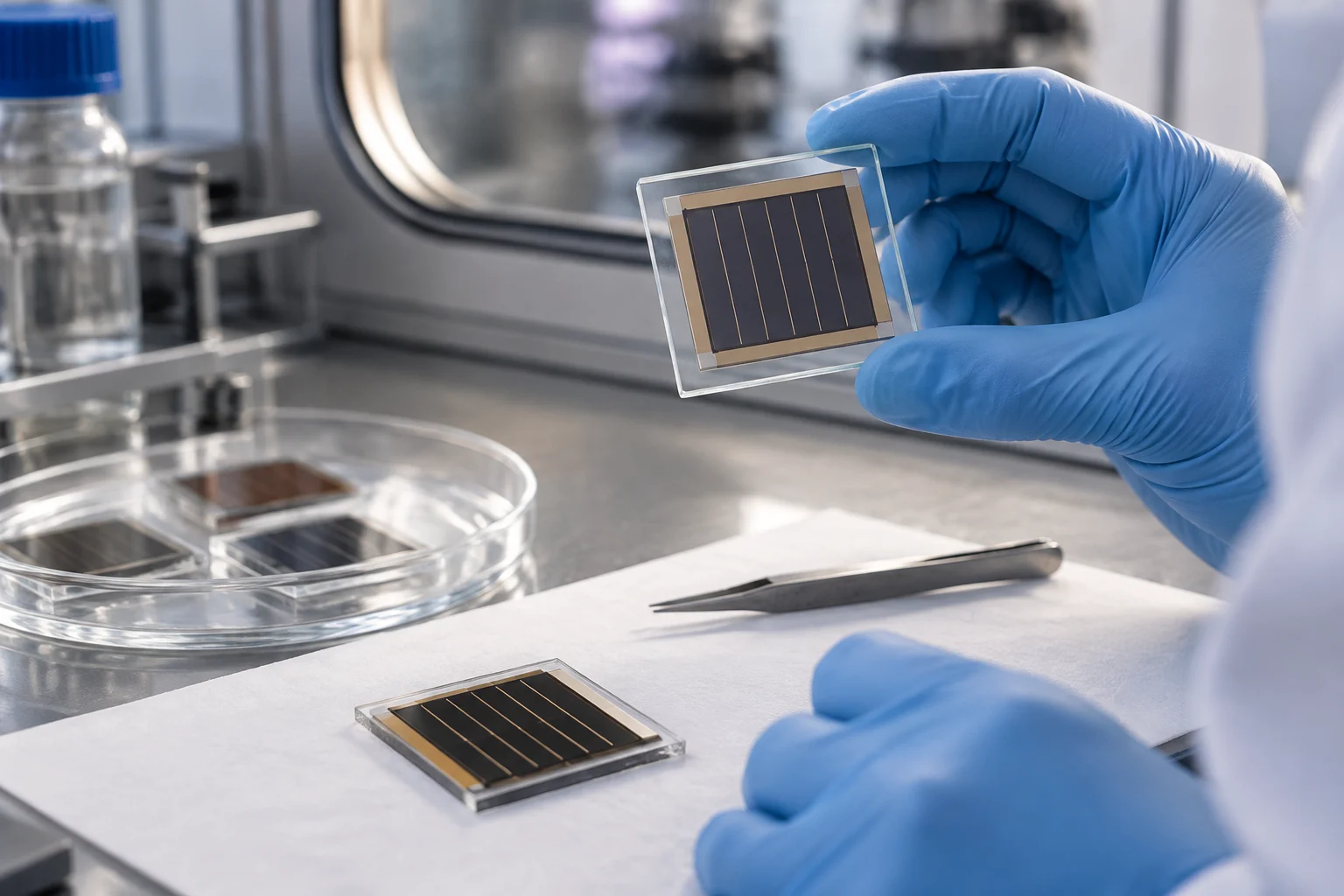
The active material is only one part of the cell. Electrical contacts, charge-transport layers, the substrate and the interfaces between components also matter. A cell can then be incorporated into a module with its own connections, barriers and seals. Durability must be attributed to the object that was actually tested: a composition in a film, an individual cell and a module are not interchangeable units of evidence. A convincing result from a small cell is informative about that configuration, but by itself does not show that a larger module will withstand years of outdoor operation.
The family attracts interest because it offers design and manufacturing possibilities being investigated for photovoltaic applications. That is different from saying that the technology is ready to replace established modules. The US Department of Energy presents perovskites as a research area and describes stability and scaling as matters requiring further work. For readers, the useful question is not whether “perovskite” works, but which composition, device and specific conditions support the published claim. DOE: Perovskite Solar Cells
Initial efficiency and stability answer different questions
Conversion efficiency indicates what proportion of incident light energy is converted into electricity under specified conditions. It is important, but a single measurement does not tell you how much will be retained after continued exposure to light, heat, humidity or operating cycles. A high figure at the outset and stable retention during a test are different results; neither should be presented as a substitute for the other. Initial efficiency describes performance in a measurement; stability describes how it changes over time under specified conditions.
To assess a result, find the starting value, the variable tracked and the definition of degradation. The metric might be maximum power, efficiency, current or another indicator; likewise, “retention” must be read together with its reference point and measurement method. If a publication says a sample retains a proportion of its performance but does not explain how it was measured, in what device or after what exposure, the figure lacks enough context for a clean comparison with another result. Responsible reading does not fill those gaps by assuming the protocols were equivalent.
It is also useful to distinguish operational stability from total service life. An accelerated test may expose a sample to demanding conditions to investigate degradation mechanisms, but it does not automatically correspond to a specific number of years on a roof. Extrapolation depends on the mechanism being accelerated, the environment and whether the observed behaviour holds under other conditions. The DOE identifies stability as a research challenge for these cells; that description is not a prediction that every configuration will fail in the same way or on the same timescale. DOE
Test conditions determine what a result means
Light, temperature and humidity are variables that can influence a sample’s behaviour. Other factors include the atmosphere, illumination intensity, applied electrical load, on-off cycles and exposure duration. Finding the word “stability” is not enough: you need to know which combination was used, how it was controlled and what was measured during the test. For example, a test under controlled heat and humidity answers a different question from operation at maximum power under continuous illumination.
A useful report makes it possible to identify, at a minimum, the exposure protocol, relevant environmental parameters, the device’s electrical state during testing and the sequence of measurements. It should also describe the number of samples and whether it presents a representative sample or aggregated results. Without that context, it is not possible to reliably distinguish a consistent response from an isolated case, or determine whether differences between reports result from the material or from different test conditions. Comparability depends on protocol details, not simply on both studies reporting a duration.
For a result to be interpretable, look for data both during exposure and afterwards. A measurement before and after can conceal intermediate fluctuations, reversible changes or recovery periods; a time series provides a different kind of information. The report should clarify whether the sample was measured under the same conditions at the beginning and end, and how the measurement procedure was prevented from affecting the comparison. If those data are unavailable, describe the scope of the result without turning it into a broader conclusion about service life or outdoor performance.
Degradation, encapsulation and device size
Encapsulation aims to protect a device from its surroundings using barriers and seals; its materials and design are part of the configuration being tested. So, “encapsulated cell” is not a sufficient description: identify what was encapsulated, how it was done and what sample was used as a reference. Comparing a protected cell with an unencapsulated one can help investigate the barrier’s function, but it does not allow every difference to be attributed to the active material. The available technical review of encapsulation and stability testing specifically addresses protection from external factors and the need to describe how tests are conducted. IntechOpen, technical chapter
Ambient humidity and oxygen may be relevant when evaluating barriers, while heat, light and mechanical stresses raise other questions about the system as a whole. A test focused on one factor does not automatically certify resistance to the others. It is especially important not to conflate the intrinsic stability of a film with that of the complete device: a sample may show a promising property and still be limited by an interface, a contact, a seal or a module connection. Encapsulation is not an incidental detail: it is part of the system whose reliability is being assessed.
Moving from small cells to modules introduces additional challenges involving manufacturing, uniformity, connections and protective materials. The sample size should therefore accompany any claim about performance or durability. The DOE has research programmes on photovoltaic modules and systems, indicating that evaluation is not limited to the absorber at laboratory scale. This does not prove that a particular solution has overcome those challenges; rather, it points to the kind of evidence needed to connect a cell result to a potential application. DOE: Photovoltaics Research and Development: Modules and Systems
How to compare studies without confusing their conclusions
Before putting two results in the same table, check whether device type and size, architecture, encapsulation, exposure conditions and the performance variable measured are the same. Also review test duration and the criterion used to define a loss. If one study measures an unencapsulated cell under one condition and another measures a sealed module under another, a direct comparison can be misleading, even if both publish a percentage or a number of hours. When conditions are not equivalent, it is more accurate to describe each result separately than to rank technologies.
The source matters too. A scientific paper may provide methods and data; an institutional page may explain research goals or programmes; an explanatory article can help readers get oriented, but it does not replace the study and its methods. Consult the original document when a central claim depends on a figure. In particular, announcements about funding or research describe initiatives; on their own, they do not prove that a sample achieved commercial stability. Readers should follow the link to the original work and look for the protocol, complete results and limitations acknowledged by its authors.
As a practical guide, look for the following in each report: (1) sample identity and scale; (2) description of encapsulation; (3) light, temperature and humidity conditions; (4) duration and operating state; and (5) changes in the metric and its measurement method. If one of these elements is missing, note it as a limitation on comparison. That does not necessarily mean the result is wrong, but it does reduce what can be concluded. This discipline prevents a specific test from becoming a general promise about all perovskites.
What evidence is needed to discuss commercial durability?
A strong durability claim would require reproducible results from devices representative of the intended application, using transparent methods and tests relevant to the expected environment. To evaluate a module, it is important to know not only its efficiency but also how the system performs as a whole and how its components and connections withstand testing. Repetition across more than one sample, along with explanations of failures or variations, helps assess whether the result appears characteristic of the design or exceptional. No single test answers every question: data need to cover relevant conditions and failure modes.
Standards can help establish comparable procedures and criteria, but mentioning a standard should not be treated as automatic proof that a specific product has been certified. Verify which document and edition were used, their scope and sample, who conducted the test and what result was obtained. A commercial guide to photovoltaic testing is not the official text of a standard and does not prove that a particular cell passed a protocol. The sources examined here do not include primary standards documentation that would support a claim of certification or conformity for a perovskite product; accordingly, no such result is attributed to any technology or model.
The conclusion is deliberately limited: laboratory results help identify progress and problems, but their meaning depends on the sample and protocol. An efficiency figure does not prove longevity, and a stability test alone does not equal years of field service. Claims about a durable application require evidence from relevant devices and modules, a full description of conditions, degradation tracking and careful comparison against appropriate protocols. DOE institutional documentation and technical literature on encapsulation provide context for asking these questions, not a guarantee that every perovskite cell will perform the same way.