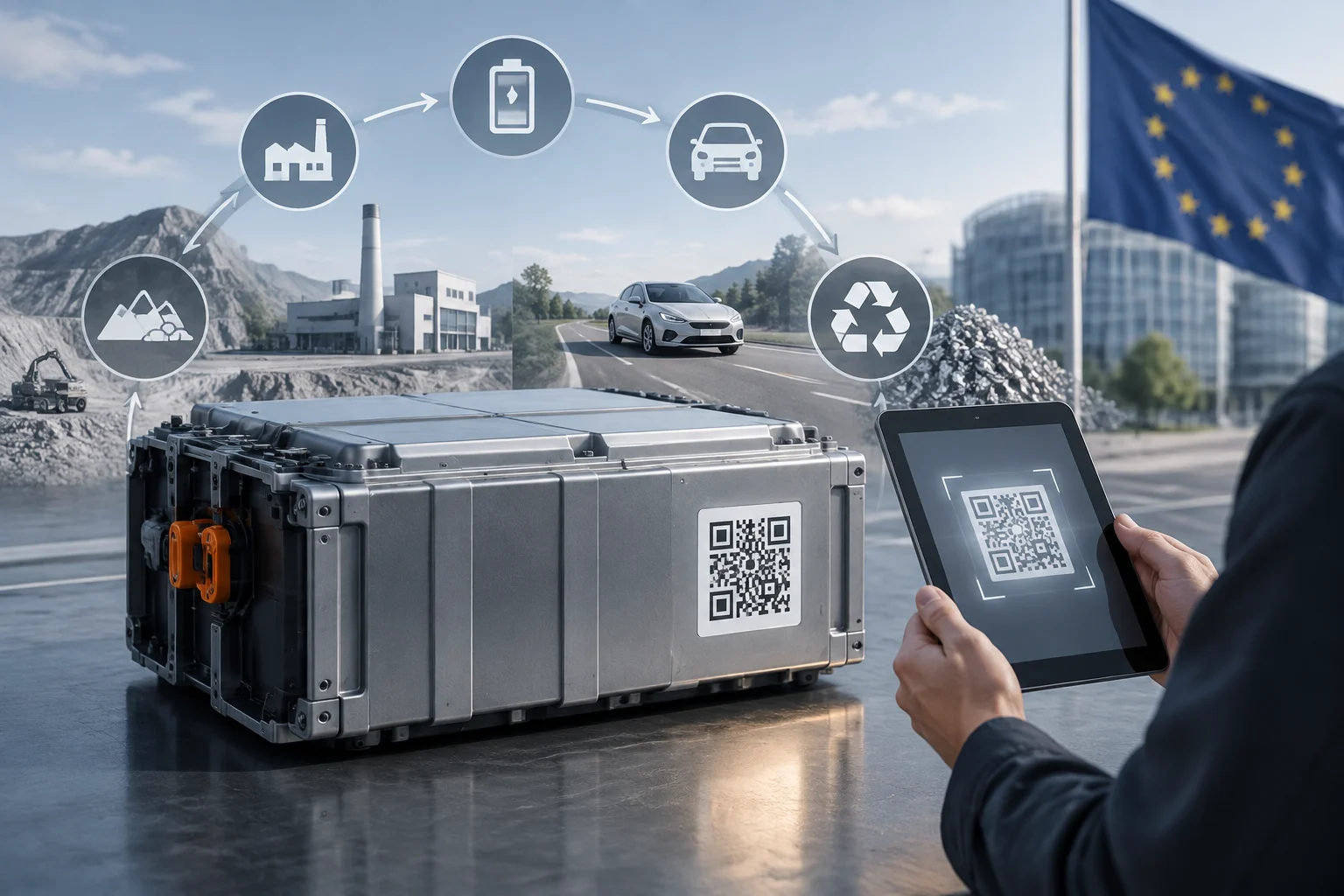
A digital record linked to each battery
The digital battery passport is a set of electronic information associated with a battery through an identifier and accessible via a data carrier, such as a QR code. It is not simply a label listing technical specifications: the EU regulation frames it as a structured way to link product data with information about manufacturing and changes throughout the life cycle. The obligation and its conditions are set out in Regulation (EU) 2023/1542, particularly Article 77 and Annex XIII. Source: consolidated text of the Regulation.
The regulatory purpose fits within a broader policy: setting requirements for batteries from production through reuse and recycling, and making it easier for different participants to consult relevant information. That does not mean that all data must be public, or that the passport by itself certifies that a battery is sustainable or safe. It is an information mechanism subject to legal requirements; its usefulness depends on data quality, whether the information is kept up to date, and whether each person accesses only the part they are entitled to see. European Commission: batteries framework.
The Commission identifies batteries as the first product group for which it expects a digital passport to become mandatory in the EU. This institutional description places the system within the wider development of digital product passports, but it does not replace the regulation or determine every technical detail in its own right. To establish what the law requires, the primary reference is the legal text; information pages can help explain it, but do not extend its obligations. European Commission: battery passport.
Which batteries are covered, and what is the timetable?
Article 77 establishes the passport for three categories: electric vehicle batteries, light means of transport batteries, and industrial batteries with a capacity greater than 2 kWh. The obligation applies to each individual battery in those categories. It is therefore not a general requirement covering every cell and battery marketed in Europe: ordinary portable batteries are not included in this specific obligation merely because they are batteries. The rest of the Regulation also contains other rules for different categories, but those should not be confused with the passport requirement. Consolidated text of the Regulation, Article 77.
The date set by Article 77 is 18 February 2027. From that date, batteries in those categories that are placed on the market or put into service must have a passport meeting the conditions in the Regulation. This date expresses a legal obligation; it does not prove that every company system, data provider or consultation tool has already been rolled out, or that compliance in practice can be considered verified before the obligation applies. Consolidated text of the Regulation, Article 77.
The category is determined by the battery’s type and use, as well as by the capacity threshold for industrial batteries. The legal threshold says “greater than 2 kWh”: an industrial battery of exactly 2 kWh does not exceed that limit in the ordinary meaning of the words. When classifying a specific case, however, the definitions and circumstances provided for in the Regulation itself may matter; the category cannot be inferred solely from the product’s commercial name. The scope is narrower than “all batteries” and more specific than a requirement for every product that contains one.
What information the passport covers
Annex XIII to the Regulation lists the information categories that the passport must contain. These include battery identification data, information on composition and materials, performance and durability parameters, and elements relating to the carbon footprint and supply chain. It also covers information useful to those assessing, maintaining, repairing, reusing or recycling the battery. The legal list defines fields and requirements; it does not promise that every user will see all the data on an open screen. Consolidated text of the Regulation, Annex XIII.
This detail matters because the passport is not an unrestricted-access database. The Regulation distinguishes publicly accessible information from information that notified bodies, market surveillance authorities and other economic operators can access according to their responsibilities and needs. Some information may be accessible to people involved in repair or end-of-life treatment; other information is subject to restrictions, including those relating to commercially sensitive information. Permissions should not be reduced to a simple split between “public” and “manufacturer”: the framework provides different access rights depending on the data and the user. Consolidated text of the Regulation, Article 77 and Annex XIII.
Access is provided through a readable physical identifier, such as the QR code provided for by the rules, which links to the relevant record or information. The code is not the complete passport in itself: it acts as an access point to the associated digital data. For a consumer, this can make public information easier to consult; for an authorised entity, it may enable access to additional data. Visibility depends on the user’s access profile and the type of information, not merely on whether someone has a camera that can read the code. Interoperability and the actual consultation experience also require the technical implementation to work properly.
Responsibilities and the flow of data
Under the Regulation, the economic operator placing the battery on the market or putting it into service is responsible for ensuring that the passport is available. The text also provides for obligations on relevant supply-chain actors and on those involved in modifying or remanufacturing a battery, in the cases it regulates. The task is therefore not limited to printing a QR code: it involves linking the code to identifiable information, maintaining the required data, and organising how that data is updated during the applicable stages. Consolidated text of the Regulation, Article 77 and related provisions.
The design aims to ensure that information accompanies the product beyond its initial sale. A repairer might need relevant technical data; a second-life operator might need information to assess whether a battery can be reused; and a recycler might need data relevant to its treatment. These uses are consistent with the information categories set out in the rules, but they should not be presented as a guarantee that each user will obtain any data they request: access depends on legal permissions and on whether the specific information is included. Consolidated text of the Regulation, Annex XIII.
In practice, preparing for compliance requires coordination among those who generate data on materials, manufacturing, performance and later stages. It also requires deciding who is responsible for accuracy and how the link between the identifier and the physical battery will be preserved. These needs are a reasonable operational consequence of the identification, content and access requirements; they are not an exhaustive list of technical tasks imposed in identical detail on every company. The rules determine obligations and categories; the corporate architecture for meeting them can vary.

What the law sets out, and what depends on implementation
It is useful to distinguish three layers. The first is the legal requirement: the categories covered, the date, responsibility and fields provided for in the Regulation. The second is the technical specification that allows identifiers, data and permissions to work interoperably. The third consists of commercial services that can help companies collect or manage information. A provider may offer a platform or methodology, but that offer does not automatically turn an additional feature into a legal requirement or, by itself, demonstrate compliance. Consolidated text of the Regulation; European Commission: battery passport.
The legal text should be read together with its annexes and any relevant implementing rules or acts. A compliance review should check the current version of the Regulation, the provisions that apply to the specific category, and any subsequent act that amends or clarifies the requirements. A commercial guide or pilot may explain one possible solution, but it does not replace that check. The Commission’s material helps put the passport in context; for specific dates and obligations, the consolidated provisions are the decisive evidence.
There are also limits to what can be concluded from a general description. It cannot establish whether a particular battery complies, confirm which platform each manufacturer will use, or predict what data will be available in a real case. Nor does it demonstrate that every field has been standardised or implemented uniformly across the market. The legal obligation has a defined timetable; the degree to which each actor is actually prepared is a separate question that must be checked case by case.
How to assess claims about the passport
When assessing an initiative described as a “battery passport”, it is useful to start by asking which product it covers, who generates the data and what legal basis is cited. Then check whether it distinguishes mandatory fields from those offered voluntarily, and whether it explains who can consult each item of data. A solution that gathers a large amount of information is not necessarily more compliant: quality, traceability and access control matter just as much as the number of fields.
A practical check can focus on these points:
- Category and date: Is the battery for an electric vehicle, a light means of transport, or an industrial battery above 2 kWh, and is the requirement linked to 18 February 2027?
- Legal basis: Does the solution refer to Article 77 and Annex XIII of the Regulation rather than present a commercial interpretation as legal text?
- Access: Does it distinguish public and restricted information and explain which users are entitled to each level?
- Identification and maintenance: Does it describe how the identifier is associated with the battery and how relevant data will be retained?
These questions help distinguish a demonstration or pilot from a regulatory obligation and from a solution ready for its intended use.
The passport can provide a common structure for sharing information over the life of certain batteries, but it is not an automatic guarantee of circularity, reparability or reduced environmental impact. It is a regulatory tool within a broader framework that also covers sustainability, collection and treatment requirements. Manufacturers and other operators need to turn the legal fields and permissions into verifiable processes; buyers and users should check what specific information is offered and under what conditions. The most precise reading is therefore twofold: the rules establish what must exist and for whom, while actual deployment and data quality must be assessed for each implementation.