
The update is confirmed, but its significance needs to be defined
The initial premise that there had been no evidence of a recent launch no longer holds: the official blog of the Spanish National Commission on Markets and Competition (CNMC) published a post on 25 August 2026 entitled “CNMC speed test: we’re launching a completely revamped version”. The service’s official page provides the test and identifies it as a connection-measurement tool. In this case, there is documentary evidence to support describing a revamp announced by the institution itself.
Precision matters: the evidence confirms that the CNMC presented a revamped version on that date, but it does not mean that every feature of the service can automatically be treated as exclusive to this update. Nor does the announcement, by itself, establish the actual performance of any one person’s connection. A launch note and an individual measurement answer different questions: the first describes a change to the service; the second estimates how a connection performs under particular conditions.
The test website says it is intended for fibre, Wi-Fi and 4G/5G connections. That breadth helps users with different types of access, but it does not mean that every result can be directly compared with one obtained using a different technology, device or environment. The news is the revamp; a responsible reading means distinguishing what the tool offers from what an individual measurement can demonstrate.
What the sources confirm—and what the announcement does not cover
The most direct primary source is the CNMC blog post, dated 25 August 2026, which presents the tool as a “completely revamped” version. The CNMC’s institutional website also hosts an official trailer for the test. The date and announcement therefore do not rely solely on press headlines: they are supported by the authority’s own channels.
The service page, meanwhile, describes the tool as an internet speed test, and its frequently asked questions page provides help information. Taken together, these pages establish that the test is available on the web and is intended to measure internet connections. They are not, however, an independent audit report on accuracy, nor a guarantee that each result will match the contracted speed or the user experience across all applications.
It is also important to distinguish the existence of an announcement from the completeness of the available documentation. The launch page and a working test confirm the announced change; they are not enough to attribute technical details not explicitly set out here to the redesign, or to determine when each specific feature became available. Media reports covering the news may provide context, but the date and basic scope should first be grounded in what the CNMC publishes.
How to interpret a speed test
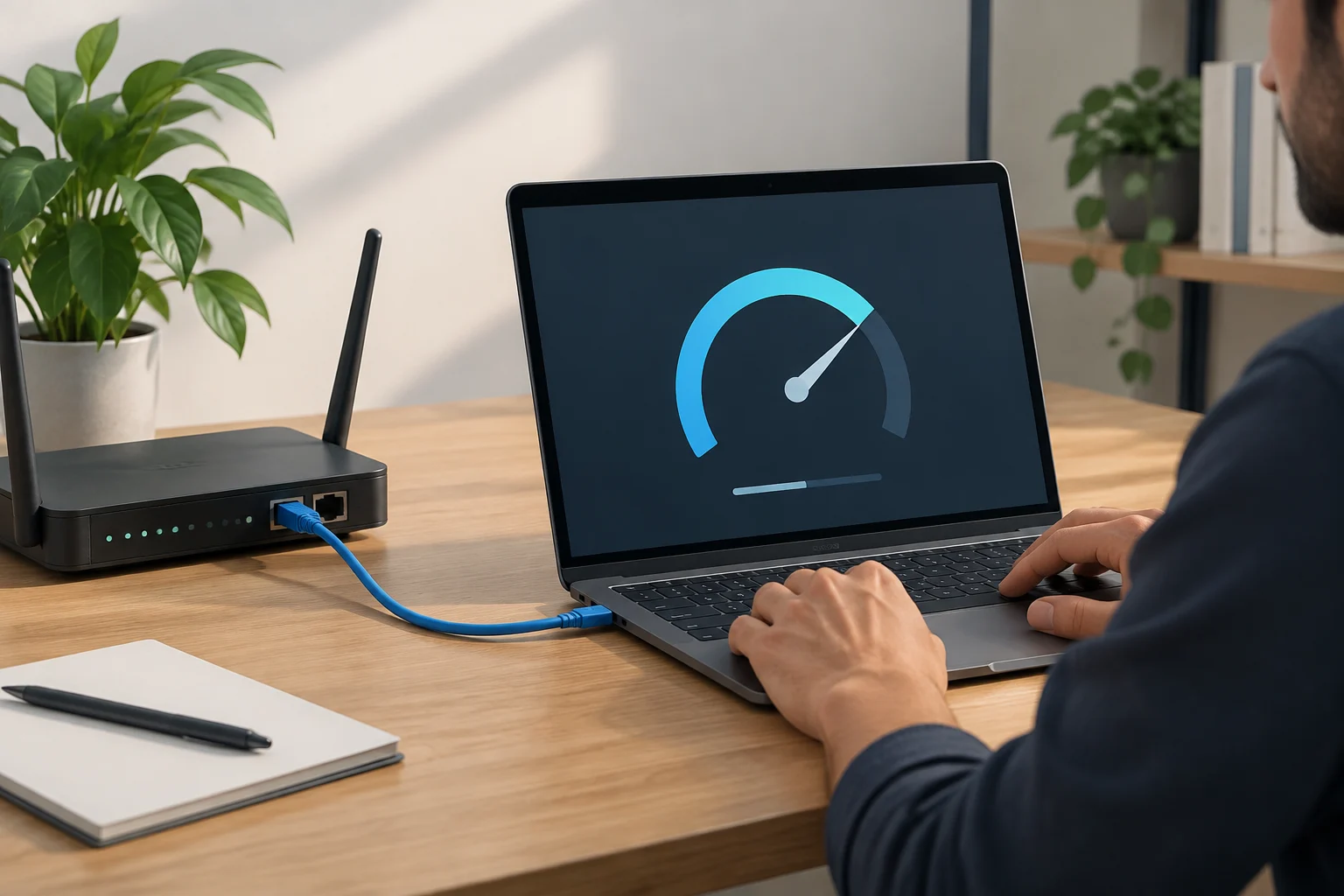
A speed test is a snapshot, not a complete diagnosis of an entire network. The result can vary with the connection type, coverage at that moment, equipment, distance from the router, congestion and simultaneous activity on other devices. Wireless conditions also affect a Wi-Fi measurement; a test over Ethernet and one run on a mobile phone therefore do not describe the same part of the connection.
Download and upload figures express data-transfer rates, while latency describes how long the connection takes to respond. A single figure does not prove that a provider is breaching a contractual term: a substantiated complaint requires the applicable contract terms, an appropriate methodology and, depending on the case, repeated and documented measurements. The tool helps users observe the service at a given moment; it does not replace a formal assessment.
The CNMC website presents its test for fibre, Wi-Fi and 4G/5G mobile networks. This indicates the environments covered, but results still depend on how the test is carried out. The phrase internet speed often bundles together several factors: the provider’s access network, the local network and the device. Understanding the distinction helps avoid blaming the contracted connection for every limitation detected on a device or on a home wireless network.
A more useful home check
To use a test sensibly, the main thing is to reduce variables and record the conditions. A straightforward check can be organised as follows:
- Note the time and whether the connection is over Wi-Fi or Ethernet; also state whether it is fibre or a mobile network.
- If you want to assess a fixed connection, test near the router and, when possible, repeat the test over a cable to distinguish wireless issues from other limitations.
- Pause downloads, backups and playback on other devices; avoid comparing a single test with another carried out under very different circumstances.
- Repeat the measurement at different times. Keep the results and conditions if you need to identify a pattern or speak to your provider.
These suggestions are not a laboratory guarantee or an official complaints procedure. They are a practical way to make comparisons less confusing. If, for example, results differ substantially between Wi-Fi and Ethernet, that difference points towards checking the local network before attributing the issue automatically to the access line. If consistent tests continue to show a problem, users can consult their contract terms and their provider’s support channels; a single screenshot does not establish a breach by itself.
Why two tools may produce different results
Speed tests are not identical simply because both display figures in megabits per second. They may differ in the server used, the route taken by data, the duration of the test and the way traffic is generated. FAST.com explains that it calculates current speed using downloads and uploads from its servers, and notes that the estimate may vary. This illustrates a general limitation: results depend, among other things, on the method and the network endpoints involved.
Comparing the CNMC test with a third-party service can therefore be useful as a cross-check, but not as a contest between numbers. If two tools disagree, first align the conditions: use the same device and connection, run the tests close together in time and, where possible, use the same type of link. Even then, differences in infrastructure or methodology can lead to different results without one test automatically being false.
The recommendation is not to choose the highest or lowest figure, but to consider repeatability and context. A one-off measurement estimates a particular set of conditions; it does not show the constant capacity of the entire network or the performance of every online service. When diagnosing an issue, several comparable observations are more useful than a striking or worrying figure taken out of context.
What the announcement adds—and what is needed to go further
The revamp is confirmed by a CNMC publication dated 25 August 2026, and the authority maintains a page dedicated to the test alongside frequently asked questions and an official trailer. This corrects the initial assumption: there has indeed been a recent announcement of a revamp. That is the most precise way to put it, without claiming that the service is a launch from scratch or that all of its features are new.
To describe the technical scope of each change precisely, documentation would be needed listing the differences between the previous and revamped versions, together with enough methodological detail to assess the measurement. The cited information does not establish an accuracy comparison with other tools or provide an independent test of results. This limitation does not invalidate the news of the announcement, but it does restrict the conclusions that can be drawn about performance and accuracy.
For readers, the immediate value is practical: the test offers a way to check a connection, while decisions about coverage, contracts or complaints require more context. It is sensible to record the conditions, repeat the test and avoid confusing the speed observed on one device with a complete assessment of the service. The revamp can thus be understood as a verifiable update to a public tool, not automatic proof that a particular connection has improved.