
“Cobot” describes a way of working, not a safety guarantee
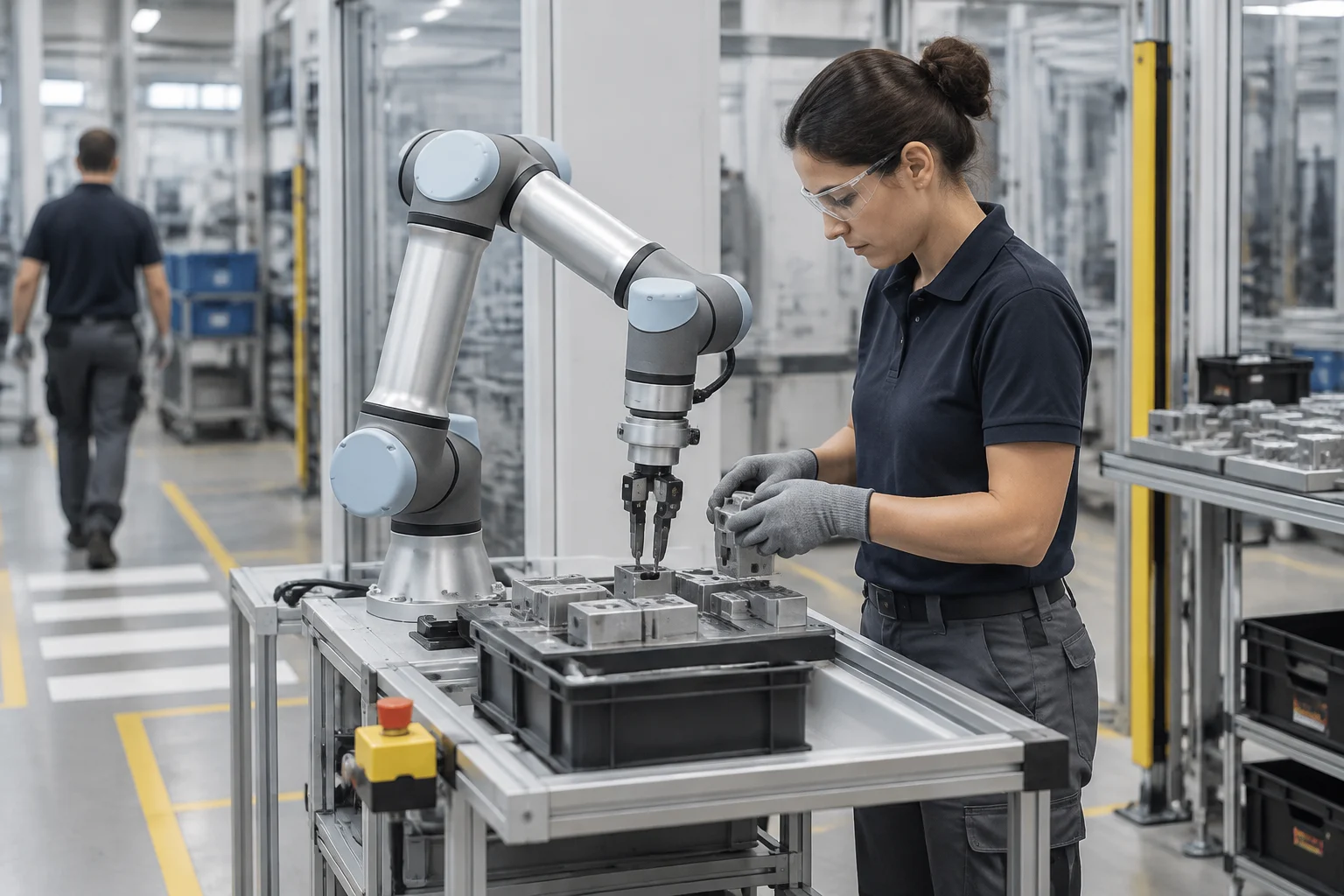
The word “cobot” is often used for robots designed to work close to people. It is a useful description, but it can be misleading if interpreted as a safety certification or a promise that any contact will be harmless. The robot arm is not the only consideration: the task it performs, its tool, the part being handled, the available space and the way workers and machine interact all matter.
The distinction matters because the same robot can be integrated into very different applications. A cell containing a fixed machine, controlled access and a stable sequence does not necessarily present the same hazards as an operation where a person shares space with the robot while changing parts or making adjustments. The equipment’s commercial designation cannot resolve those differences. The useful question is not whether the robot is collaborative, but under what specific conditions it can operate alongside a person.
EU-OSHA presents collaboration as a characteristic of the complete application: the system in which people and robots interact, not just the robot on its own. It also notes that using these systems may be associated with changes in work organisation, such as greater work intensity or less autonomy. This broadens the assessment: alongside contact injuries, it is worth considering how the task is organised and how automation affects the people working with it. (Source: EU-OSHA, OSHwiki.)
What standards contribute—and what they do not decide on their own
Industrial robot safety is addressed through technical standards and general safety obligations applicable to machinery and workplaces. The industrial robot safety standard identified in the research provides a framework for robot safety requirements. However, a standard does not replace an assessment of a specific installation: equipment is integrated with other components and used in a particular process. The available reference is a standard entry titled Robots and robotic devices. Safety requirements for industrial robots. (Source: BSI, standard entry.)
The application may include items outside the robot that change the risk: a gripper, a cutting tool, a load with sharp edges, a table, a nearby machine or a walkway. Programming, speeds and foreseeable conditions of use also matter. Checking the manufacturer’s documentation is therefore necessary, but it is not enough to infer that the final installation is safe in every configuration.
Three levels should be distinguished: the equipment’s declared characteristics, the applicable regulatory requirements and the measures implemented in the workplace. They are not equivalent. A statement about the robot does not automatically describe all the tools, accessories and tasks added later. Nor does a standards reference on its own show that every hazard in the application has been assessed. Component conformity should not be mistaken for an automatic conclusion about the complete system.
Assessment starts by describing the work as it is actually done
Before selecting measures, the work cycle needs to be described with sufficient precision. What does the robot do, and what does the person do? When do they enter the shared area? Are there product changes, adjustments, cleaning or jam removal? An assessment focused only on the normal cycle may overlook less frequent but foreseeable activities involving different access or movements.
It is also necessary to look at how the part is presented, which tool is fitted and what may happen if the process is interrupted. A tool that holds or manipulates a load can introduce hazards that do not come from the robot arm itself. Likewise, the material, geometry and orientation of the part can change the consequences of contact. The point is not to assume that every scenario will occur, but to identify reasonably possible conditions and consider how they are controlled.
A practical outline for preparing the review can include the following points, without replacing the work of a person competent in machinery safety:
People and the environment are also part of the system
The assessment is not limited to the space physically occupied by the robot. It should consider the path of its moving parts, the areas its tool can reach and the access routes used by operators or maintenance staff. The workstation layout can introduce risks: for example, a walkway that crosses a movement area, or a manual operation that requires someone to approach during a particular phase.
It also matters who interacts with the installation and in what circumstances. Routine work, maintenance and recovery after a stoppage may involve different actions. Clear instructions and appropriate training help people apply the planned measures, but they do not replace technical safeguards or make an unsuitable design safe. It is also worth checking whether procedures match the actual sequence of work and remain appropriate when products or shifts change.
The work-related dimension is not secondary. EU-OSHA warns that collaborative robots may be related to changes in work intensity, autonomy and monitoring. This does not mean that these effects occur in every installation, nor does it allow them to be attributed automatically to a particular technology. It does justify reviewing how work is organised: who controls the pace, how much scope a person has to stop or change a task, and how interruptions are managed. (Source: EU-OSHA, OSHwiki.)
Safety functions: examine the conditions, not just the name
Commercial materials may use function names that suggest closer interaction between a person and a robot. The name of a function does not, by itself, explain which hazards it controls, the limits under which it works or what happens in the event of an anomaly. To interpret it, consult the relevant technical documentation and understand the conditions of use: configuration, tool, load, workspace and behaviour when faults or process changes occur.
Motion limitation, robot stopping or separation monitoring may form part of a safety strategy, but they are not interchangeable and cannot be assessed separately from the rest of the system. The presence of sensors, for example, does not prove that every access area is covered or that the response to an intrusion is sufficient for the task in question. Nor should it be assumed that a stop eliminates risks associated with the tool or the part that remains held.
It is therefore more useful to request specific evidence than to accept a brief description. Which function is declared? Under what conditions is it validated? Which components are involved? What changes would invalidate the reviewed configuration? These are not a universal list of legal requirements; they are a way to prevent a nominal feature from taking the place of checking the application. The information available here does not make it possible to specify force, speed or distance values for a particular installation.
How to review an automation proposal
For a small business considering automating a task, the most useful opening question may not be “Which cobot should I buy?” but “Which operation do I want to change, and what risks does it involve today?” This makes it easier to compare proposals by looking at the task as a whole, rather than only at a model’s reach, payload or advertised functions. It also brings to light changes that may require a review: a different tool, a new part or a change to the workspace.
An initial document review can follow these steps:
- Describe the normal cycle and foreseeable interventions, including adjustments and recovery after interruptions.
- Identify the robot, tool, part, nearby equipment and people’s access routes.
- Ask the integrator or supplier for relevant safety documentation and declared conditions of use.
- Ask what assessment was carried out for the configured application and what changes require it to be reviewed.
- Confirm who maintains the measures, trains staff and updates procedures when the process changes.
Conclusion: assess the application, not a label
A robot called collaborative may be part of an application designed for people and machines to share tasks or spaces. But the term does not, on its own, resolve whether that application is safe. The answer depends on movements, the tool, the part, the environment, human tasks and the measures selected and integrated. The assessment must follow the actual installation; it must not stop at the product name.
Standards documentation and safety guidance can help structure questions and establish a review framework; without details of the case, they cannot provide universal approval. The consulted standards source identifies a document of safety requirements for industrial robots, while the EU-OSHA guide emphasises the broad nature of a collaborative application. The available pages do not provide a technical assessment of a specific installation or determine which measures would be sufficient in each scenario.
To make a decision, a company should ask the manufacturer, integrator and safety representatives to clarify what each document covers and how the installed configuration was verified. If the tool, task or environment changes, it is worth checking whether the assessment remains valid. This avoids the most common mistake: treating “cobot” as a guarantee when it is only a label that should prompt verifiable questions.