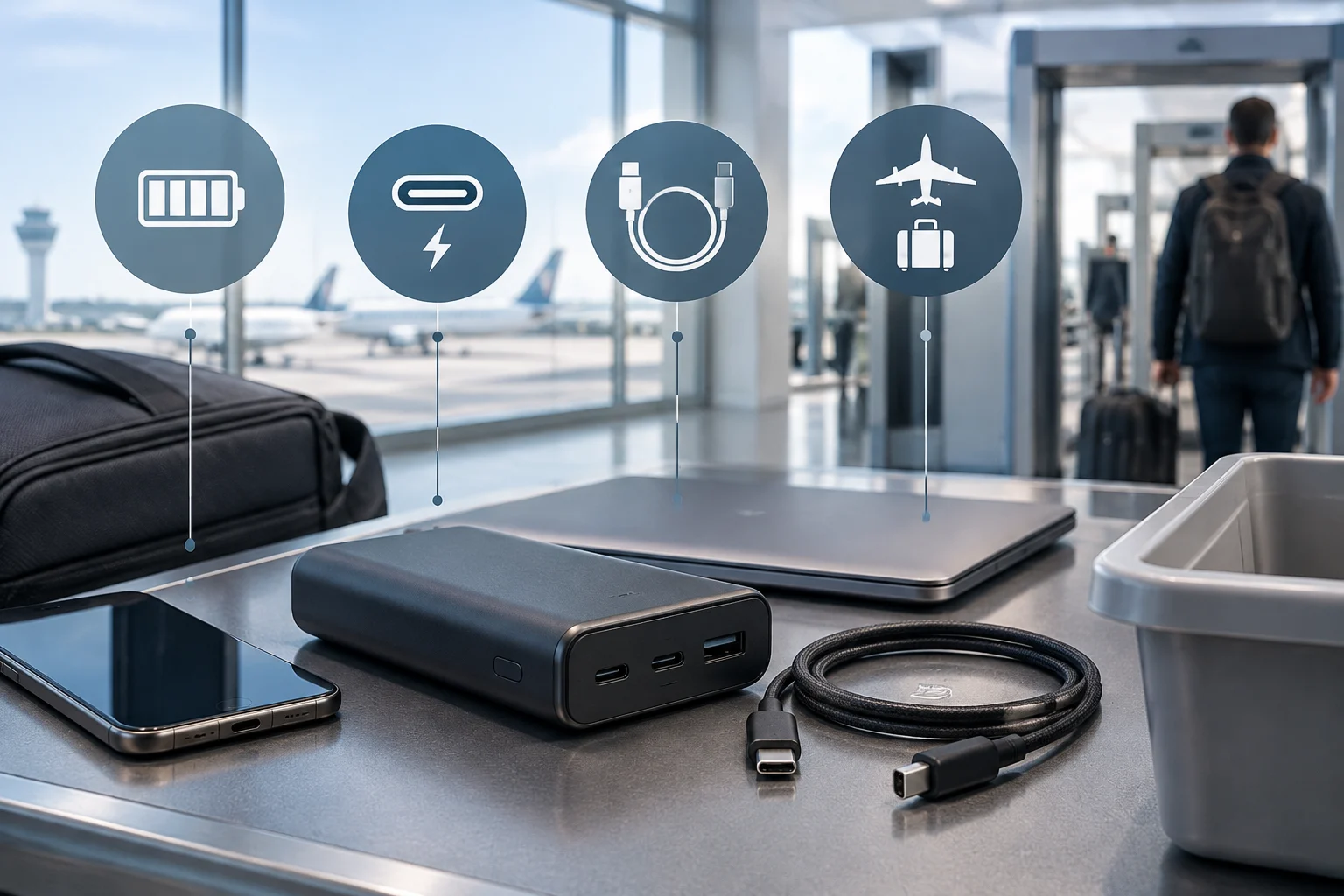
Quick summary: power, capacity, and the rules that matter in 2026
To travel without avoidable problems, focus on three things: capacity, charging power, and clear documentation for the power bank and its cables. Power and capacity are not interchangeable: power is measured in W and describes the charging rate available under particular conditions; capacity indicates how much energy the bank can store. With USB‑C, USB Power Delivery (PD) negotiates charging between the power source and the device. Before buying, check that the bank and your equipment are compatible with the power you need. Consider the complete setup, not just the number displayed prominently on a product page: the device, selected port, cable, and charging profile all matter.
Do not assume that every product advertised as “high power” will work as expected with your equipment. Check the output specifications for each port and the conditions for using multiple ports at the same time. For transport, verify the applicable regulations and each airline’s policy: a limit set by one jurisdiction should not be presented as a universal rule. Keep the product label and manufacturer documentation accessible. Having those details to hand may make an airport enquiry easier, but it does not replace any approval that may be required. IATA’s traveller guidance covers air transport of lithium batteries, but it does not replace the rules applicable to your route. Check your itinerary and the relevant official sources rather than relying on a general summary.
Step 1 — The power you really need: reading your laptop or console specifications
Before buying, look in the device documentation for its charging power and USB PD compatibility. If the original charger is marked 20 V/5 A (100 W), look for a bank that specifies that output on the port you intend to use. Avoid product pages that advertise only a maximum combined power figure without breaking down the individual outputs. For equipment that needs more power, check the device and bank documentation to identify a compatible profile; an unsuitable cable can also prevent the setup from reaching the expected power. The original charger’s rating is a useful reference, but it does not replace the device specifications. A device may support more than one profile, and the power it actually draws can depend on its state and settings.
If the device supports PPS, check whether the bank and charger support it too; do not assume this feature is necessary or decisive for every laptop. Available power depends on the negotiated profile and may change when other equipment is connected. That is why it is worth checking the output specifications for each port and the conditions for simultaneous use. A display showing voltage or current can help you understand charging status, but it does not replace compatibility documentation. If charging is slower than expected, compare the profile requested by the device with the output specified for that port and configuration. Also check whether the port remains at the stated level when another device is connected, rather than relying on a single headline figure.
Step 2 — Capacity: checking Wh and flight rules
When comparing banks, prioritise the Wh value stated by the manufacturer and keep the technical data sheet. If the product lists only mAh, do not infer its energy without also knowing the nominal voltage to which that capacity refers; mAh alone is not enough to compare devices that use different reference voltages. If you need to document the figure, retain the product’s stated Wh value or request the technical information from the manufacturer. Do not automatically use the USB port’s 5 V as the reference for interpreting internal capacity. The figures on a label may describe different parts of the power bank, so check what each value represents before comparing products or answering a transport question.
Transport requirements depend on the regulations applicable to the route and on the airline’s conditions. IATA’s traveller guidance addresses lithium batteries and power banks in the context of air travel, but it does not replace the operator’s policy or local official requirements. Before travelling, check whether the bank must be carried in cabin baggage, whether prior approval is needed, whether quantity limits apply, or whether the terminals must be protected. Wh is useful information for that check, but it does not by itself determine whether carriage is authorised. Verify the conditions well in advance, especially if your itinerary involves multiple airlines or connecting flights. If an operator gives route-specific instructions, check those rather than assuming that another carrier’s policy applies.
Step 3 — Ports and profiles: USB‑C, PD, PPS, and power sharing
The USB‑C connector alone does not guarantee a particular power level. In the specifications, look for the profiles supported by each port and the power available when several ports are used at once. If the product gives only a total figure without explaining how power is shared, you cannot tell how much each device will receive. Distinguish the maximum output of one port from the maximum combined output: they may be different values and may depend on simultaneous use. Check whether a particular combination of ports changes the available output, and whether the manufacturer explains that behaviour clearly.
If you plan to power a laptop and charge a phone at the same time, review the manufacturer’s power-sharing diagram. One port’s output may change when another is occupied; do not assume the advertised maximum will be available in every configuration. A USB‑C hub does not replace PD: if the bank does not negotiate a compatible profile, the device may not receive the expected power. Check the cable rating too: data capability and power-delivery capability are separate aspects. Identify the use case that matches your devices, ports, and requirements before buying. It is more useful to compare that real-world combination than to choose a bank solely by its highest advertised wattage.
Step 4 — The right cables: rating, power, and documentation
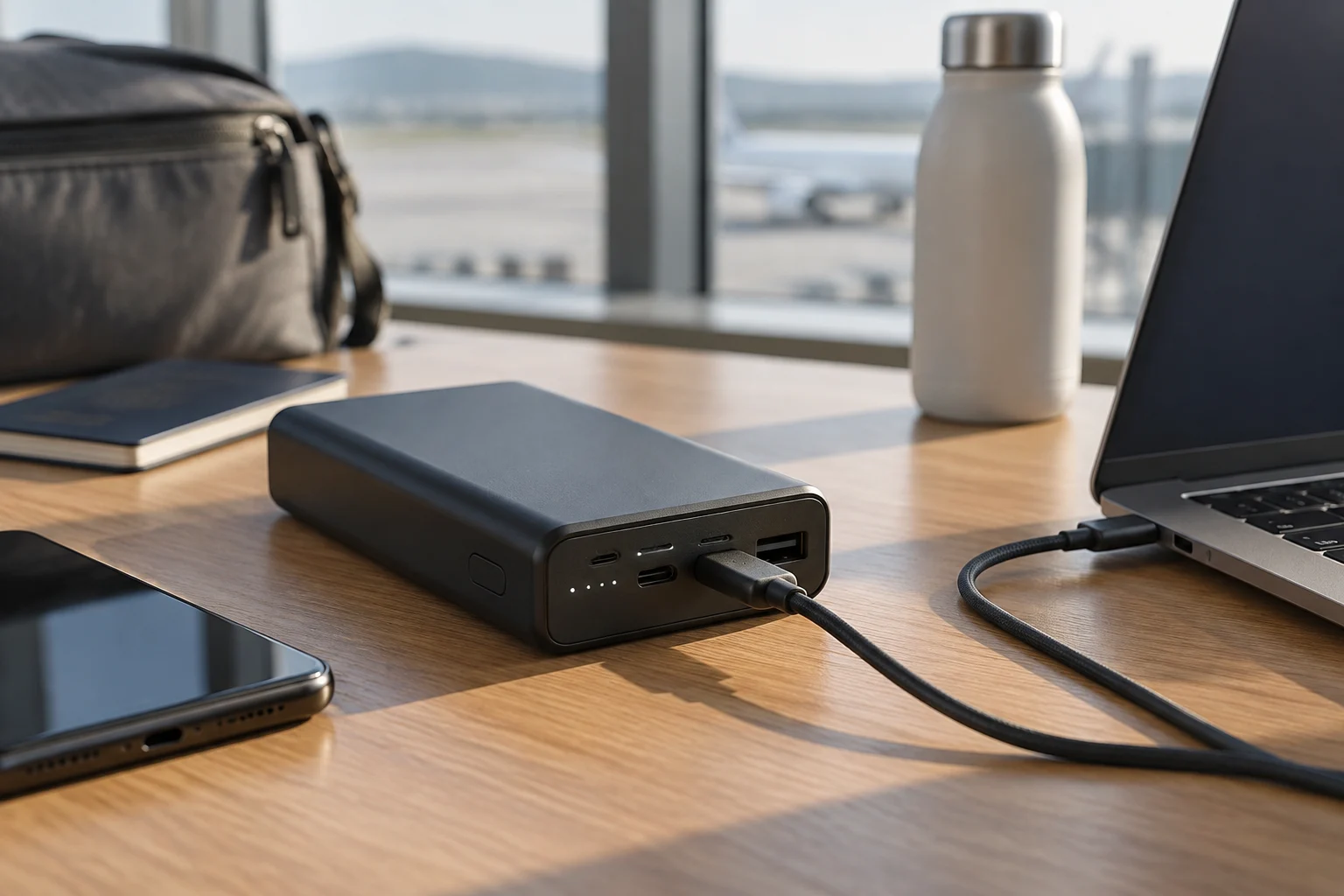
For power levels requiring more than 3 A, verify that the cable is suitable for the expected current and voltage and that its manufacturer declares its capability. USB‑IF publishes information about cables and connectors, including power-rating logos for USB‑C-to-USB‑C cables. That information can help identify products labelled under its programme, but similar-looking wording in a product description does not prove that a particular cable is certified. Check the exact rating and documentation, not just the connector’s appearance or a prominent number on the packaging. Make sure the stated rating applies to the model you are buying, rather than a different cable in the same product range.
Data capability—for example, USB 2.0 or higher data rates—is not enough to determine power capability. Consult the specifications for the exact model and make sure its rating matches the power and configuration you intend to use. If charging is slower than expected, the cable is one of several possible causes; the selected port, the device profile, and the bank’s power sharing may also matter. There is no simple visual test that can confirm electrical performance by itself. Keep the model reference or a link to its specifications so you can check it if you need to replace the cable while travelling. If a replacement is needed, compare its documented rating with the requirements of the devices and power bank.
Step 5 — Recharging the power bank: USB‑C input and compatible chargers
To recharge the bank, check the maximum power accepted by its USB‑C input and the profiles it supports. Output compatibility does not guarantee the same input power. The charger and cable must also support the required profile; otherwise, the bank may recharge more slowly than expected. Check whether the manufacturer documents simultaneous input and output use and what limits apply. Do not confuse a port that can supply power with an input that accepts the same power: that capability must be explicitly stated in the specifications. A port may support different functions in different directions, so read the details for the exact model and port rather than assuming all USB‑C ports behave alike.
If the bank advertises passthrough, look in the manual for the conditions and limitations. Do not assume that it is suitable for every combination of charger and device. Compare the stated input power with the charger you already own, but do not derive an exact recharge time from the maximum power: capacity, internal power management, and charging conditions also affect the result. Use that figure to compare specifications, not as a guarantee of a particular charging time. If timing matters before a trip, allow for variation and check the manufacturer’s guidance for the actual charging setup you plan to use.
Step 6 — Safety and durability: documentation, standards, and transport
Prioritise banks with verifiable safety documentation and clear manufacturer and model details. IEC 62133‑2 is a standard concerning safety requirements for portable secondary lithium cells and batteries. A reference to a standard, on its own, does not prove that a particular product has been assessed or certified against it. Check what declaration or certificate the manufacturer provides and which model it covers; make sure the documents refer to the exact product, not merely a product family or general description. The IEC 62133‑2 page lets you consult the scope of the standard. Keep the documentation with the product information so that you can identify what evidence is actually being claimed.
Do not infer transport authorisation from commercial chemistry, nominal capacity, or a safety certification. Confirm the current rules for your route and airline, including baggage conditions and terminal protection. If the label does not let you determine the energy, request the technical data sheet from the manufacturer. Follow the storage and handling recommendations in the manual for that model; do not replace them with generic charging or temperature figures that are not supported by that documentation. Keeping the label legible and the data sheet with your travel information makes it easier to verify product details when needed. These checks help you prepare, but they do not remove the need to follow the instructions of the carrier and relevant authorities.