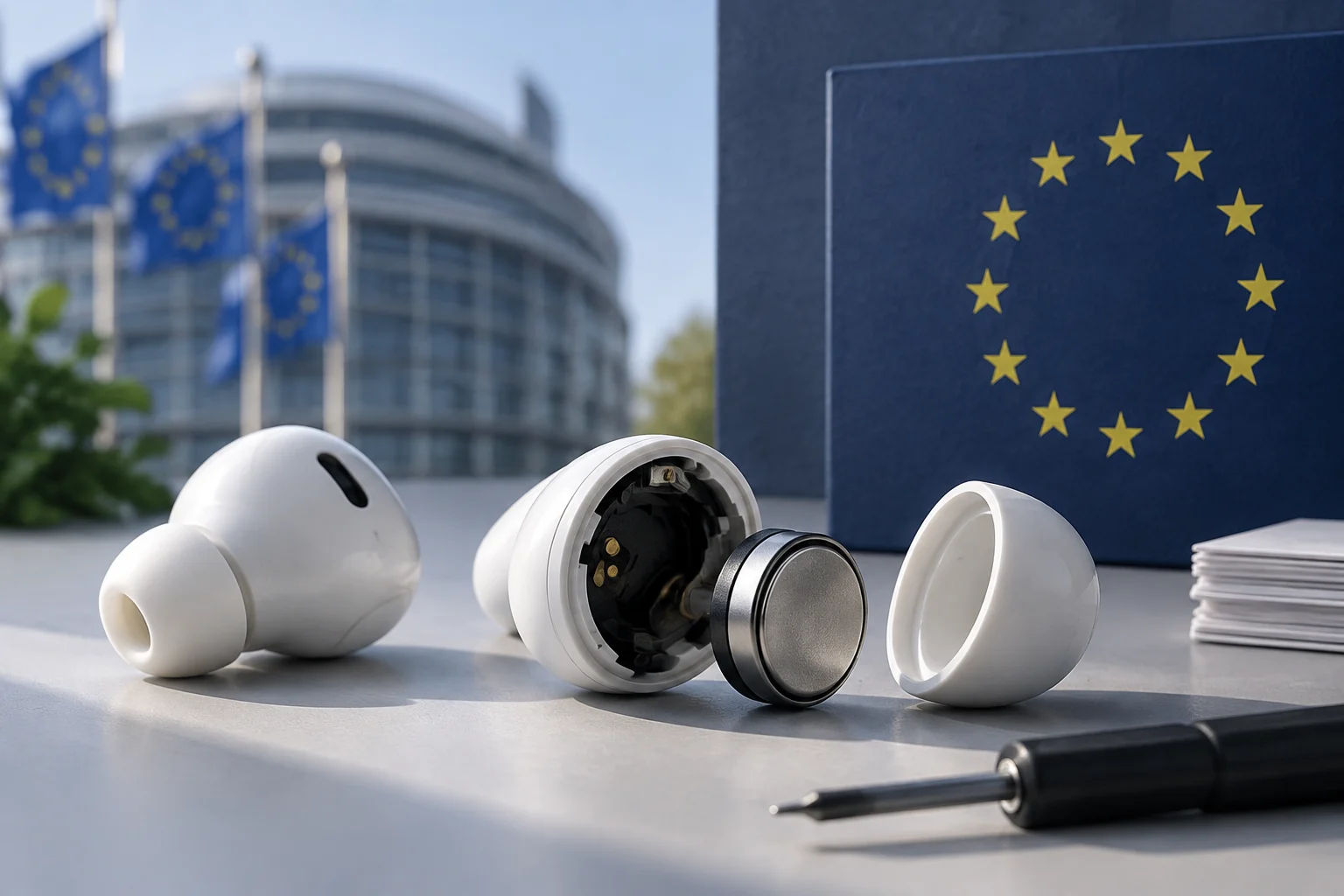
The key date is 18 February 2027
Regulation (EU) 2023/1542 on batteries and waste batteries includes a design requirement for certain products containing portable batteries: those batteries must be removable and replaceable by the end user during the product’s lifetime. The date set for applying this requirement is 18 February 2027. This does not mean that every pair of headphones sold today must be designed to open so its battery can be changed, nor that the rule is already in force for new designs. Both the timetable and the precise scope of Article 11 matter when interpreting the requirement.
The legal text is the reference point for distinguishing enforceable requirements from commercial announcements or expectations about future generations of products. The regulation does not prescribe a particular headphone design, nor does it guarantee that every battery will be interchangeable with a standard part. It sets conditions for removing and replacing batteries and includes circumstances in which the general requirement does not apply. The date alone does not allow us to claim that every model sold from that day onwards will have a battery accessible to consumers. A date of application is not, by itself, a product-by-product ruling: the relevant provisions still have to be applied to the product and its design.
What it means for users to be able to change the battery
The rule concerns portable batteries incorporated into products and requires them to be easily removable and replaceable by the end user. Article 11 also sets conditions relating to tools and procedures. In general, removal must not require specialised tools unless those tools are provided free of charge, or proprietary tools, heat or solvents to disassemble the battery. The wording is intended to ensure that replacement is a practical possibility rather than a purely theoretical one, although it does not mean that changing a battery must be instantaneous or identical for every device. The relevant question is whether the procedure meets the conditions described in the article, not whether all products use the same construction.
It is useful to distinguish three questions that are often conflated. The fact that a battery can be removed does not prove that the manufacturer sells a replacement battery to consumers; the existence of a replacement part does not show that the user can install it under the conditions in Article 11; and the fact that a battery is built into an enclosure is not, by itself, enough to decide whether the design complies or qualifies for an exception. The assessment depends on the product’s construction and on how the legal requirements apply, not on a broad label such as “wireless” or “True Wireless”. These are separate points, and evidence for one should not be treated as proof of the others.
Does it affect wireless headphones?
Wireless headphones use batteries, but their commercial category does not automatically settle how Article 11 applies to them. The starting point is to establish whether the product falls within the rule for portable batteries incorporated into products and then to consider whether an exception in the regulation applies. It is therefore not sound to conclude that every pair of earbuds, every model with a charging case or every over-ear headset will have to allow users to change its battery under identical conditions. The category name alone cannot resolve the legal assessment for an individual design.
One relevant exception concerns products specifically designed to operate mainly in an environment that is regularly subject to water splashes, water streams or immersion, where continuity of power supply and product integrity require a permanent connection between the appliance and the battery. The exception is conditional: water resistance alone does not prove that a model is exempt. Its design would have to be assessed, along with whether it meets the conditions described in the law. Nor can we infer that all sports headphones, or all headphones with a particular resistance rating, automatically fall within this exception. The stated environmental use and the conditions in the regulation matter; a general description or rating cannot replace that assessment.
A legal requirement and a recommendation are not the same thing
The law also contains specific exceptions, including certain medical devices and products for which continuity of power supply or data integrity may justify a permanent connection. Those cases should not simply be extended to consumer headphones: delicate electronics, small size or a sealed enclosure are not, on their own, enough to invoke an exception. The conclusion depends on the applicable legal provision, not on an isolated commercial explanation. A manufacturer’s design recommendation or description should therefore not be confused with a determination that a product meets the legal conditions for an exception.
To assess a claim about a particular model, consumers can check the following points:
- Identify the exact model, including its variant and intended market; do not assume that a description of a product family covers every version.
- Consult the manufacturer’s documentation on the battery, disassembly and repair, and look for a specific explanation if the product is said to be exempt.
- Distinguish a repairability promise or design recommendation from a declaration of compliance with Article 11.
- Keep the application date in mind: the requirement discussed here must not be presented as already enforceable from the date the regulation was published.
What a buyer can reasonably say today
The prudent reading is that the EU has set a future requirement for the removal and replacement of portable batteries incorporated into products within scope, applying from 18 February 2027 and subject to conditional exceptions. This gives consumers a useful reference point when asking about headphone repairs, but it does not allow anyone to certify a model’s compliance in advance or to guarantee that replacement batteries will be available in every country or for a specified period. The rule sets a requirement; it does not, by itself, establish the commercial availability of each spare part.
The information available for this article does not include official Commission guidance that specifically resolves the case of wireless headphones. The interpretation is therefore limited to the wording of the Regulation and avoids attributing a universal conclusion to the category. In practice, there is an important difference between a device that can be repaired professionally and one whose battery the user can replace. Article 11 sets specific requirements for the latter case, but the text alone does not describe the design of every product. Until specific, verifiable manufacturer documentation or applicable official clarification is available, the 2027 date should not be turned into a guarantee about every pair of headphones. A careful answer about an individual model must take account of its design and the relevant conditions, rather than relying only on the product category or the date.