The label does not guarantee the function
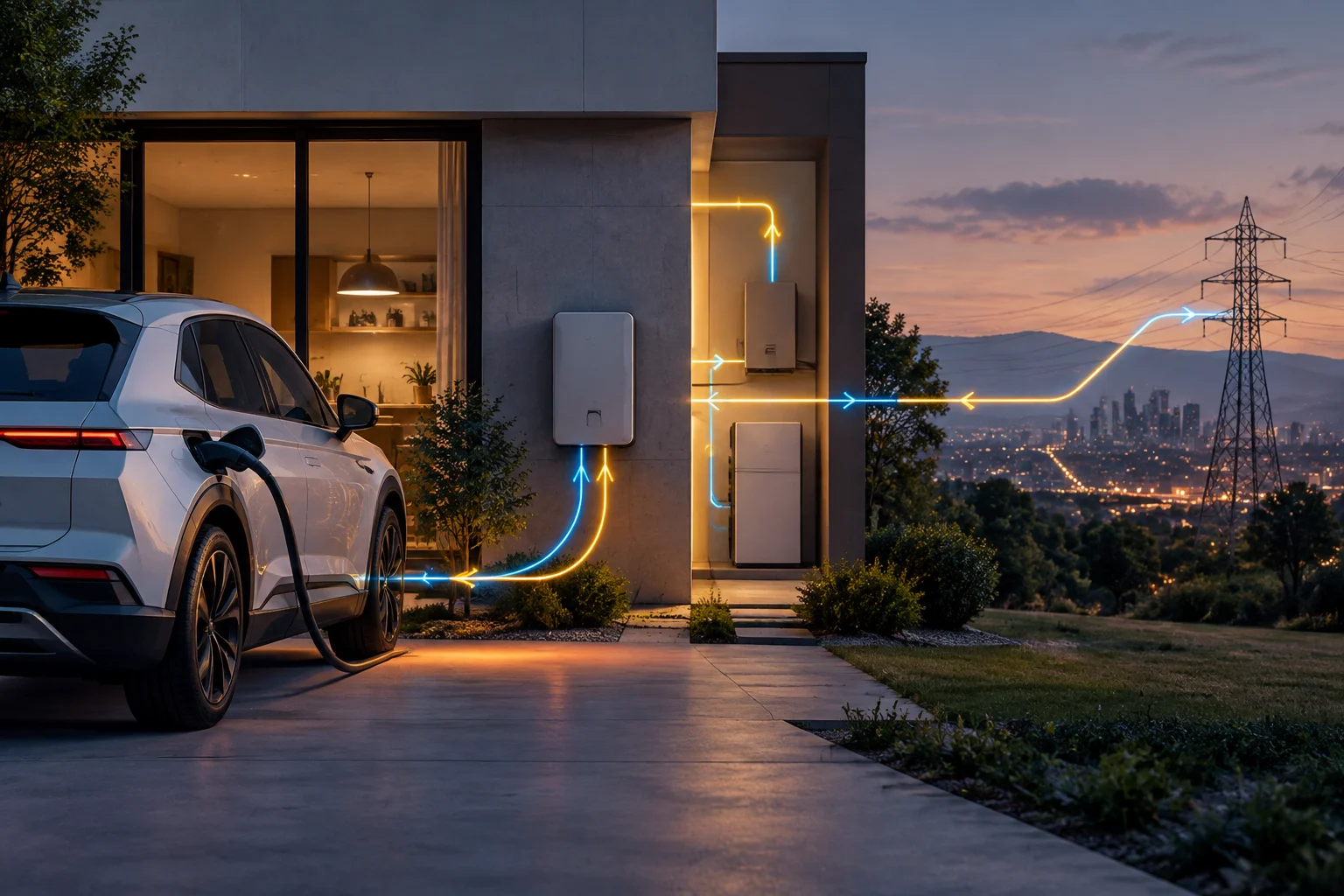
Bidirectional charging allows energy stored in an electric vehicle’s battery to flow out of it, as well as into it during charging. However, terms such as V2L, V2H and V2G describe different destinations or uses; they are not a universal promise that any car can power any installation. For anyone comparing vehicles or chargers, the distinction between an advertised capability and a usable system is decisive. The result may depend on additional equipment, configuration, market and grid-connection approval.
The acronyms help structure the discussion. Vehicle-to-load (V2L) usually means supplying power to a load, such as an appliance; vehicle-to-home (V2H) means supplying a home; and vehicle-to-grid (V2G) means exchanging electricity with the power grid. But those names alone do not establish the power available, how long it can be supplied, whether the system can operate while connected to the grid, or whether a specific installation is required. The relevant manufacturer and equipment documentation must clarify those conditions.
The same caution applies to the word “bidirectional”. It can refer to the technical capability of the vehicle, the charger or both, while actual operation may require coordinated communication, power conversion, protection and rules for exporting energy. Do not infer compatibility with a home or the grid from an acronym, a similar-looking connector or a smart-charging feature.
Three destinations, three different checks
For V2L, the practical question is what output the vehicle provides and which loads it can support according to its instructions. A car having a power outlet or adapter does not mean it can be connected to a home’s fixed wiring: these are different electrical situations. The documentation should specify the operating mode, limitations and approved accessories. It is not prudent to improvise a connection from an appliance outlet to a household circuit.
For V2H, the energy is intended for the home. That means checking how the system integrates with the electrical panel and what equipment is needed to separate, control or protect circuits under the approved design. The V2H name alone does not say whether the system backs up the whole home or only selected circuits, whether it can operate during an outage, or what installation requirements apply. These answers should be explicitly documented for the particular vehicle and charger combination.
V2G adds a different destination: the public grid. It is not simply a matter of powering a local load, because operation must be coordinated with the electricity system and its connection, metering and participation rules. The European Commission describes work on governance and standards for communication exchange between vehicles and charging infrastructure, with the aim of facilitating interoperability across the ecosystem (RegEx group). This framework points to a central issue: compatibility is not only physical; it is also operational and communication-based.
What standards contribute—and what they do not certify
ISO 15118-20:2022 is a standard for communication between an electric vehicle and a charging station. The IEC entry identifies this edition as a communication specification and includes bidirectional power transfer within its scope (IEC, ISO 15118-20:2022 entry). It is a relevant reference because it shows that two-way charging belongs within a standardised communication framework, rather than being merely a commercial feature with an appealing name.
But a communication standard is not the same as certification that a specific vehicle model, software version, charger and residential installation will work together. Nor does it prove that a service is available in a particular country or that an electricity company will accept exported power. The European Commission has tasked a subgroup with recommending minimum principles and a governance architecture for communication between vehicles and infrastructure; that work should not be mistaken for automatic approval of every product or installation.
The useful distinction for buyers is between interoperability envisaged by a standard and compatibility demonstrated for a specific combination. Look for explicit references to the standard’s version, compatible equipment and conditions of use in primary documentation. If a brochure only says “V2G-ready” or “smart charging”, ask which function is actually enabled, what hardware it requires and who is responsible for the installation.
A complete chain: car, charger, home and grid
Verification needs to cover the whole chain, not a single product specification. First, the vehicle manufacturer should confirm that the exact variant supports external discharge or bidirectional exchange and state the applicable conditions. Next, the charger manufacturer should confirm compatibility with that vehicle and clarify whether a particular model, accessory or configuration is required. Matching brands are not sufficient evidence, and neither is the fact that both devices use a common connector.
For a home installation, the installer should confirm which components and protective measures the design requires, which circuits can receive power and how the system behaves if the supply is lost. The V2H label does not tell you whether backup is available during a blackout: that possibility depends on the supported configuration and installed equipment. For V2G, also confirm local connection requirements and the service or agreement that permits electricity to be exchanged with the grid.
A useful checklist before buying or signing a contract is:
- Vehicle: model, year, version and market for which the function is declared; limits and required accessories.
- Charger: exact model, declared compatibility and enabled function (V2L, V2H or V2G).
- Installation: approved design, included circuits, protective measures and behaviour during outages.
- Grid and service: local requirements, authorisation where applicable, and actual availability of a programme or contract.
- Warranty and operation: manufacturer conditions on use, scheduling and the energy that must remain in the battery.
If an answer remains general, request written confirmation for the specific combination you intend to install.

Commercial availability cannot be inferred from trials
Pilot projects and technical guidance show that work is under way on integrating vehicles and electrical systems, but they do not certify that an offer is available to every driver. The EU Urban Mobility Observatory has described European trials and projects related to V2G and bidirectional charging. This is evidence of deployments or ongoing work, not a list of compatible home models or a guarantee that a commercial installation is available in every country.
Likewise, recommendations and guidance from European projects can help steer standardisation and data exchange. They do not replace manufacturer specifications, grid-operator requirements or assessment by a qualified installer. A result achieved in a trial may depend on particular vehicles, chargers, agreements and grid conditions; applying it to another market without checking those factors would be an unsupported inference.
It is also important to distinguish managed charging from bidirectional charging. Managed charging can adjust when or at what rate the vehicle charges without the battery returning energy. Bidirectional charging involves energy flowing out. An app that schedules charging, an off-peak tariff or demand control therefore does not prove that a car can export power. Before attributing savings or income to V2G, confirm that an enabled offer exists and understand its conditions; do not assume technical potential translates into financial benefit.
How to assess a promise before deciding
The most useful question for a seller or installer is not “Is it V2G-compatible?” but “Which vehicle model and version, charger and installation allow this function in my country, and what document confirms it?” Then ask whether the claim is about powering appliances, backing up household circuits or exporting energy to the grid. These are different outcomes, and a yes to one does not prove the others.
Check warranty, operating and availability conditions as well. The battery may be subject to minimum charge limits or usage rules, and the service may require software, a particular configuration or participation by a third party. If the intended use is home backup, ask about operation during outages; if it is export, ask which organisation authorises and manages the exchange. Commercial documentation should make both the scope and the limits clear.
The conclusion is more measured than some promotional claims, but more useful: standards and projects help build interoperability, and some configurations can enable bidirectional flows; real-world feasibility depends on a verifiable combination of equipment, installation and local conditions. Until the manufacturer, charger provider and installer confirm that combination, V2L, V2H and V2G should be read as categories of use, not as a guarantee of a service ready to purchase.