
It is not an expanded label or a register for every battery
The digital battery passport is a set of information associated with a specific battery and accessible electronically. Regulation (EU) 2023/1542 makes it part of a wider framework covering battery sustainability, safety, labelling and management. Its central purpose is to make information available throughout a product’s life, not to replace every instruction, marking obligation or document already required by law with a QR code. The EU Regulation sets the requirement for specified categories, not every cell or battery sold in Europe.
The distinction matters because “passport” may suggest a public database containing the complete history of a battery. The Regulation does not provide unrestricted access to every field: it combines publicly available information with data available only to people or organisations with a legitimate interest, and information reserved for relevant authorities or bodies. Having a passport therefore does not mean that every buyer can consult the most sensitive technical, commercial or manufacturing data.
In practice, it is best understood as a digital information layer linked to the product, with different permissions—not as an unrestricted public page containing every available detail. “Passport” describes the function of identifying and accompanying the battery; it does not mean that physical documentation disappears or that every person must see information in the same way. Labels, instructions and other applicable obligations remain separate matters within the regulatory framework. The QR code provides access to information, but does not automatically replace those requirements or settle how each item is presented to the end user. This distinction helps clarify both the system’s scope and the expectations its name may create.
Which batteries are covered by the passport timetable
The requirement does not apply indiscriminately to portable batteries, button cells, starter batteries or every component that stores energy. The Regulation identifies three groups covered by the passport: electric-vehicle batteries, light means of transport batteries, and industrial batteries with a capacity greater than 2 kWh. This category-based definition—and, for industrial batteries, the capacity threshold—is the first check before concluding that a particular product needs a passport.
In practical terms, light means of transport batteries include those intended for light vehicles such as electric bicycles and scooters. The legal category determines coverage, not the vehicle’s appearance, the pack’s size or the way it is marketed. In an uncertain case—for example, an industrial-use battery system installed in a machine—its use and regulatory classification need to be identified. The obligation should not be inferred solely from its size.
This approach avoids two opposite mistakes: extending the requirement to every large battery, or assuming that every product resembling an e-bike battery is covered without checking its classification. First identify the legal group; then check whether a specific threshold applies. The threshold of more than 2 kWh applies only to the industrial category described here. Visible size alone is not a substitute for that check, and the fact that a product stores energy does not establish that it belongs to one of the three covered categories. Where the relevant category is unclear, the answer depends on the applicable regulatory classification, not an informal comparison with similar products. This keeps a defined rule from becoming a general obligation for the entire battery market.
When the requirement starts and which reference to use
The common application date for the passport is 18 February 2027. This does not mean that every requirement in the Regulation begins that day, or that every battery manufactured before then automatically faces the same obligation. The date marks the start of the passport requirement for the covered categories; the position of a particular unit may depend on its placing on the market and the role of the relevant economic operator. Article 77 and Annex XIII of the Regulation are the primary references for scope and content. Text of the Regulation.
Three different points should not be confused: the Regulation entering into force, a particular obligation becoming applicable, and a uniform, readily accessible system already being available on the market. The legislation entered into force in 2023; each obligation has its own timetable under the relevant articles. For the passport, the date provided is 18 February 2027. The European Commission summarised the broad scope of the new framework when announcing its entry into force, but that announcement does not replace the specific provisions. The Commission notice provides context; the legal text supplies the detail.
The date therefore answers when the specific passport requirement applies—not when the entire Regulation first exists, nor when a single tool for finding any battery will necessarily be available. For a particular case, consulting the relevant article and annex is more reliable than extrapolating from a general news report about the legislation. That makes it possible to distinguish the application date, battery category and economic operator’s obligations rather than treating them as interchangeable.
How information is linked to the battery
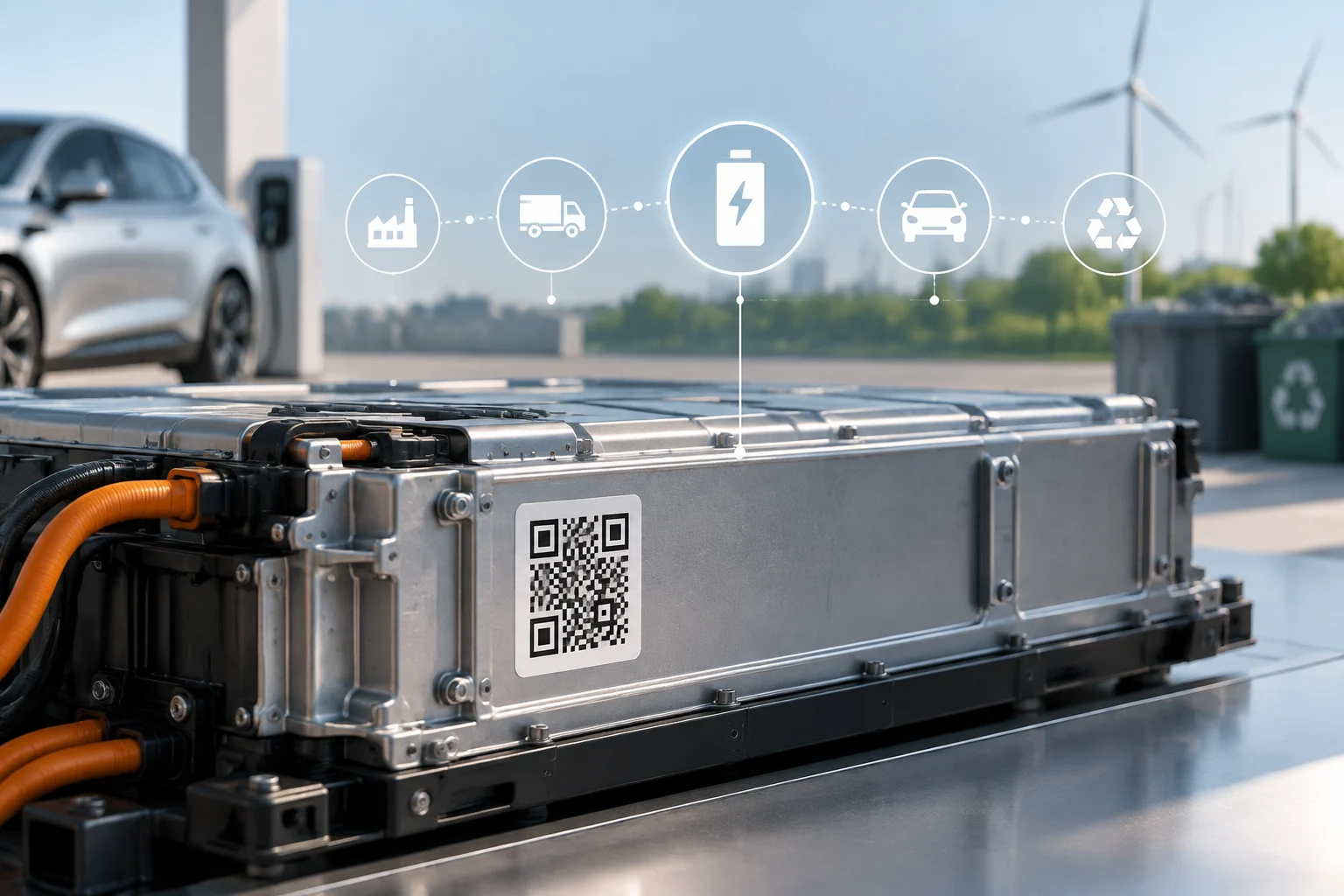
The passport will be linked to an individual battery through a unique identifier and accessed using a QR code. The code is a gateway to digital information, but it is not the passport itself and does not show that every field is publicly available. The structure must identify the correct unit and connect its data to the physical product through stages such as marketing, use and end-of-life treatment.
This individual link matters because the data should relate to the battery being consulted, not merely to a generic model or broad category. The identifier distinguishes the unit, while the QR code points to its associated digital resource. The usefulness of that connection depends on the identification and information being correctly linked; finding a code, without checking what it opens and which battery it refers to, is not enough to assess the passport’s contents.
The information provided for includes data identifying the battery and relevant economic operators, alongside technical, performance, durability and sustainability information specified in Annex XIII. Regulated topics include battery characteristics, composition and raw materials, carbon footprint, recycled content, and parameters relating to condition and service life. The list and access level depend on the field: it would be inaccurate to describe the whole set as a record that every user can download in full. Annex XIII is the reference for which data are covered; access rules determine which profile can consult each item. The presence of an information category does not mean that everyone may access it freely.
Updates and responsibility for data
The passport must be updated when appropriate during the battery’s life. The entity responsible for placing the battery on the EU market—or the operator to which the rules assign that responsibility—must ensure that required information is available and correctly linked. In certain situations, operators involved later may update information about state of health or expected lifetime, in accordance with their roles and access rights. This does not mean that every repair shop, owner or platform may change any data it chooses.
The possibility of updates reflects the fact that some information may relate to how a battery changes over time, rather than only to its original characteristics. However, the fact that a field can change does not itself determine who may change it or under what conditions. Intervention depends on the responsibilities and permissions established for the different operators. The passport should therefore not be regarded as a document editable by anyone who handles or owns the battery.
This division of roles also matters when interpreting the information: the economic operator assigned the duty is responsible for making data available, even if other entities can take part in specific updates. Responsibility is not automatically transferred to someone who scans the QR code, and access for a particular purpose does not grant general permission to alter the record. Identification, updating and consultation are related, but distinct, operations.
Who can consult each part
Access is differentiated according to purpose and type of information. The public can consult certain general battery data relevant to understanding its characteristics and environmental profile. Other fields may be available to people who demonstrate a legitimate interest, while authorities and competent bodies need access for the functions assigned to them by law. The practical principle is that the QR code facilitates access, but permissions and the rules for each data item determine what can be seen.
For buyers and users, the potential value lies in obtaining more structured information for comparing characteristics, understanding sustainability aspects or considering reuse options. But the passport should not be assumed to be a complete buying-decision tool, or to include an independent assessment of each battery’s quality. Information is supplied by the parties required to provide it and must be interpreted within the fields defined by the rules.
Accordingly, two people opening the same QR code will not necessarily have permission to see the same information. Public access, access based on legitimate interest and access for authorities serve different functions. This also prevents a missing field in a public view from being treated as proof that the data do not exist: they may simply fall outside that access level. The passport organises information under differentiated rules; it is not an identical screen for every user.
Uses for buyers, businesses and authorities
For repair, reuse and recycling businesses, information about composition, condition and characteristics can help determine how to handle, assess or repurpose a battery. For manufacturers and importers, the system means organising data and internal processes, ensuring identification and managing passport availability. For authorities, it provides information that may support monitoring and compliance checks. These uses differ: data useful to a recycler are not necessarily public, and an authority’s access does not mean every business has the same permission.
For buyers and users, structured information may make relevant characteristics and environmental aspects easier to understand. It can support comparison or bring together data that might otherwise be scattered, but the help it offers depends on which fields are accessible and how they are interpreted. The passport does not automatically turn those data into a buying recommendation: it is not presented as an independent evaluation of each product or a single verdict on which battery is best.
For economic operators, the issue is also organisational. Identifying the information associated with a battery, keeping it linked to the unit and ensuring its availability require data-management processes. Authorities’ access relates to the duties assigned to them by the rules. The usefulness of each field therefore depends both on its content and on who can access it and for what purpose; folding all these uses into a general idea of “transparency” would obscure those differences.