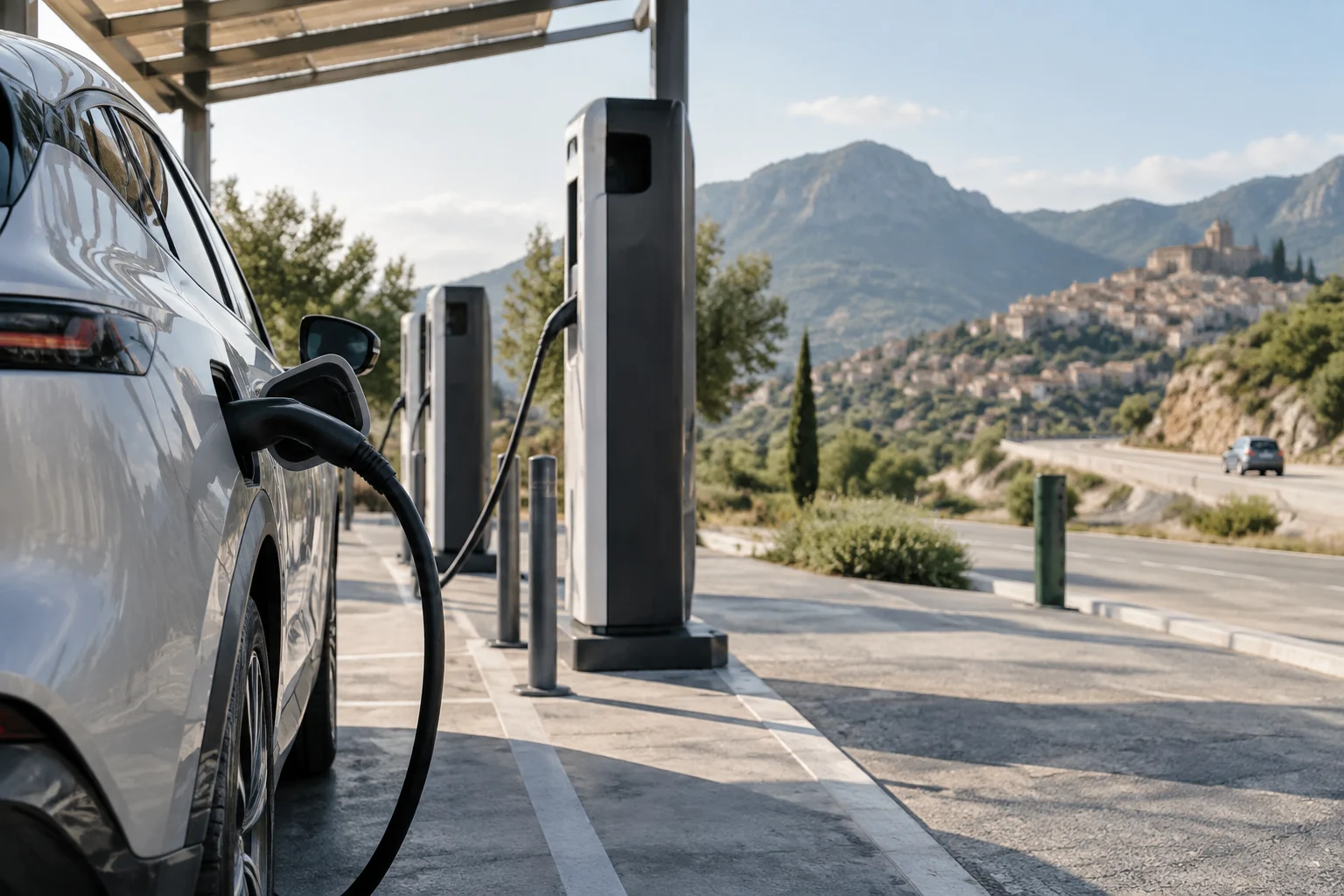
A location alone is not enough to choose a charger
When planning a public charging stop, it helps to separate four questions: Where is the point? Can I access it? How much does it cost and how do I pay? Is it available now? These are different pieces of information, and one does not answer the others. A point may be correctly shown on a map and still be inside a car park with restricted opening hours, require a particular app, or be out of service at that moment.
The location and connector type can help narrow down the options, but they do not confirm that a charger is free or working. Nor can you use its nominal power alone to calculate how long a session will take: effective charging power depends, among other things, on the vehicle, the station and charging conditions. When deciding on a route, therefore, look for the most recent operational information available. Do not treat a map marker as a promise that the charger will provide a service when you arrive.
What European rules require—and what they cannot guarantee
Regulation (EU) 2023/1804 on alternative fuels infrastructure, known as AFIR, sets requirements for public charging. These include the possibility of charging without a prior subscription through an ad hoc payment at points covered by that obligation. The Regulation also sets requirements for price transparency: users must be able to find out the cost before starting a session. It provides for information on the price of energy and, where applicable, other cost components. Check the applicable wording and conditions directly in the consolidated Regulation on EUR-Lex.
Transparency does not mean one single price or an identical tariff across every channel. The rules establish obligations for operators within their scope, but they do not make every app display tariffs in the same way, nor do they prove that information shown by a third party is up to date. The European Commission also publishes a questions-and-answers page on how the Regulation is applied. It is useful as guidance, but for a specific doubt the legal text is the primary reference: Commission questions and answers.
Ad hoc access and specific conditions
The existence of a one-off payment option does not mean that every site works in the same way or that the process is identical. The payment method, the identification required and physical access to the car park may vary. Before making a detour, check the operator’s information to see whether the point is open to the public and which payment methods it accepts. If the cost consists of more than one item, review the breakdown shown before confirming the charge. Do not assume that a figure per unit of energy includes every possible charge.
How to cross-check apps, operators and public sources
Start with the operator’s listing, if one is available. It is the most direct source for checking tariffs, access requirements and any maintenance notices. Compare it with the map or navigation app you are using: differences in the name, connector or address may mean that the listings refer to different points. Before setting off, also check whether the site itself—for example, a car park—has its own opening hours or restrictions.
The European Alternative Fuels Observatory (EAFO) provides maps, infrastructure data and a section on charging prices for the European context. It can help you explore and compare published information, but the existence of a public tool does not make every listing a real-time check. Nor does an Observatory listing replace confirmation from the operator about the charger’s current status. Use the EAFO portal as a source for cross-checking, not as a guarantee that a point will be working when you arrive.
A practical checking order
- Location and connector: Make sure the point is at the specific place on your route and has a connection supported by your vehicle.
- Access: Check the exact address, opening hours, entry conditions and activation method.
- Price: Look for the tariff that applies to your payment method and the price breakdown shown before the session.
- Status: If the operator shows availability, look for the update time or a recent notice. If that information is missing, treat the status as unconfirmed.
- Alternative: Identify another reasonably nearby charger before relying on one point, especially if you have no recent information about whether it is working.
The advertised price and the cost of a charging session are not the same thing
A useful comparison is not simply «which figure is lower?» but what is being charged, per which unit, and under what conditions? A tariff may be expressed per unit of energy supplied and may include other items, depending on the operator and the session. Check whether the offer depends on a subscription, a contract, an app or a particular payment method. A price shown on a map may not apply to your circumstances if those conditions do not match.
Before you start charging, check the information shown by the operator for that point and payment option. If there is a confirmation screen or a price displayed on the charger itself, compare it with the tariff you checked earlier. If the figures differ, do not assume that the third-party app takes precedence: check the operator’s terms before starting. This check cannot always predict the total cost exactly, because the energy you will need depends on the vehicle and the journey. It can, however, help you avoid comparing tariffs that use different bases.
EAFO’s public price tools can put the available offer into context, but they should not be mistaken for a personal contractual tariff or a guaranteed quote for a particular session. To compare two alternatives, note the applicable price, the unit, any additional charges and the access conditions. If any of those elements is missing, the comparison is incomplete; it is better not to fill the gaps with assumptions.
Availability: the most time-sensitive information
Availability is often the hardest information to rely on in advance. An app may say that a charger is free, occupied or out of service, but how useful that indication is depends on the source, communication with the equipment and the time of the last update. If a listing does not state when it was updated or where the status came from, there is not enough basis to treat it as current confirmation. That does not prove that the information is wrong; it sets out what a user can verify from the screen.
It is worth distinguishing three situations: the point exists, the site can be accessed, and the equipment is working and available when you arrive. Confirming the first does not confirm the other two. To reduce uncertainty, check the status again close to arrival and keep an alternative in mind. If your journey leaves little margin, it is more prudent to choose an option with recent information and a nearby backup than to depend on one point whose status is not clearly reported.
Maps, registers and apps are planning tools, not a physical inspection or a service guarantee. This limitation matters: public sources may bring together useful infrastructure and price information, but they do not allow you to infer that every individual charger will be free, accessible and working at the moment you arrive. That is why this analysis separates what the rules require from what a particular app may show in real time.
Final checklist before setting off
Before relying on a point, check each of the following: exact address, access and opening hours; compatible connector; price and payment method; reported status and how recent it is; and a nearby alternative. If the price depends on a particular payment option, make sure that it is the one you plan to use. If the operator provides no recent availability information, plan on the basis that the status is uncertain, not confirmed.
A quick cross-check can also prevent mistaken identity: compare the site name, address and connector in the map and the operator’s listing. If anything does not match, look up the location directly or contact the operator before travelling there. Do not assume that two results with similar names are the same station. In areas with several chargers, that mistake can lead you to check the price or status of the wrong point.
The practical conclusion is straightforward: the rules improve transparency and public tools help with locating and comparing, but neither by itself proves that a particular piece of equipment is available at that moment. To plan with fewer surprises, combine the operator’s information with an independent resource, verify the conditions that apply to your situation and keep an alternative plan.