A product page is not a launch announcement
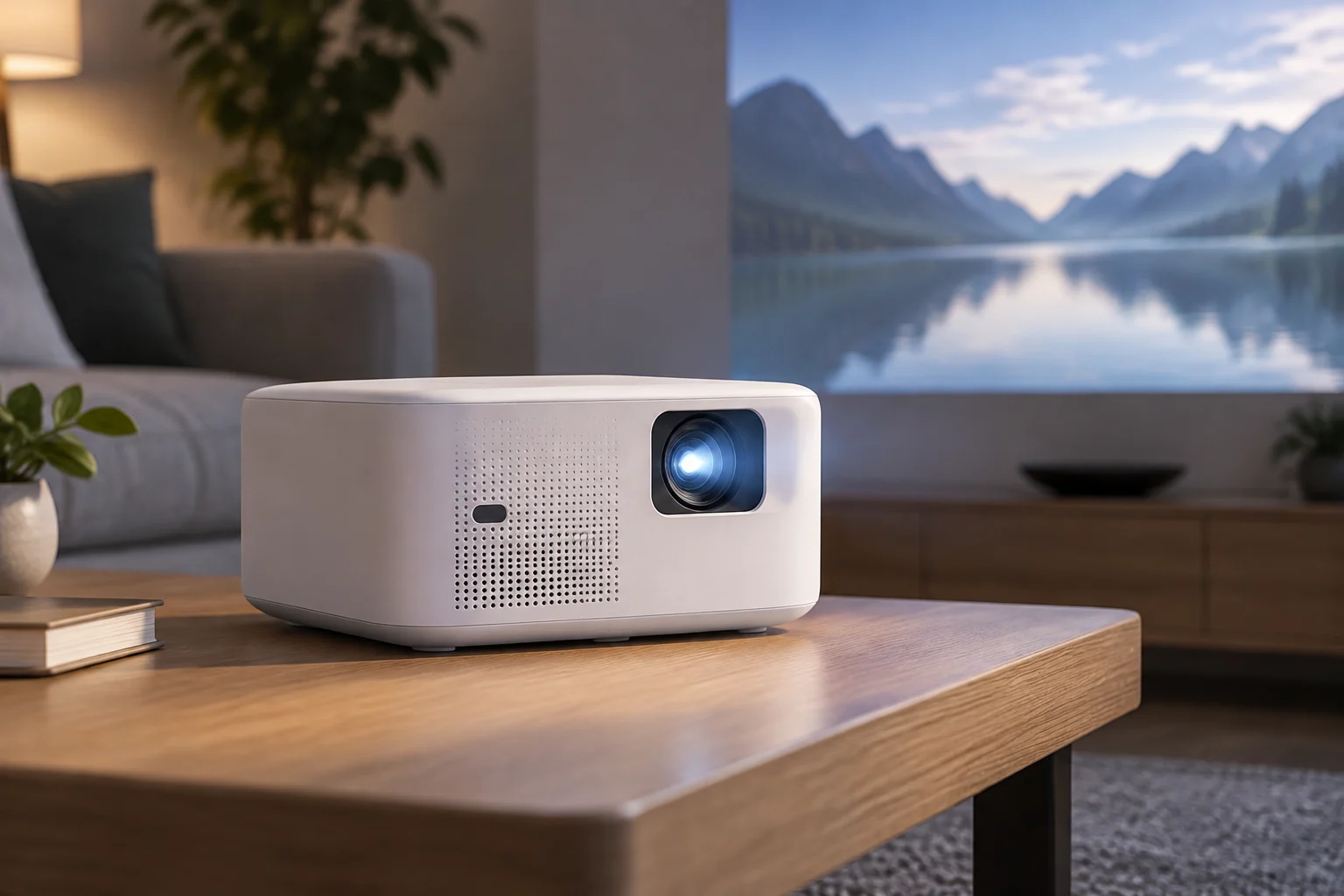
Epson’s Spanish website identifies the product as the Lifestudio Pop EF-61W and describes it as a portable projector with Full HD 1080p resolution, 700 lumens, Google TV and Sound by Bose audio. This information is useful for identifying the product and forming a basis for comparison, but a commercial product page is not, by itself, a dated announcement. The page consulted does not provide a presentation date that would establish when the model was introduced to the market. It shows how the manufacturer positions the product, but cannot, on its own, reconstruct the timeline of its arrival.
The editorial question, then, is not only what the EF-61W offers, but whether there is enough evidence to call it a current new release. The documentation reviewed verifies features stated by Epson; on its own, it does not place the launch on a calendar. That distinction matters to anyone looking for recent news: a product appearing on an official website or in a retailer’s catalogue does not prove it was announced this week, this month or even this year. Such a claim needs dated information specifically tied to the model, not merely a page that remains available.
What Epson says about the EF-61W
Epson Spain presents the EF-61W as a portable home-cinema device and highlights Full HD 1080p resolution, 700 lumens, Google TV, audio associated with Bose and an image of up to 150 inches. These are specifications from the manufacturer’s product page, not the results of an independent test. They should be read as specifications and descriptions published by Epson, not as a guarantee that every room, surface or type of content will deliver the same experience. This distinction helps separate what the manufacturer claims from what could only be established through hands-on evaluation.
The 150-inch figure describes the image size stated on the page, but should not be treated in isolation as a usage recommendation. The viewing experience depends, among other things, on projection distance, ambient light and the surface; the information available here does not document measurements taken under controlled conditions. In other words, the figure expresses an advertised capability, not a promise about the quality users will get in every space.
Likewise, “portable” is the product’s positioning on the page, not a comparative assessment of its weight, battery life or ease of transport. Those aspects require checking the full specifications or carrying out independent tests. The label describes the approach Epson takes to the device; by itself, it supplies no parameters for comparing it with other portable projectors.
Google TV, resolution and brightness: how to read the figures
Google TV appears in Epson’s own product description. For buyers, this indicates that the manufacturer promotes built-in smart-TV features. It does not, by itself, establish which apps are available in each country, which formats individual services support or how the interface performs. Those answers may depend on software, region and provider terms, and the platform name on the product page does not verify them. Anyone who requires a particular app or format should therefore check the relevant documentation before assuming it is supported.
It is also important to keep Full HD and 700 lumens in context. Full HD 1080p identifies the stated resolution; the lumen figure is the brightness specification published by Epson. Neither figure, on its own, shows how a film will look in a particular room or allows a rigorous comparison with devices measured using different methods or conditions. They are useful reference points for beginning to assess the product, but they do not fully describe the visual result.
The product page can help narrow down options and frame questions; it cannot replace a like-for-like comparison or an independent test. When comparing devices, it is worth checking whether the available figures were obtained using equivalent criteria. The material consulted does not document such conditions, so the most precise approach is to treat these numbers as specifications published by Epson.
What the external documentation adds—and what it does not
Retailer LDLC identifies a white unit as the Epson EF-61W and lists the identifiers V11HB72040 and GTIN 8715946741529. This information helps distinguish the exact model when comparing listings or looking for accessories. Codes are particularly useful for checking whether different retail references point to the same unit, rather than relying only on an abbreviated name. A retailer’s product page, however, should not be confused with a manufacturer announcement or used to date the launch. A catalogue entry shows that the retailer lists the unit; it does not show when Epson announced it.
Coverage published by Trusted Reviews in September 2025 discusses Epson’s Lifestudio projectors, Google TV and Bose sound. This provides independent context about the product family, but the material consulted does not support using that article as the specific launch date of the EF-61W. The date of an article about a family should not automatically be applied to each model included in or associated with that family unless the source establishes that connection.
Nor is a product’s appearance in retailer listings enough to establish that it is new: commercial availability and a recent announcement are different facts. A listing indicates that a retailer offers a reference for sale, whereas a launch story needs evidence of when the model was announced. Supporting that story would require a dated communication that unambiguously identifies this model, or a reliable source that does so.
Conclusion: specifications confirmed, new-release status unverified
Given the available sources, the prudent conclusion is limited. Epson publishes a product page for the Lifestudio Pop EF-61W listing Full HD 1080p, 700 lumens, Google TV, Sound by Bose audio and an advertised image size of up to 150 inches. Retail listings also identify the device as the EF-61W. The material consulted contains no official presentation date for the model that would allow us to describe it confidently as a current launch. This does not prove that an announcement never took place; it means the evidence reviewed does not establish one. The conclusion concerns the scope of the sources examined, not a claim that the product has no presentation date.
For prospective buyers, the official product page is a starting point for confirming the model and its stated features. It is then worth checking the product code on the specific unit, its connections and operating conditions in the full documentation, and consulting independent tests before drawing conclusions about picture or sound. This keeps three separate questions distinct: what Epson specifies, which unit the retailer is offering, and what performance has been verified in a test.
For a news article, by contrast, the responsible approach is not to turn a current product page or a retail offer into a launch story. The EF-61W can be described as a model documented on Epson’s website; its status as a recent new release remains unverified. That wording preserves what the sources do support without presenting an unconfirmed premiere date as fact.