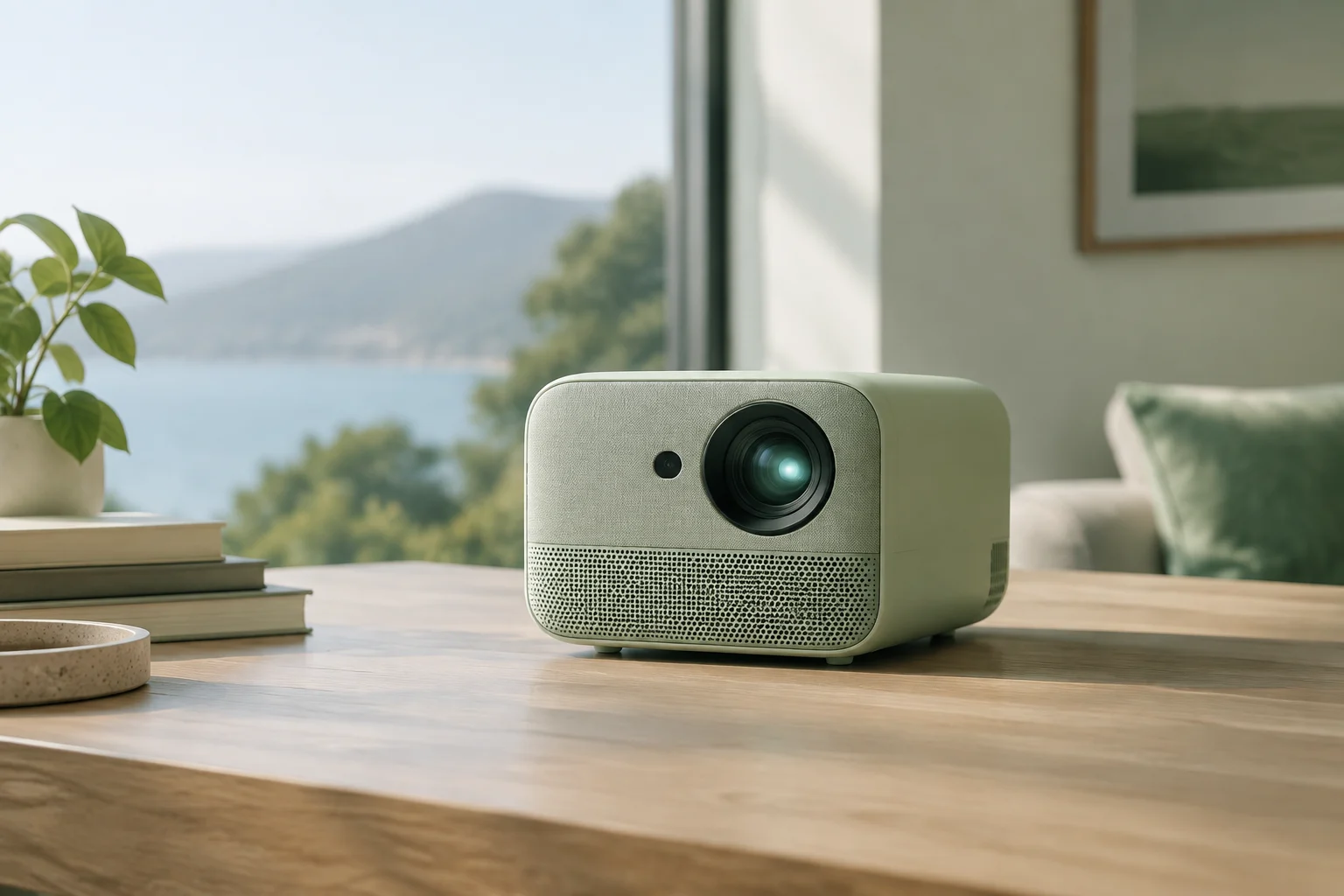
What Epson’s product page confirms
Epson’s Spanish website lists the Lifestudio Pop EF-61G in its catalogue and describes it as a portable Full HD 1080p projector with Google TV, Sound by Bose audio and an image size of up to 150 inches. It also states a brightness of 700 lumens. These details identify the product and summarise what its manufacturer says about it; they do not, by themselves, prove that it was recently introduced or provide an independent measurement of how it performs.
There is an important editorial distinction between a product page and a launch announcement. The former documents that the brand presents a model with particular features. To say that the company has just announced it, we would need a dated reference—such as a press release or official post—that places the announcement in time. The available product page does not provide that evidence of timing in the information consulted.
The product page therefore establishes which model Epson describes and which specifications the company attributes to it. On its own, it cannot reconstruct the product’s history: its current presence in a catalogue does not tell us when it was added or when its features were first communicated. Keeping these questions separate prevents a current commercial description from becoming a chronological claim that the source does not support.
Announced specifications, not independently tested performance
The Full HD 1080p resolution, 700-lumen figure and maximum screen size of 150 inches are specifications that Epson attributes to the EF-61G. The same applies to Google TV and Sound by Bose, which describe the software integration and announced audio collaboration. In this article, we treat these as details published by the manufacturer, not as test results. We have not measured brightness, image quality, audio reproduction or ease of setup.
This distinction matters particularly for brightness: a figure on its own does not explain the conditions under which it is obtained, nor does it allow a direct comparison between two projectors if their specification or measurement methods differ. The stated screen size is not a universal recommendation either: the visible result will depend, among other factors, on projection distance, the surface and ambient light. Without a methodology or an independent test, those figures cannot be translated into a conclusion about real-world performance.
Accordingly, the features can be cited with clear attribution—for example, Epson states 700 lumens—but should not be presented as observed performance. The same precision matters for software functions and audio: the names used on the product page tell readers what the brand says, but do not replace a practical check of how those features behave in everyday use.
What is missing to establish that this is a new launch
To confirm a recent launch, we would need to find a dated primary source that explicitly links the EF-61G to an announcement: an Epson press release, an official launch notice or launch documentation bearing a date. The current product page is a first-party source about the product, but it does not establish a timeline. A manual may help explain operation and warnings, although it too would not, by itself, prove when the model was announced.
Availability is a separate question. A product appearing in the catalogue does not confirm when sales began in Spain, whether units are available now or what the current price is. Reporting those details would require checking an offer identified by variant and market, with a seller and observation date, or consulting an official sales announcement. Without that kind of evidence, we would avoid presenting an arrival date or price as confirmed.
The announcement date and the date sales begin should not be treated as equivalent either: a source confirming a presentation would not automatically establish when commercial sales started in Spain. Similarly, finding a shop listing would describe that offer at the time it was checked, but would not show when the model was announced. Each claim requires a reference suited to what it is intended to confirm.
How to check the specifications
A useful technical verification would require more than repeating the product page. We would need complete documentation from Epson to clarify the meaning and conditions of the stated specifications; to assess performance, we would also need independent tests explaining their methodology, the equipment used and the viewing conditions. It is also worth checking the connections on the specific model and which Google TV functions are available in the country, rather than inferring them solely from the product name.
As a reading guide, verification should distinguish three layers:
- Identity: confirm that each document refers to the EF-61G and not another finish or variant in the family.
- Specifications: distinguish manufacturer specifications from third-party measurements and review the conditions of each test.
- Launch and sales: look for an announcement date and, separately, dated evidence of availability in the Spanish market.
Epson’s European product page identifies the same model name and repeats the main specifications. This match helps confirm that the description is not unique to the Spanish page, but it remains manufacturer information, not independent corroboration.
This order helps clarify what each source contributes without attributing more to it than it can establish. Manufacturer documentation can specify the features and the model to which they apply; an external test can report performance observations under stated conditions; and a dated publication can help establish the chronology. If a source serves only one of these purposes, the other questions remain open.
Conclusion: listed in the catalogue, but a recent launch is unverified
The sources gathered allow us to say that Epson maintains a product page for the Lifestudio Pop EF-61G and presents it with Full HD 1080p resolution, 700 lumens, Google TV, Sound by Bose audio and a screen size of up to 150 inches. The page does not establish when the model was announced, when sales began in Spain or whether it achieves those specifications in real-world use. These are separate questions and require different evidence.
The EF-61G can therefore be described accurately as a product included in Epson’s official catalogue, but not as a newly announced release. This conclusion does not mean the model is old: it means that the launch date is not verified by the sources available for this research. The priority sources for updating the information would be a dated Epson announcement, more detailed official technical documentation and independent reviews that publish their methodology.
The most rigorous wording preserves both sides of the assessment: Epson has published the specifications, while the chronology and independently verified performance remain unresolved by the evidence consulted. If new sources emerge, those questions can be updated separately without changing what the official product page currently confirms.