There is not enough evidence to announce a recent change
The initial question is whether a recent update to live-streaming standards has taken place that verifiably changes latency or compatibility. The documentation collected does not support that headline: it includes explanatory material and technical pages about Low-Latency HLS and Low-Latency DASH, but it does not confirm a recent announcement establishing a specific change whose effects have already been observed in consumer services. The responsible approach is therefore to treat this as a technical explanation, not as news of a newly approved modification.
A document’s status matters. An IETF Internet-Draft is not equivalent to a published standard and does not imply general adoption; the IETF Datatracker page about overlay network impacts, for example, identifies it as an active draft. Nor is it enough to find a current page from an organization to infer that its content has just changed. Update date, formal status, scope, and evidence of implementation are separate checks. The conclusion of this article is limited: the cited sources do not substantiate the kind of novelty required to present this as an announcement.
What it means to reduce latency
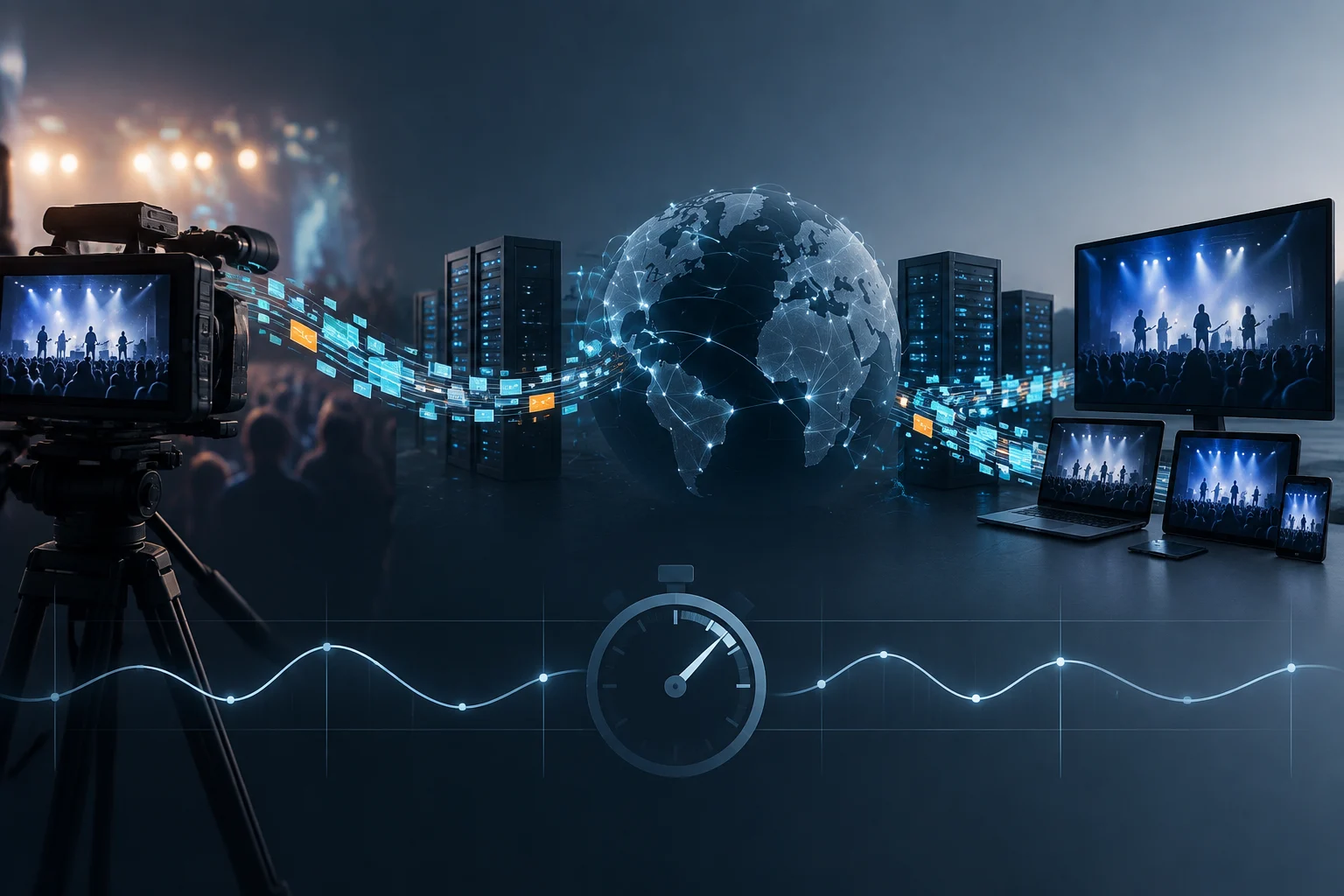
In a live broadcast, latency is the time between an event and its playback on the viewer’s device. It does not depend on one setting alone. Capture and encoding, video segment preparation, delivery over the network, the player’s buffer, and clock synchronization all play a part. Reducing one stage does not eliminate the others: if the player accumulates more content than needed to recover from interruptions, delay can increase even when segment delivery is fast.
Low-latency HTTP technologies aim to shorten the cycle between content production and its availability to the client. For DASH, the dash.js guide describes low-latency modes and the importance of player configuration; DASH-IF, in turn, documents mechanisms such as CMAF chunks and HTTP chunked transfer. These elements help explain how parts of the content can be delivered earlier, but they do not by themselves constitute a promise of fixed latency. An implementation has to coordinate the origin, packager, distribution network, and player.
HLS: a mode that requires end-to-end support
Low-Latency HLS is a mode of HTTP Live Streaming designed to shorten live-playback delay. Apple maintains documentation for enabling it and an authoring specification for Apple devices. That documentation helps explain what a provider must do to publish a compatible stream within that ecosystem; it does not prove that every channel, app, or device uses the mode, or that a recent update has changed the experience for all its users.
The practical distinction is between declared compatibility and effective operation. For the improvement to reach viewers, content must be prepared with the appropriate signaling and units, the infrastructure must deliver it in time, and the player must interpret it. If one of those pieces is not configured, the service may use a different playback strategy or maintain a larger buffer. Technical documentation explains capabilities and requirements, but it does not replace a measurement of the specific service under real audience conditions.
Consequently, reading “low-latency compatible” as synonymous with “will play with little delay” would be an extrapolation. The experience can also vary with congestion, device, wireless connection, and operator decisions. Apple’s guides are evidence about its technology and requirements, not an independent assessment of the services that implement it.
DASH: useful mechanisms, results that depend on configuration
In the DASH environment, DASH-IF documentation describes the use of CMAF chunks, HTTP chunked transfer, and consistent manifest signaling, together with recommendations for clients. The dash.js guide addresses low-latency playback from the perspective of a specific player. Taken together, these sources make it possible to explain that progressive delivery of parts of a segment can reduce waiting compared with a stream that becomes available only when the full segment is ready.
But an implementation guide is not the same as a universal comparative test. Final latency depends on parameters such as chunk size, encoding rate, target buffer, and network capacity. If the buffering margin is reduced too much, a change in connection conditions can cause pauses or loss of continuity. Therefore, latency and stability are objectives that must be balanced, not figures that the name of a technical mode guarantees on its own.
The included academic evidence provides context, with limits: a study published in 2022 compared LL-HLS and LL-DASH systems on emulated mobile networks using LTE traces, and observed metrics such as latency, buffering, and quality changes. It is useful as an example of controlled evaluation, but its results should not be generalized to every network, platform, or current version. Nor does the study demonstrate that a recent standards change has occurred.

What a verifiable news report would need to show
To turn an update into a solid news story, sources would have to substantiate both the change and its scope. At a minimum, it is worth checking the following points before publishing or interpreting an announcement:
- Document and status: identify whether it is an approved standard, a published specification, an implementation recommendation, or a draft under discussion.
- Technical change: locate the requirement, signaling, or mechanism being modified, and compare it with the previous version.
- Compatibility: specify which broadcasters, players, devices, and networks need to be updated; do not assume the change takes effect automatically.
- Measured effect: look for reproducible tests on described services or in described environments, distinguishing experimental results from stated targets.
- Date and adoption: distinguish the publication date from the date when a platform or provider deploys support.
The documentation examined provides material for explaining existing mechanisms, but on its own does not assemble all the evidence needed for a recent development. A technical announcement can confirm an intention or capability; release notes can show that a component has incorporated it; and an independent evaluation can study the result. These are complementary pieces. They should not be conflated into a single claim about what all users are already experiencing.
What viewers can check
From the viewer’s side, it is usually not possible to identify the standard from the player’s appearance alone. A setting or the label “live” does not indicate how many seconds of delay there are. If a service publishes technical details, viewers can check whether it specifies Low-Latency HLS or DASH, which apps and devices are compatible, and whether it explains how latency is measured. If it provides no such details, it is prudent not to infer the protocol or result from visual quality.
To compare experiences usefully, one would need to choose the same event and moment, record the event’s time reference and the playback time, repeat under comparable conditions, and note pauses and quality changes. A difference observed in a single session could be due to the network, device, or configuration, not necessarily a standard. This article has not tested services or made its own measurements: it explains what the cited sources allow us to claim and where that evidence ends.
Conclusion: HLS and DASH have mechanisms and documentation aimed at low latency, but improvement depends on an implementation chain and variable conditions. The available sources do not verify a recent announcement that would justify proclaiming a general new reduction in delay. For a future news report, the decisive step will be to locate the updated primary document, establish its status, and compare its effects with implementation data.