A Packaging Component, Not a Glass Chip
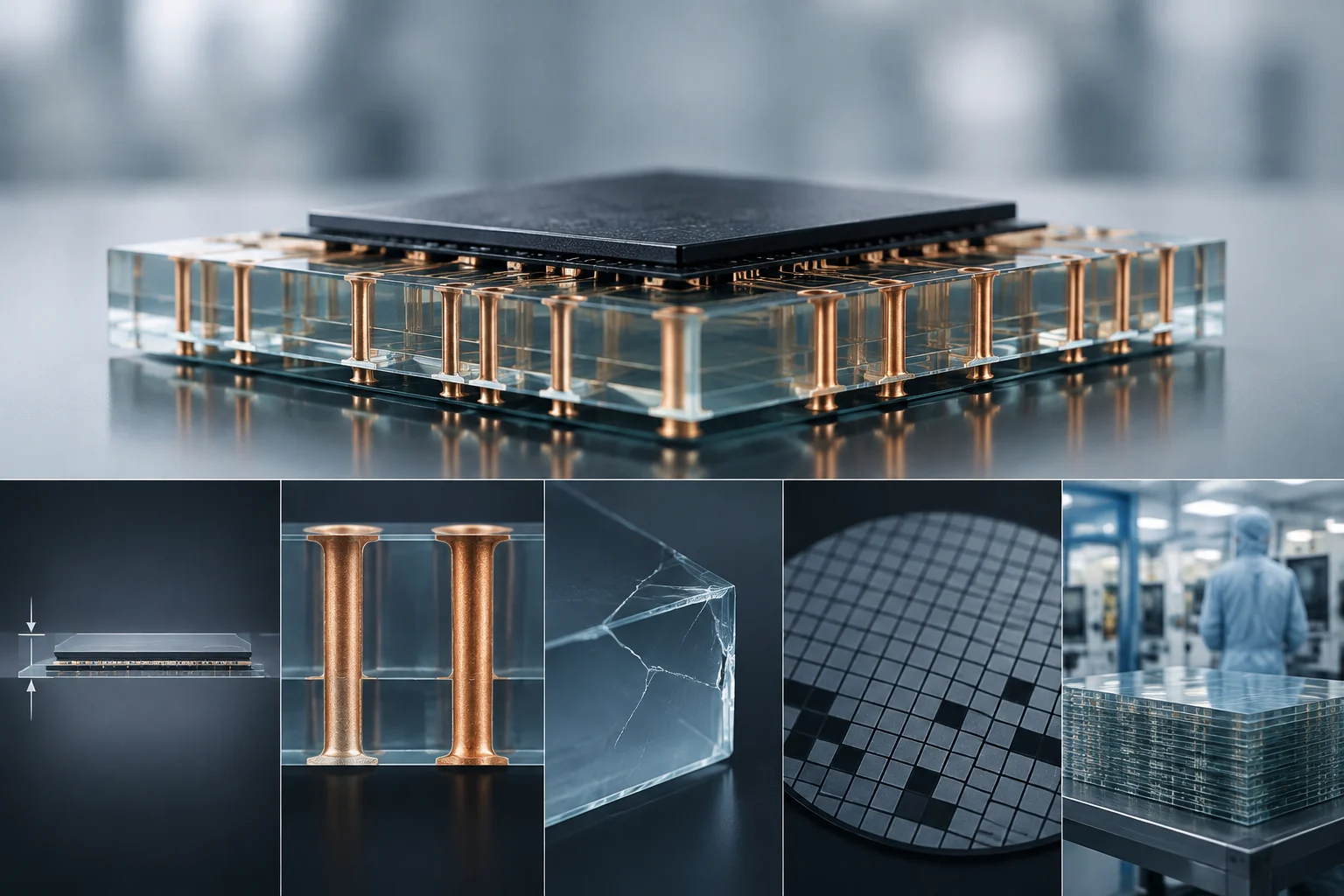
A semiconductor glass substrate is a platform that forms part of a package: it helps support and connect one or more chips to the interconnects and other components in the assembly. It does not replace the silicon in the transistors. The proposal is to change the material used in part of the structure that distributes electrical signals and holds components together. In designs with multiple chiplets, accelerators or high-bandwidth memory, the platform must enable dense connections while also withstanding manufacturing steps and operating conditions. Intel and Lens Technology announced a collaboration to explore glass-based advanced packaging opportunities; the announcement describes an initiative, not a commercially available product. (Intel)
The usual comparison is with the organic cores used in packaging substrates. It is also important to distinguish a glass substrate from a glass interposer: both may use vias that pass through the material, but they do not necessarily occupy the same position or serve the same function in every architecture. Saying that “glass replaces the substrate” can be imprecise unless it is clear which component is being replaced. The useful questions are which part of the package uses glass, what problem it is intended to solve, and whether the balance of performance, reliability and cost improves over a specific alternative. The application and design matter as much as the material.
Potential Benefits and How to Verify Them
Glass is being considered for packaging substrates because of characteristics such as flatness and thermal and mechanical stability, which could support larger packages or denser interconnects. Nippon Electric Glass describes these properties and presents its own glass-core materials as an option for addressing packaging scale-up. These are potential benefits described by a supplier, not independent results demonstrating that every glass product will be faster, more efficient or less expensive. Overall performance depends on other elements: metal and polymer layers, interconnect routing, assembly, integration with the chips and thermal management. (Nippon Electric Glass)
Assessing the benefits requires comparisons under equivalent conditions and with defined metrics. These could include flatness before and after processing, deformation at different temperatures, interconnect density and continuity, electrical performance, mechanical strength, and the share of units that pass manufacturing tests. Repeatability between batches, compatibility with existing processes and cost per accepted unit also matter. Saying a package can be larger or more stable does not indicate how much it changes or whether the difference matters in a particular application. Without a reference point, a measurement method and reproducible results, a favorable material property is a technical possibility, not a demonstrated industrial advantage.
Through-Glass Vias: Integration, Not Just Drilling
Through-glass vias, or TGVs, enable electrical connections between the two faces of a substrate. Making the hole is only one part of the process: its walls must be prepared and a conductive path created through metallization or filling, depending on the design. The uniformity of these operations affects electrical continuity and mechanical behavior. A via working in a sample therefore does not automatically show that the same process can be repeated consistently across large panels and many units. An ECTC 2026 paper addresses TGV and substrate-recess technologies for integrating devices and co-packaged optics. Its subject places vias within packaging integration, but is not itself a measure of industrial performance. (ECTC 2026)
Manufacturing and reliability risks must be assessed for a specific process and design. The presence of a conductive via in a sample, by itself, does not establish a defect rate, service life or performance in volume production. A via conducting in an initial test is only a first criterion. It is also necessary to determine whether it retains its integrity through processing and passes tests relevant to its intended use. The cited technical source discusses TGV applications, but does not support claims of a universal failure rate or quantify long-term reliability.
Fractures, Warpage and Manufacturing Yield
Glass stiffness and dimensional stability may be useful, but they do not eliminate the risk of fracture. Drilling, cutting, handling and subsequent operations can damage the material; added metal and polymer layers can also create stress at interfaces. Warpage depends on glass composition and thickness, package dimensions, incorporated layers, processing and interconnect design. It is therefore inaccurate to present glass as a solution that guarantees deformation-free packages. What needs to be assessed is how the complete structure responds, not just an isolated sheet of glass. iNEMI maintains a project dedicated to predicting and characterizing package warpage. Its existence shows that this is a studied engineering problem, but does not in itself provide a measurement specific to glass substrates. (iNEMI)
Moving from a prototype to repeatable production takes more than showing that one part can be made. Data are needed on manufacturing yield, consistency between batches, cycle times, costs, available capacity and reliability over the period of use. A sample may establish that a particular design was produced, but it does not by itself reveal how many conforming units are obtained or what they cost to make. Nor does it demonstrate that the package maintains performance after the relevant tests. On a manufacturing line, infrequent defects can affect the number of acceptable units and the effective cost of each one. These are criteria for assessing maturity, not proof that glass will fail or that its challenges cannot be overcome.
Announcements and Samples: Distinguishing Milestones
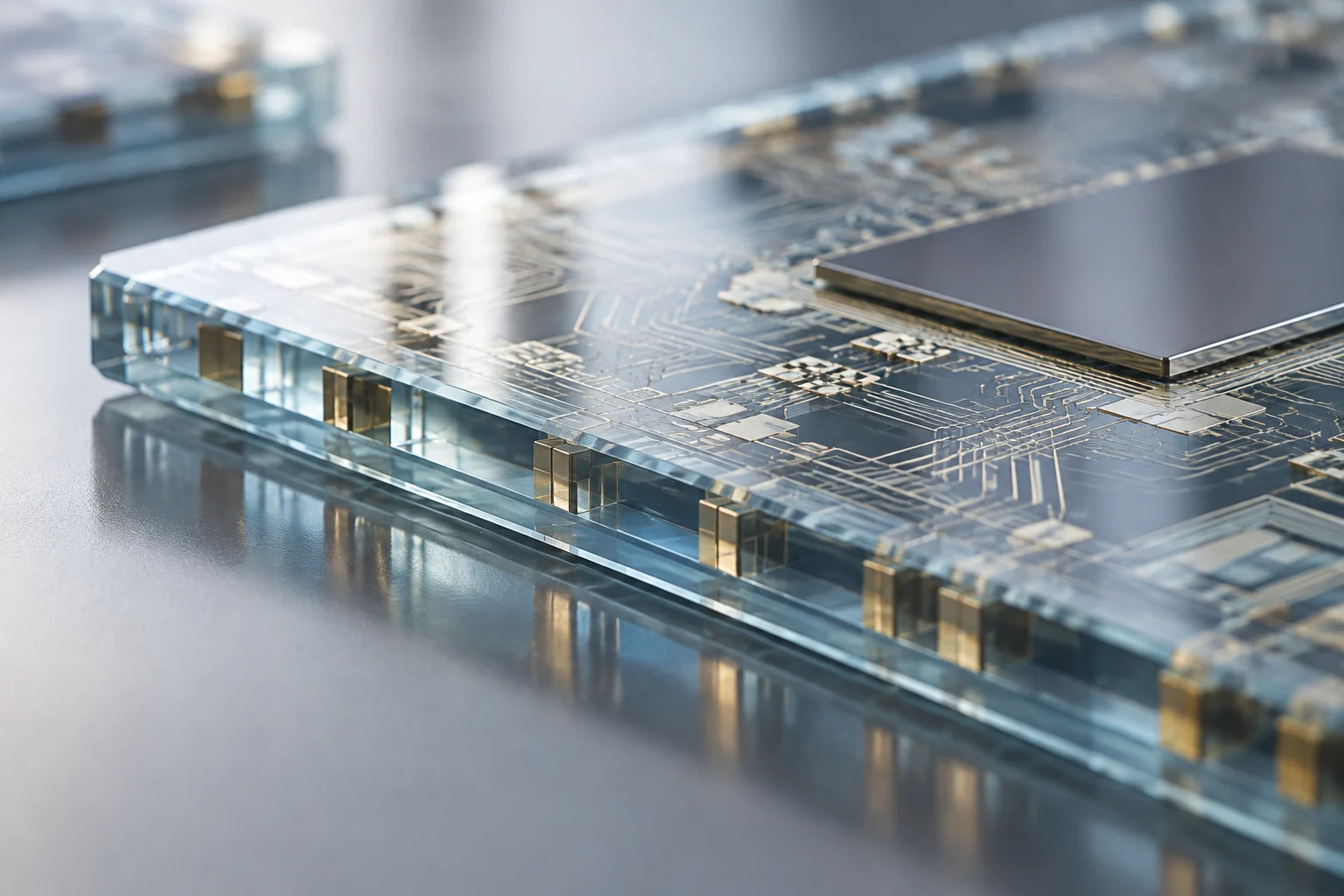
Intel and Lens Technology announced a collaboration combining Intel’s advanced-packaging expertise with Lens Technology’s glass-processing capabilities. The release points to opportunities for future uses in artificial-intelligence workloads and data centers, but does not by itself provide data on production performance, customer qualification, commercial deliveries or volumes manufactured. It is important to separate what companies announce from what an announcement demonstrates. (Intel and Lens Technology)
TrendForce reported that Intel showed a sample in January 2026 combining its EMIB packaging technology with a glass substrate, and relayed claims about the chip size it could support and the absence of microcracks in the cited tests. This is secondary information about a specific sample: it is not equivalent to published manufacturing-yield data, commercial qualification or high-volume production. A demonstration, a pilot line, limited production and large-scale commercial manufacturing are distinct milestones. (TrendForce)
What Public Signals to Watch
To assess maturity, look for specific information about the component and the process: which part of the package uses glass, who makes the substrate, whether it incorporates TGVs, what tests were conducted and what development stage has been reached. A collaboration announcement may show that two companies are exploring complementary capabilities, but it does not demonstrate that a qualified process exists. Similarly, a sample shows that a design could be manufactured, not how many conforming units can be produced, what the process costs or how the assembly behaves after reliability testing.
The most informative signals will be repeated data across batches and a clear description of the milestone being announced: sample availability, pilot capacity, customer acceptance, qualification for an application or commercial production. It also matters whether a claim comes from a manufacturer, an industry organization or scientific research; a projection should not be mistaken for a measured result. The cautious conclusion is that glass substrates are a developing alternative with potential benefits and manufacturing and reliability challenges that require more specific public evidence. The decisive test will be repeatable performance of the complete package, not a list of material properties.