
What the energy label means and what information it provides
The European energy label is a starting point for comparing appliances, not a prediction of how much you will spend at home. It presents an efficiency scale and, depending on the product category, other standardised product information. The exact information varies between appliance types: a washing-machine label does not necessarily describe the same aspects as a refrigerator or display label. Before interpreting any figures, therefore, make sure you are looking at the label for the relevant appliance category. A comparison is only useful when you know what the numbers refer to and whether the products perform the same kind of task. The label helps make that first check possible, but it does not remove the need to look at the details.
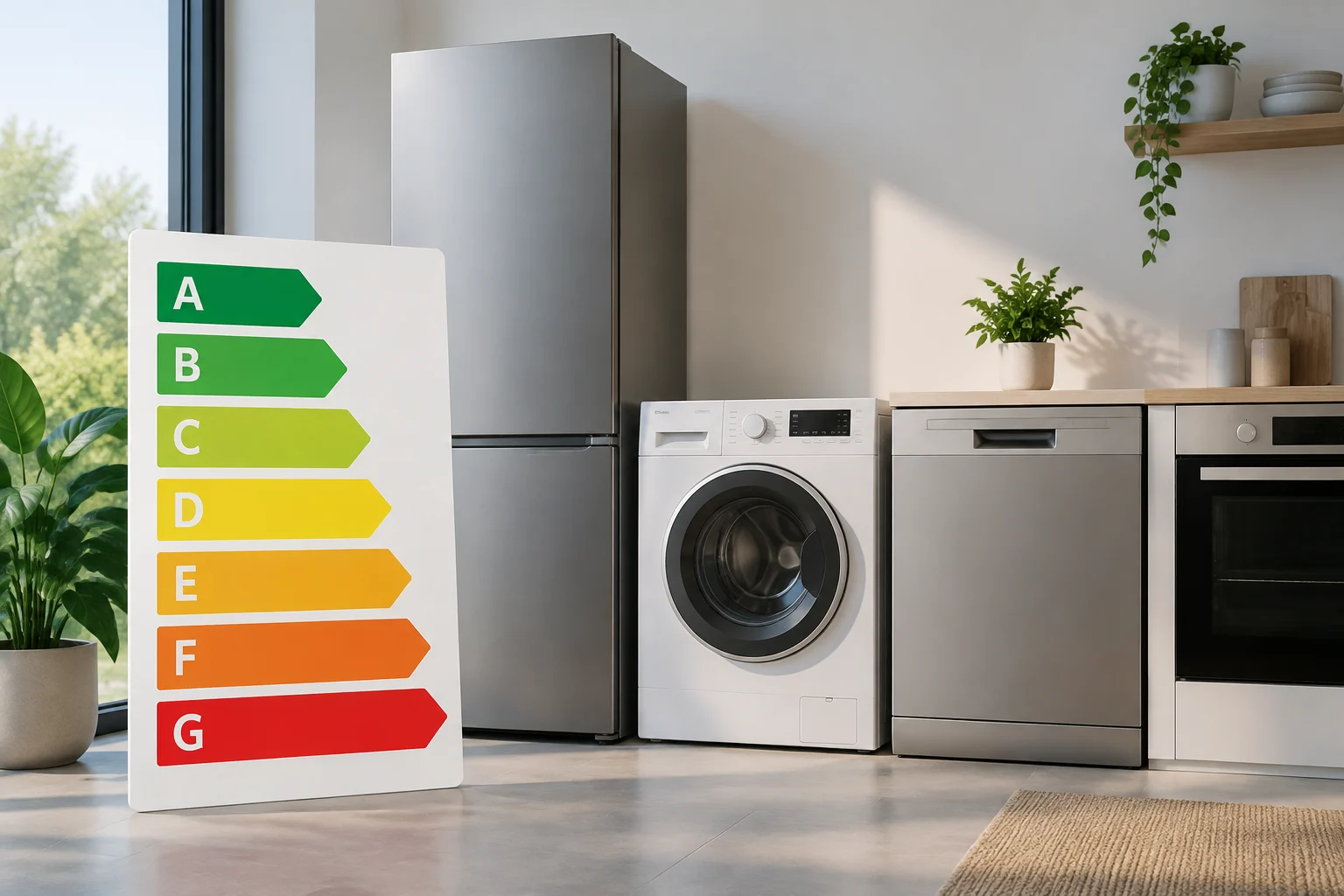
On rescaled labels, the usual scale runs from A to G: A represents the highest efficiency class and G the lowest within the applicable scale. The scale was rescaled to leave room for future improvements and make classes more comparable; a letter is not a consumption measurement in itself. When choosing between models, also read the quantitative figure shown on the label—for example, consumption in kWh for the relevant period or cycle—and check both the unit and the reference method. A class gives a quick orientation, whereas the numerical value tells you what has been declared under specified conditions. Neither should be interpreted as a direct estimate of your own bill without considering your usage and electricity tariff.
The label may also include useful purchasing indicators such as capacity, water consumption, duration or noise, depending on the product. Do not assume that every indicator appears on every label, and do not compare a figure without checking its unit. A value in kWh per cycle, for example, is not directly equivalent to one expressed per year. A comparison only makes sense when the category, measurement conditions and units match. The European Commission explains the system and how to interpret the label in its official energy-labelling guide. Use that guidance if an indicator is unfamiliar, and read the full label rather than relying on a colour or letter alone. That way, the label remains a practical comparison tool rather than a promise about the precise performance you will see at home.
Compare equivalent models, not just letters
A useful comparison begins by defining what you need. For washing machines, that means checking capacity and the reference programme; for refrigerators, volume and configuration; and for dishwashers, place settings and the programme used to declare consumption. A larger-capacity appliance may show different figures because it provides more service. Comparing only the class or absolute consumption without accounting for these differences can lead to the wrong conclusion. Consider whether the models are genuinely being compared on like-for-like terms, and whether the extra capacity or feature set is useful for your household rather than simply attractive in a product listing.
A comparison in two steps
First, filter for models that meet the same need: compatible dimensions, suitable capacity and functions you actually require. Then compare their class and the standardised consumption figures for the same category. If volume or capacity differs, consider whether that difference offers you value. Choosing the largest-capacity appliance is not necessarily better if it is usually run with a small load; equally, a small model may mean running more cycles than expected. Think through your ordinary pattern of use instead of assuming that the most impressive specification will be the best fit. This helps keep efficiency figures connected to the amount of useful work an appliance will do.
When several indicators can be compared, put them in your own table and note their source. For example, record energy class, declared consumption and its unit, capacity and noise, if those details are provided on the label. A table helps you apply the same criteria to each model, but it does not turn standardised test conditions into a prediction for your home. The class provides orientation; the figures and context explain the difference more clearly. Avoid mixing labels from different generations or product categories: even if they look alike, their indicators and methods may not match. If a retailer’s listing omits a unit or reference period, find the product sheet before drawing conclusions. A consistent comparison is more useful than a long list of specifications gathered under different conditions.
Check the exact model in EPREL
The European database EPREL—the European Product Registry for Energy Labelling—lets you consult product information sheets for appliances covered by energy labelling. The QR code shown on applicable labels may lead to the relevant product sheet; you can also search for the product in the database. The sheet helps you check declared information against the appliance being offered, rather than relying only on a shortened commercial description. It is particularly useful when a listing gives a family name or abbreviated reference that could cover several variants. Use the database as a way to establish what product the figures concern before comparing one appliance with another.
When checking a listing, look for the full model reference and do not stop at the series name. Two appliances that look similar may have different capacity, features or consumption figures. Compare the brand, model identification and product category, then check that the label and sheet refer to that exact reference. If the retailer shows an incomplete name or a different code, ask for clarification before comparing. A small difference in a model suffix can matter when determining whether a document applies to the product on sale. Avoid assuming that a photograph, shared product-family description or similar appearance establishes that two appliances have the same specification.
The European Commission’s documentation describes EPREL and the associated product documents, including the label and product information sheet. The database is a consultation tool, not an independent assessment of each offer and not a guarantee that a model will suit your home. EPREL helps verify what the register declares for a specific reference; it does not replace checking dimensions, installation requirements and purchasing conditions. Keep the link or a copy of the sheet you used so you can later confirm which variant you compared. This is helpful if a retailer updates a listing or if you need to revisit your shortlist. The exact model reference remains the link between the appliance offered and the figures recorded in the database.
From declared consumption to your household costs
Standardised consumption lets you compare appliances under common conditions, but everyday use may differ from those conditions. The frequency of operation, programmes selected, amount of laundry or dishes per load, room temperature, installation and maintenance all have an influence. For some equipment, allowing adequate ventilation space or avoiding unnecessary use can also affect operation. The value on the label is therefore a comparative reference, not a promise that every household will achieve identical consumption. A household that runs an appliance often or chooses different programmes may not experience the same pattern as the standard test, even when the model itself is unchanged.
To estimate the variable electricity cost, you can multiply the consumption expected over the period being analysed by the price you pay per kWh. But both figures need to be clearly defined: annual consumption cannot be compared directly with a per-cycle cost unless you convert them to the same period and estimate the number of cycles. Your tariff may also include different components and conditions; this simple calculation is not intended to reconstruct the full bill or predict price changes. It is a way to make a limited, transparent estimate, provided the assumptions are realistic and the period and units are consistent.
If you only have a standardised figure, avoid false precision. You can build indicative low-, medium- and high-use scenarios, provided you explain the assumptions and do not present them as measurements. The difference between two models matters more when they are used frequently; for an appliance used occasionally, other factors may carry more weight in the decision. Do not confuse kWh with euros: the label reports performance under a defined method, while your bill also depends on usage and your electricity contract. If you cannot establish how often the appliance will run, state that uncertainty rather than inventing a single definitive cost. A careful estimate is more useful when it distinguishes declared performance from household behaviour.
Efficiency is not the only buying criterion
Before choosing, check that the appliance fits its location, including the space needed to open doors, connect hoses or allow ventilation where applicable. Verify the width, height and depth on the technical sheet for the exact model, not just in a general description of the product family. It is also worth confirming installation requirements, door-opening direction, connection type and the availability of technical service. An efficient class does not make up for physical incompatibility or an installation that prevents the appliance from working properly. Check access routes too, where relevant to getting the product into its intended position, rather than finding out only after delivery.
Assess capacity in relation to your household’s usual needs and the functions you will genuinely use. Extra programmes, connectivity or automation may be useful for some people and unnecessary for others; do not treat them as automatic proof of greater efficiency. Also consider noise if the appliance will be near spaces used for rest, and consult the warranty, repair and parts information available in your market. These are different criteria from consumption, but they can be decisive in making a purchase satisfactory over time. A feature is worthwhile when it solves a real need, not simply because it appears in a specification list. Similarly, capacity should suit typical loads rather than a rare maximum requirement.
Purchase price and running cost are separate components. To assess a possible price difference, compare equivalent models, estimate a reasonable usage pattern and use an electricity price relevant to your tariff and period. Without those details, it is not possible to claim that a particular class will be cheaper in the long term for everyone. The practical aim is not to maximise a letter: it is to find a suitable model whose features and declared consumption fit your situation. Keep the decision grounded in your priorities, including the space available and how often the appliance will be used. That approach avoids treating efficiency as the only measure of value while still giving the label an important role in a well-informed comparison.
Checklist before deciding
Before paying, make one final check of the listing and documentation. Identify the category and exact reference; confirm that the label and EPREL sheet match the model being offered; and note the class, consumption, unit, capacity and any other relevant indicator. If variants exist, do not assume that they share the same sheet. Also check that you are comparing figures for the same product category and expressed under equivalent conditions. Record any missing information and ask the seller to clarify it rather than filling the gap with an assumption. A complete reference and a clearly stated unit make it easier to review your decision later.
Quick checks
- Does the capacity and do the dimensions meet your needs and fit the available space?
- Does the consumption figure refer to kWh per cycle, per year or another period, and are you comparing the same unit?
- Do the class and indicators refer to the same category and exact model?
- Have you checked the EPREL sheet linked to the model, as well as the seller’s information?
- Have you considered frequency of use, necessary functions, installation and noise without attributing them to the energy letter?
There is no universal household consumption figure that can be inferred from an energy label for every home. The most reliable guide combines standardised, verifiable information with explicit assumptions about your own use. If the precise reference or unit for a figure is missing, request the correct sheet instead of filling the gap with an estimate. This keeps the comparison on verifiable ground: first equivalence and capacity, then efficiency, and finally suitability for your home. Once those checks are complete, you can make a decision that reflects both the declared performance and the practical conditions in which the appliance will be used. The label is valuable precisely when it is read alongside the rest of the product information, not in isolation.