1) Release status and scope
Apple released iOS 27.0 (build 24A437) on September 14, 2026. This milestone brings the broad rollout of Apple Intelligence and the Siri AI assistant as system components, with availability conditioned by device hardware and system language. Apple officially describes Apple Intelligence as a set of capabilities integrated into iOS/iPadOS 27 that prioritizes local processing and, only when more capacity is needed, turns to Private Cloud Compute (PCC).
The company notes that Apple Intelligence and Siri AI are in beta and require a device with Apple Intelligence enabled —for example, iPhone 15 Pro, 15 Pro Max, or models in the iPhone 16 family and later— and that Siri and device language must be among those supported. This distinction is crucial for teams assessing compatibility across fleets and regions.
2) What runs on the device and what goes to the cloud
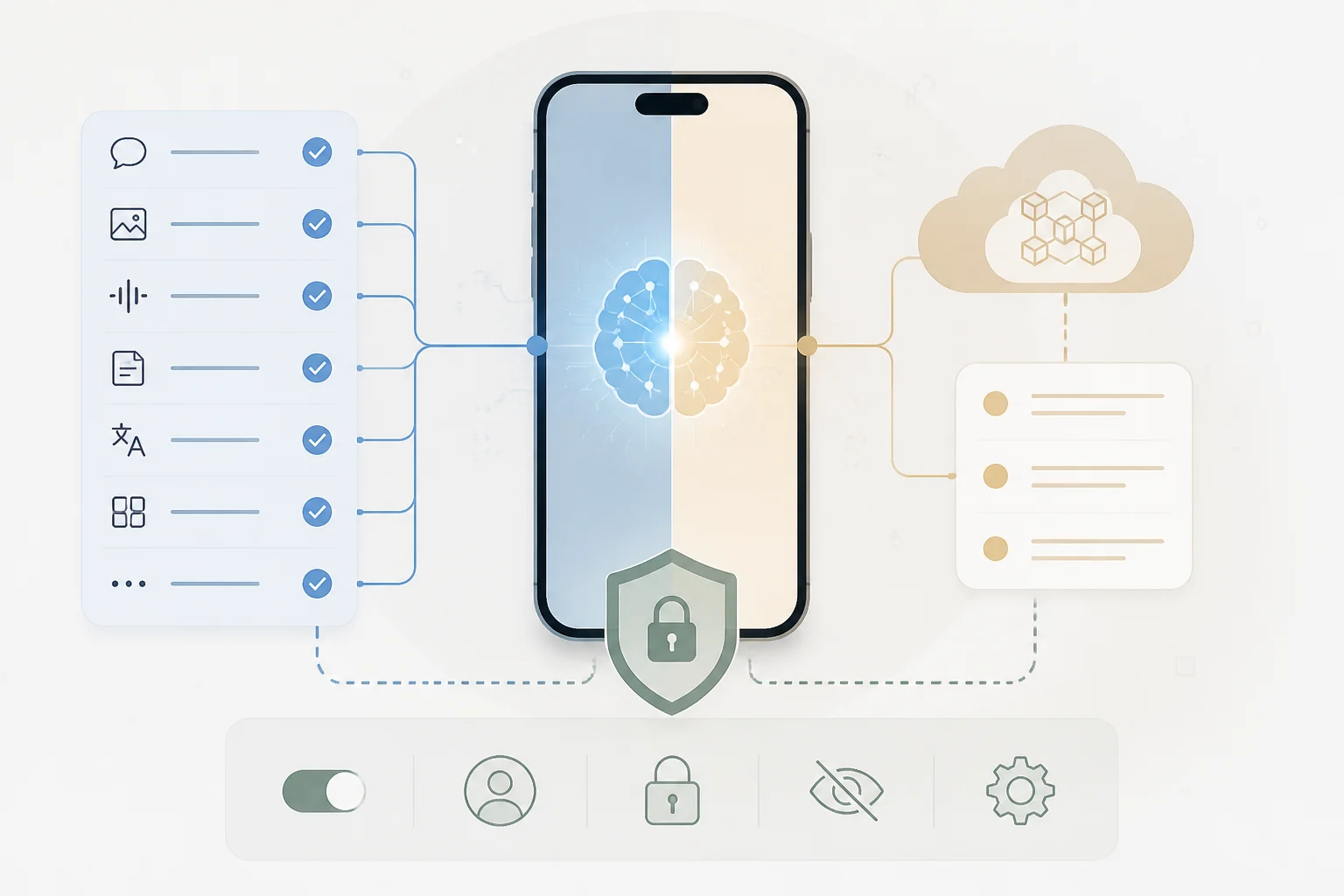
According to Apple, many Apple Intelligence features run entirely on‑device. Examples Apple highlights include notification prioritization and other models that can be handled by the device’s Neural Engine on iPhone or iPad. This approach reduces exposure surface and latency, and prevents personal content from leaving the handset for tasks that don’t require it.
When a user request needs more compute (for example, certain image generations with Image Playground or more complex language responses), the system may send the request to Private Cloud Compute. PCC is Apple‑operated infrastructure, built on Apple silicon in the data center, designed to perform inference with security assurances: stateless execution, no privileged access, and transparent verification. Apple emphasizes that data processed in PCC is not stored nor left accessible to the company once the request is fulfilled.
3) Data flows and processing bases
Practically speaking, iOS 27 differentiates what stays local and when PCC activates. Apple also documents an option to record narrowly scoped, non‑identifiable metrics about request size and duration to improve system reliability, excluding the content itself. Power users and administrators get an additional transparency signal via the new “Apple Intelligence & PCC Report” in Settings > Privacy & Security, which lets you export a log of requests sent off the device, including those originating from watchOS when applicable.
Separate from the Apple Intelligence framework, Siri and Dictation maintain their own data policy. Apple explains that some Siri interactions may send audio, transcripts, and contextual data to Apple to process the request and improve language products, associating those records with random identifiers on the device (not the account). If “Improve Siri & Dictation” is enabled, retention is expanded for product improvement; if not, storage is limited, especially for audio.
4) User controls to limit or disable AI
Apple provides several layers of control. At the feature level in iOS 27, you can turn off or restrict Apple Intelligence from Settings > Privacy & Security > Apple Intelligence (or via Screen Time to block specific features like writing tools, image creation, or intelligence extensions). These switches are complemented by the ability to disable Siri entirely from Settings > Siri (including the path to delete Siri and Dictation history from the device).
The new Apple Intelligence & PCC Report section acts as a form of lightweight audit: it shows whether a request was processed off‑device and lets you export a transparency file. In addition, under Settings > Privacy & Security > Analytics & Improvements, you can disable sending device analytics, further reducing aggregate signals used for improvement. For professionals and compliance leads, these paths provide traceability and minimization by design.
5) Technical security signals in Private Cloud Compute
PCC brings iPhone‑style security properties to the data center. Apple details secure boot, a secure enclave, and a hardened operating system with a narrow attack surface, as well as stateless inference: user data is used only to produce the response and does not persist after completion. Within the internal cluster links, attested authentication and hardware‑bound keys are employed.
Apple maintains public documentation, code, and research materials for third parties to review the design, alongside SOC 3 reports covering PCC’s provisioning system. These elements, together with technical blogs and open repositories, serve as reference points to evaluate that the stated guarantees (no storage, no privileged access) are implemented via verifiable mechanisms.
6) Fleet management: MDM and recommended policies
In iOS/iPadOS 27, organizations can restrict or allow Apple Intelligence and Siri features via declarative management and specific keys. Apple documents declarations such as com.apple.configuration.intelligence.settings for Apple Intelligence and com.apple.configuration.siri.settings for Siri, as well as objects that enable per‑app granularity. This allows IT to align AI scope with internal policies or regulatory frameworks, distinguishing between use cases and risk profiles.
Operational recommendation: apply profiles that disable non‑essential capabilities (for example, image generation or assisted writing) on high‑risk devices; require officially supported languages; and enable Screen Time with content restrictions as a belt‑and‑braces measure. In regulated environments, test DDM interoperability and classic restrictions before mass deployment of iOS 27 to avoid control gaps after major updates.
7) Limitations, language coverage, and regional considerations
Apple notes that Siri AI is in beta and availability depends on language and device. Some features may not appear if the iPhone/iPad doesn’t meet requirements or if the language is not yet included. In addition, Apple Intelligence can look up current information on the web for certain tasks when the user enables it, introducing dependencies on network and search policy.
To assess residual risk: continuously verify the Apple Intelligence & PCC Report after critical operations; ensure that “Improve Siri & Dictation” is turned off if contribution to improvements is not desired; and document, in internal policies, which on‑device functions are authorized and in which scenarios PCC is permitted. In short, Apple provides explicit controls, transparency signals, and a clear perimeter between local and cloud compute; using them with operational discipline is what delivers the expected risk posture.