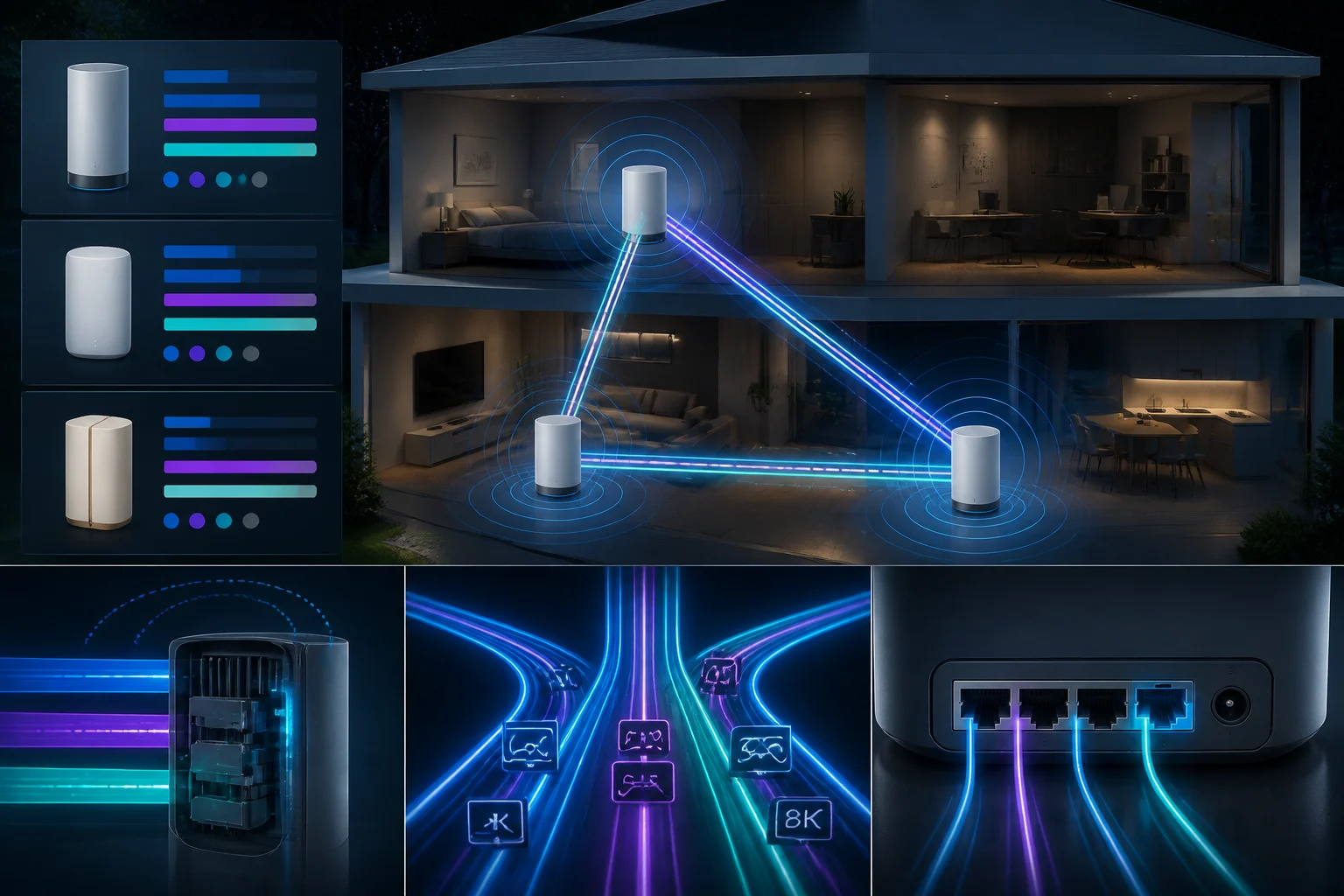
2026 context: what “Wi‑Fi 7” really means in home mesh
As of September 2026, Wi‑Fi Alliance continues to operate its Wi‑Fi CERTIFIED 7 program, which validates interoperability and key capabilities such as Multi‑Link Operation (MLO), 320 MHz channels, and 4K‑QAM. It is not a performance badge; it confirms the availability of features under the certification scope. The program launched on January 8, 2024, and remains active. In mesh systems, these features touch both client access links and the inter‑node backhaul. (globenewswire.com)
Two essential technical nuances shape expectations. First, 320 MHz exists only in 6 GHz; if your country does not open sufficient contiguous spectrum or your client devices do not support that width, you will not see an effective 320 MHz link. Second, MLO comes in several flavors (for example, EMLSR for single‑radio devices, or STR for true simultaneous transmit/receive across radios). The mere presence of Wi‑Fi 7 on the box does not guarantee every combination is active from the first firmware. Always cross‑check the public certificate and the official spec sheet for the exact model. (api.cert.wi-fi.org)
In day‑to‑day use, Wi‑Fi 7 adds mechanisms that reduce variability. MLO can negotiate multiple parallel or switchable links to dodge congestion and micro‑outages; 320 MHz doubles the maximum channel width relative to 160 MHz; and 4K‑QAM raises modulation density with benefits mostly at short range and on clean signals. Setting the right expectations matters: many gains arrive as lower latency and more consistent throughput rather than as spectacular one‑off speed peaks.
Method: primary documents first, reviews as context
This analysis relies on primary documentation: official product pages, technical PDFs, and manuals, plus downloadable certificates from the public Wi‑Fi Alliance database when available for the exact model. We include no in‑house testing or measurements. Third‑party reviews are useful later to judge firmware maturity and user experience, but they do not drive the verification of advertised capabilities here.
For each system we verify: bands and streams, the presence of MLO, availability of 320 MHz, backhaul options (dedicated wireless, MLO and/or Ethernet backhaul), and multigigabit WAN/LAN ports. To read spec sheets correctly, look for stream notation (4×4 per radio), the supported widths per band (20/40/80/160/320 MHz), and the port topology. Also distinguish tri‑band (one radio per band) from quad‑band (two radios in at least one band, typically 6 GHz), as this affects how spectrum is shared between clients and backhaul.
Verified sheet — Netgear Orbi 370 (RBE373): dual‑band with backhaul MLO and 2.5G
The Orbi 370 (RBE373) is a dual‑band Wi‑Fi 7 mesh kit positioned for value, with a combined headline rate up to 5 Gbps and a three‑pack coverage claim of 6,000 ft². Its official datasheet confirms a 2.5 GbE WAN and a 2.5 GbE LAN on the router, plus 2.5 GbE LAN on each satellite, and explicitly calls out “Enhanced backhaul — Multi‑link operation.” (downloads.netgear.com)
That design matches its market slot: with fewer radios than tri‑ or quad‑band systems, MLO becomes the lever to stabilize inter‑node return traffic without carving as much spectrum away from clients. In homes with obstacles or mixed client generations across bands, MLO’s ability to switch or pair links helps the network recover quickly when signal conditions shift. The 2.5 GbE ports also prevent bottlenecks if you opt for partial or full Ethernet backhaul.
On ecosystem support, Orbi operates within its proprietary environment and is not part of EasyMesh. Netgear documents EasyMesh for certain Nighthawk Mesh Wi‑Fi 6 lines, not for Orbi; the company maintains Orbi compatibility tables among its own routers and satellites, and cross‑brand or cross‑family mixing beyond the stated matrices is not supported. (kb.netgear.com)
Verified sheet — TP‑Link Deco 7 Pro BE11000: tri‑band, 320 MHz, and certified MLO
The Deco 7 Pro BE11000 is a tri‑band system with explicit support for 320 MHz in 6 GHz and Wi‑Fi 7 Multi‑Link. The official page shows 4× 2.5 GbE with configurable WAN/LAN roles, which is practical when you need several multigigabit ports (NAS, 2.5G switch, gaming PC) or immediate Ethernet backhaul without being limited to 1 GbE.
Unlike broad marketing claims, this model carries a public Wi‑Fi CERTIFIED 7 certificate under “Deco BE11000” (June 12, 2024). The PDF lists “320 MHz channel width in 6 GHz” and the EMLSR profile (Enhanced Multilink Single‑Radio), i.e., a specific MLO mode within the certification program. This primary reference confirms both 320 MHz and MLO on this model. (api.cert.wi-fi.org)
With tri‑band + MLO (EMLSR) and ample 2.5 GbE ports, the kit suits hybrid designs: you can keep 6 GHz open for next‑gen clients while running a robust multigig Ethernet backhaul without extra switches. In homes with several workstations, consoles, and storage, that division reduces contention and accelerates internal flows without relying on features that may still be maturing.
Verified sheet — ASUS ZenWiFi BQ16 Pro: quad‑band, dual 6 GHz, and dual 10G
The ASUS ZenWiFi BQ16 Pro is a quad‑band system with two 6 GHz radios. Its specifications detail channel widths up to 320 MHz, 4×4 streams on 2.4/5/6‑1/6‑2, and, on the wired side, two 10 GbE ports (1× WAN/LAN + 1× LAN) alongside Gigabit ports and USB 3.0; it’s ready for 10G Ethernet backhaul or for multigig residential uplinks. (asus.com)
Regarding MLO, ASUS includes it in its AiMesh approach to Wi‑Fi 7 in official communications, and the BQ16 Pro can reserve one of its 6 GHz bands for wireless backhaul while keeping the other for 320 MHz and 4K‑QAM clients. Although we did not locate a public model‑variant certificate PDF, the official specifications and ASUS communications are consistent with this design. (asus.com)
In practice, the dual 6 GHz layout helps separate traffic: one radio prioritizes node‑to‑node links, while the other serves next‑gen clients. The presence of 10 GbE on both WAN/LAN and LAN enables very fast internal trunks or home networks already exceeding 2.5 Gbps for local services, without choking the mesh return path.
Certification and ecosystems: how to verify before buying
To confirm that a given unit is Wi‑Fi CERTIFIED 7, download the public PDF from Wi‑Fi Alliance tied to that exact model (not just the family). For the Deco 7 Pro BE11000, the certificate (ID WFA131581) records 320 MHz in 6 GHz and the EMLSR profile of MLO, alongside the certification date and per‑band capabilities (including WPA3 security). (api.cert.wi-fi.org)
On mesh ecosystems, ASUS runs AiMesh (proprietary across ASUS gear), TP‑Link operates the Deco mesh with broad in‑family compatibility, while Netgear Orbi maintains its own ecosystem and does not adhere to EasyMesh. Netgear documents EasyMesh for its Nighthawk Mesh Wi‑Fi 6 offerings, not for Orbi—a crucial point if you plan to mix brands. (kb.netgear.com)
A quick, verifiable checklist: 1) Which bands and widths are supported per radio? If you see 320 MHz, it will be on 6 GHz. 2) Is MLO explicitly mentioned (e.g., EMLSR on the certificate)? 3) Which WAN/LAN ports are present and at what speeds? With these answers, you can decide whether your network benefits most from wireless backhaul (with MLO), Ethernet backhaul, or a mix—and whether your current clients can truly leverage the new capabilities.
Backhaul, ports, and real‑world clients in 2026: practical choices
- Dedicated wireless backhaul vs MLO: In quad‑band systems like ZenWiFi BQ16 Pro, dedicating one 6 GHz band to backhaul reduces contention with clients, and MLO helps aggregate or switch links to minimize drops. In dual‑band designs like Orbi 370, the note “Enhanced backhaul — Multi‑link operation” signals that engineering leans more on MLO to optimize inter‑node routes with less spectrum to play with. If you can run cable, Ethernet backhaul remains the most stable option, and 2.5G/10G ports prevent chokepoints. (downloads.netgear.com)
- Multigig WAN/LAN vs ISP ceilings: For residential uplinks in the 1–5 Gbps range, a 2.5 GbE port (Deco 7 Pro, Orbi 370) already beats 1 GbE by a wide margin; if you foresee heavy local aggregation (NAS, video editing, concurrent backups) or a very demanding backhaul, 10 GbE (ASUS BQ16 Pro) offers headroom. Also consider port count: the Deco 7 Pro integrates 4× 2.5 GbE, which is handy for Ethernet backhaul plus several endpoints without an external switch.
- Clients and expectations: Even if your access point supports 320 MHz and 4K‑QAM, you need compatible 6 GHz clients to realize the full uplift. In homes with mixed‑generation laptops and phones, the most visible gains may be stability and lower latency due to MLO, not dramatic speed jumps across the board. Choosing among tri‑band with ample ports, dual‑band leaning on well‑used MLO, or quad‑band with dual 6 GHz depends on how many Wi‑Fi 7 clients you own today and whether you can wire backhaul.