What can be compared using the available sources
The iPhone 18 Pro has specifications published directly by Apple, while much of the available information about the OPPO Find X10 comes from third-party publications and databases. This difference in origin fundamentally shapes the comparison: a figure repeated across several websites is not, by itself, an official statement from the manufacturer. Source transparency is the first filter for assessing the reliability of each technical detail.
The chronology of the information also matters. La Razón published information about the Find X10 on September 2, 2026, explicitly presenting it as leaks; a later article, dated September 24, distinguished the standard model from the Find X10 Pro Max and attributed different configurations to each. The cameras of the two models must not be conflated, nor should early rumors be retrospectively treated as official specifications. This distinction of timing and model is crucial to avoiding errors of attribution in a specification sheet.
The aim here is not to declare a winner, but to separate data backed by primary sources from figures attributed to secondary sources. Apple confirms the iPhone’s main camera and chip; the Find X10 camera and processor details collected in this package do not have an official OPPO specification sheet against which they can be checked in the same way. This asymmetry limits the conclusions, but also offers practical guidance: before deciding on a purchase, check the official specifications for the exact model rather than relying only on an aggregated comparison.
Main camera: details and limitations
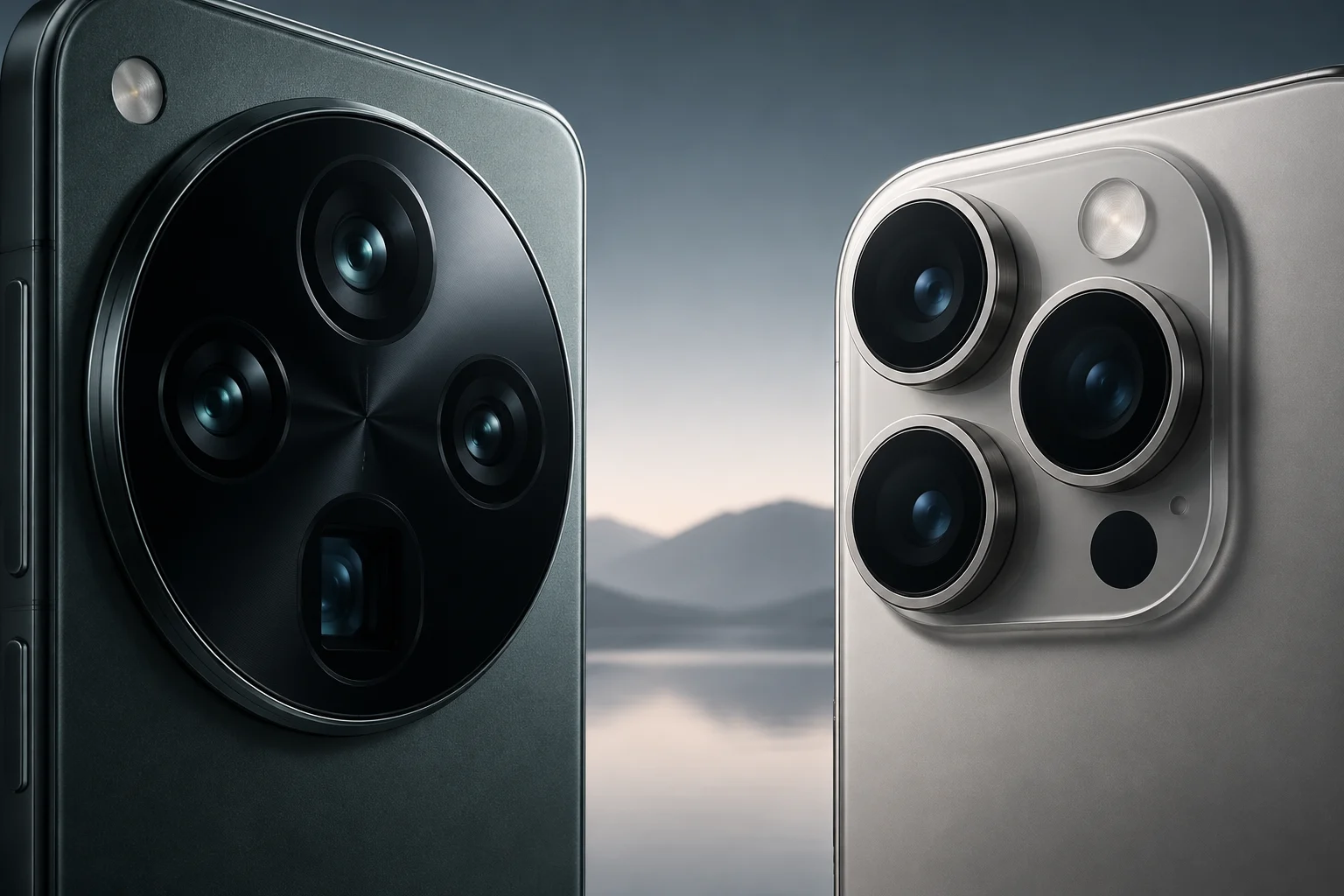
Apple lists the iPhone 18 Pro with a 48 MP Fusion main camera and variable aperture. The product page links that aperture to depth of field and low-light shots. Xataka’s technical specifications provide several aperture values, but the central detail directly supported here by Apple is the presence of a 48 MP camera with variable aperture. This feature allows the amount of incoming light to be adjusted dynamically, a key factor in photography of challenging scenes.
For the standard OPPO Find X10, a secondary publication attributes two 200 MP cameras to the phone; in the same report, a three-camera 200 MP system is assigned to the Find X10 Pro Max. The distinction is decisive: the headline or specification sheet for the higher-end variant must not be transferred to the standard model. The published figures are evidence of the configuration attributed to it, not official verification by OPPO. Confusing these variants can create incorrect expectations about the hardware available in the base version.
Megapixels describe nominal resolution, but they are not enough to establish which camera takes better photos. Assessing the results would also require comparable information about sensors, optics, stabilization, image processing, and performance in different conditions. The documentation gathered here does not provide a controlled photography test between the two phones or a complete primary-source specification sheet for the OPPO. It therefore cannot establish which handles night scenes, portraits, or motion better. Resolution is only one part of the imaging system.
Video: what can be stated and what remains unverified
The draft comparison mentioned 4K recording at 120 frames per second, HDR, Dolby Vision, Log, and 10-bit video for the iPhone 18 Pro. The official Apple documentation included in the research does not confirm this full set of capabilities here, so they should not be presented as verified. The same rule applies to any specific resolution or frame-rate figure attributed to the Find X10. Without primary-source confirmation, these details must be treated as unverified until the manufacturer confirms them.
A secondary publication mentions 8K recording for the OPPO Find X10 series, but the available information is not supported by an official manufacturer specification sheet that clearly identifies the model and the conditions of use. It is not enough to compare codecs, color profiles, recording-time limits, or the modes available on each lens. In video, these details can change how useful a phone is for recording and editing, so an isolated figure does not settle the decision. The editing workflow depends on specifications that remain unconfirmed.
Anyone intending to edit their recordings should check the official list of video modes for the exact model and variant, as well as verifying resolution, frame rate, codec, color profile, and compatibility with the intended workflow. In this case, the documentary comparison cannot recommend a video winner: the sources gathered do not establish equivalent capabilities for both devices through primary documentation. Uncertainty about the video specifications prevents a recommendation based on solid evidence.
Processors and image processing
Apple identifies the A20 Pro as the chip in the iPhone 18 Pro. Its documentation also lists two 16-core Neural Engines. These details make it possible to describe components, but they do not prove that a particular camera function is faster or produces better images than OPPO’s; that would require comparative tests using common methods and conditions. Raw processor power does not automatically translate into a better experience in photography without software optimization.
Kalvo attributes a MediaTek Dimensity 9600M and a 3 nm manufacturing process to the Find X10. Since this is a secondary specification sheet, rather than official documentation from OPPO or MediaTek included in the package, these details should be understood as attributed claims, not primary-source confirmation. Moreover, the processor’s name alone does not show how the camera, video, or battery life will perform in the finished product. Chip architecture is one factor, but not the only determinant of final performance.
Computational processing depends on more than the chip: the sensor, camera software, algorithms, and the way the manufacturer combines these components all play a part. Photographic quality cannot be inferred from the processor alone or from its manufacturing process. Without independent image tests, any claim that the A20 Pro or Dimensity 9600M is superior for photography would be speculative. The integration of hardware and software is what defines the final result.
What to check before buying
The available evidence supports, through a primary source, the iPhone 18 Pro’s 48 MP Fusion main camera with variable aperture. For the Find X10, the 200 MP figures and Dimensity 9600M come from secondary sources. The difference in provenance is part of the comparison and should be considered when weighing how certain each detail is. Buyers should be aware that information reliability varies according to the manufacturer and the type of source consulted.
Before choosing a phone for photography, check the official specifications for the exact variant and look for samples taken with the same scene, lighting, and settings. If video is the priority, confirm the recording modes and formats that can actually be used instead of assuming that features attributed to an entire product family are available on every model. Direct verification of the specifications is the safest way to avoid disappointment.
The practical conclusion is limited but clear: published specifications make it possible to describe some components, but they are not enough to determine which phone delivers better photo or video results. For the iPhone, Apple confirms the main camera and chip. For the Find X10, the available claims require official confirmation before they can be treated as definitive. Until then, there is not enough documentary evidence to recommend a winner for imaging. Caution in interpreting the data is the best strategy for an informed consumer.