Editorial Context: The Need for Precision
In the current technological ecosystem, it is common to confuse market forecasts with effectively operational deployments. Searching for mobile connectivity news for October 2026 mainly yields trend analyses for that year and regulatory documents, but lacks a dated announcement from a manufacturer or operator that constitutes a specific and verifiable news item. This distinction matters because a growth expectation is not equivalent to a service that is already available to users.
To provide useful coverage, it is essential to separate documented facts from projections. This article focuses on the hard data available: actual coverage in Spain, traffic recorded by the CNMC, and European Union connectivity policies. The goal is to explain what is confirmed and what still belongs to the realm of trends, without speculating about technologies that have not yet been deployed.
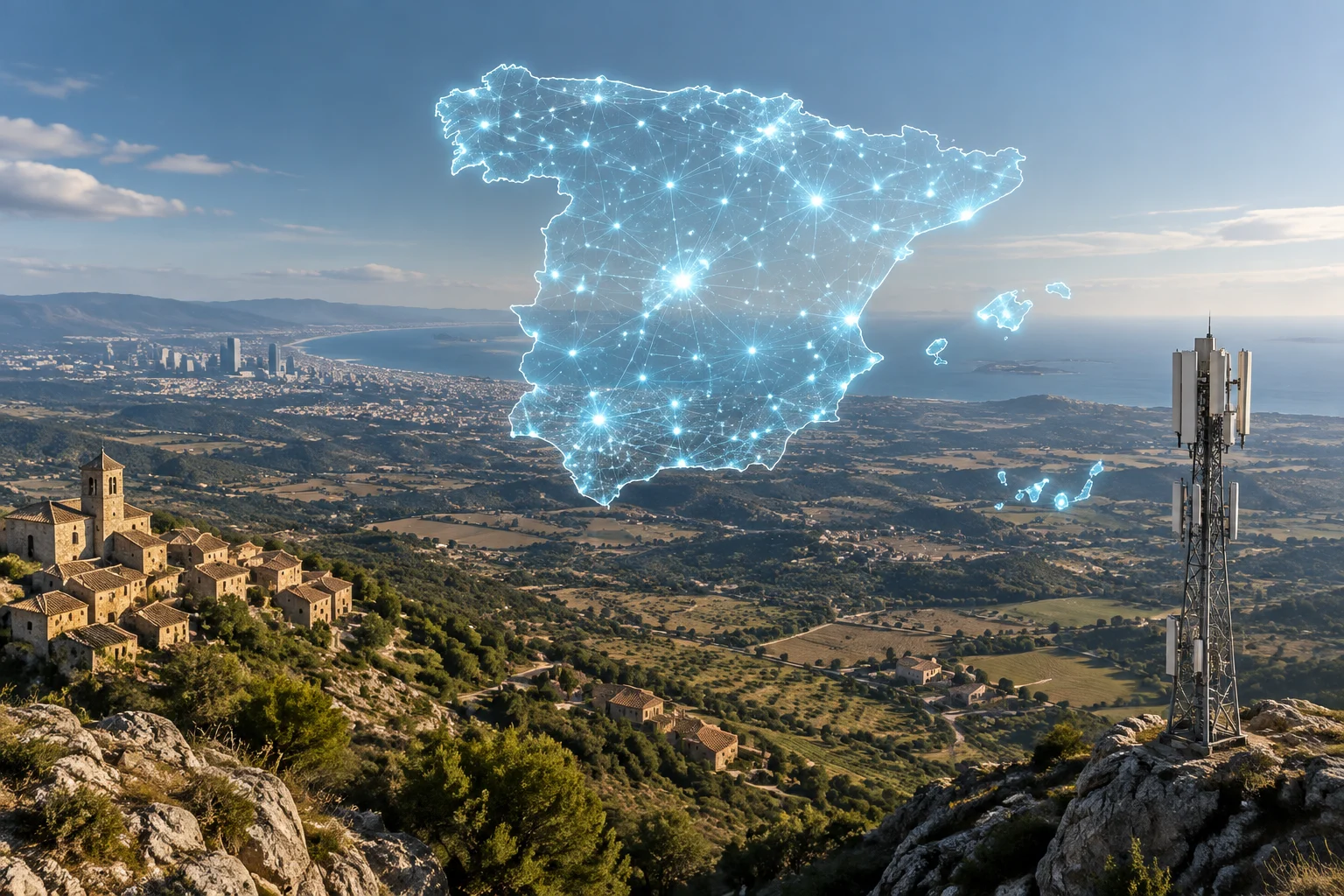
5G Coverage in Spain: Official Data
According to the latest report from the Canary Telecommunications Observatory (OCTSI), based on data from the State Secretariat for Telecommunications, 5G coverage in the Canary Islands already reaches 99.1% of homes. The percentage describes the reach of residential coverage and places the archipelago among the regions with the highest deployment of this mobile technology. The report also places it slightly above the national average in 5G SA (Standalone), although that comparison refers to a specific network modality.
At the national level, the General Telecommunications Law (Law 11/2022) establishes the regulatory framework for the digital transition. Recently, the Ministry for Digital Transformation published Order TDF/812/2026, which regulates aid to provide 5G services to rural areas without 4G/5G signal. The measure is therefore directed at areas where current mobile networks do not offer coverage, and reinforces the commitment to reducing the digital divide in remote places.
Mobile Traffic and Market in Spain
The National Commission on Markets and Competition (CNMC) has published data from the second quarter of 2026 showing significant growth in the use of mobile networks. 5G traffic increased by more than 60% year-on-year and now represents almost a quarter of total mobile broadband traffic, which reached 2.8 million terabytes. The figure shows that 5G use is gaining weight within mobile consumption, although the total volume includes traffic from different access technologies.
Regarding the market, retail revenues remained practically stable at 5.648 billion euros. Movistar, Vodafone, MASORANGE, and DIGI concentrate 82.8% of those revenues, reflecting the combined weight of the main operators in the retail segment. Among the variations of the period, DIGI stands out, which billed 14.4% more than in the same quarter of 2025, while Movistar experienced a drop of 2.4%.
Connectivity Policies in the European Union
The European Commission is driving the 'Digital Decade' with specific connectivity objectives. Countries such as Latvia, Lithuania, Poland, and Denmark have aligned their national strategies to guarantee access to 100 Mbps networks upgradable to gigabit and 5G coverage in main urban areas. These objectives combine two dimensions: the availability of fixed broadband with the capacity to evolve and the deployment of next-generation mobile networks.
In Denmark, the strategy agreed in 2021 seeks to cover 98% of homes and businesses with 1 Gbps by 2025. In Poland, the National Broadband Plan and the European Funds for Digital Development 2021-2027 finance the construction of the gigabit society and seek to ensure access to ultra-fast Internet across the entire territory. These are examples of national objectives and programs within the European push for connectivity; they should not be confused with results already achieved in all places.
Future Trends and Satellite Connectivity
Beyond terrestrial networks, direct-to-device (D2C) connectivity is emerging as an area of interest. Companies like Starlink, Amazon, and Viasat are competing to lead this technology, which would allow phones to connect directly to satellites. The possibility sparks interest because it proposes a connection path different from terrestrial stations, but it is still advisable to distinguish the sector's evolution from the availability of a service for the public.
It is estimated that this market could exceed 2.6 billion dollars by 2030. That figure is a market projection, not a measure of current revenues or a guarantee that the technology will be implemented on a specific schedule. It expresses an expectation about the potential growth of the segment, so it should be read as a forecast and not as a confirmed deployment.
To date, there is no massive and verified deployment of direct satellite connectivity for the end consumer in Spain that alters the dependence on terrestrial 4G/5G networks. Therefore, although D2C is part of the trends that are closely followed, it cannot be presented as a widespread substitute for existing mobile networks.
Conclusion: Facts vs. Rumors
The available evidence confirms solid progress in 5G coverage and mobile traffic in Spain, supported by active public policies. The cited data allow describing both the extent of coverage and the increase in 5G use, while measures for rural areas and European objectives show the role of public policies. However, there is no record of a disruptive technological novelty announced specifically for October 2026 that justifies breaking news.
For readers, the key is to verify the sources and pay attention to what type of information each provides: data published by the CNMC and BOE provisions are documented facts; analyst forecasts describe trends. Maintaining that distinction helps to interpret the state of connectivity with judgment and make informed decisions about devices and services, without treating as available what is still an expectation.