
Residual value is not an expiration date
The residual value of a phone or laptop is the amount recoverable when selling, exchanging, or integrating it into a used fleet. It is not equivalent to accounting depreciation or the useful life assigned by a company: it is a market price, affected by demand, condition, configuration, age, and the timing of the sale. Therefore, no single rule allows deducing how much a device will retain based solely on its original price.
It is advisable to separate two horizons. Technical useful life ends when the device no longer performs a specific task or requires an unreasonable repair; economic useful life may shorten earlier if the cost of maintaining it exceeds the benefit of continued use. Conversely, a device may retain utility and resale value after ceasing to receive major software updates, although the end of support does reduce its appeal to certain buyers.
Available information allows identifying factors that sustain or erode price, but not calculating a universal depreciation rate. The market sources included here are articles and editorial selections, not transparent series of comparable transactions. The practical conclusion is more limited: evaluating support, repair, and condition helps compare options, but does not replace a real quote for the specific model and configuration.
Software support marks a horizon, not a price
When buying a device, the update timeframe helps estimate how long it can be used with less exposure to known vulnerabilities and reasonable compatibility. A verifiable support commitment is more informative than a general durability promise, but it does not by itself state how much a buyer will pay in three years: preferences, condition, and the supply of similar units also intervene.
For smartphones sold in the European Union, regulations applicable from June 2025 establish eco-design requirements including the availability of operating system updates for at least five years from the market launch of the last unit of the model. This is a specific regulatory reference, but it should not be confused with five years from individual purchase or a guarantee that the phone will receive every new feature. The relevant date for estimating the horizon may be the last commercialization of the model, not the day the user acquired it.
In iPhone, Apple publishes security and compatibility information by version and device; that documentation is the most solid starting point to confirm the status of a specific model. In Android, the timeframe depends on the brand, family, and sometimes the variant or market. It is not advisable to extrapolate one manufacturer's policy to all its phones, nor to take a third-party guide on average years as an official promise.
In laptops, Windows adds another nuance: the support for an operating system version and the support for the hardware are not the same. Microsoft publishes the lifecycle of each Windows version; a device may continue working after the end of support for an edition, but its security situation and the possibility of moving to another version will depend on compatibility and requirements. Therefore, when valuing a used laptop, one must verify the exact model, the installed system, and the update path, not infer it from the device being relatively recent.
Repairability: a useful signal, with limits
From June 20, 2025, smartphones and tablets covered by European regulation must display an energy label with information including a repairability class from A to E. The evaluation takes into account aspects such as access to priority parts, disassembly, tools, and the availability of information and spare parts. This introduces a more structured basis for comparing devices sold in the EU, although the class does not represent a second-hand appraisal nor does it summarize all repair costs in each country.
The same regulation sets eco-design requirements relevant for prolonging use: it includes that batteries retain at least 80% of their capacity after 800 charge cycles and that certain spare parts are available for seven years after the end of the model's commercialization. Specific applicability depends on the category and the product's regulatory requirements. The label does not guarantee a cheap repair: labor, part price, transport, and local availability can change the economic decision.
Research disseminated in September 2026 by Europa Press reported that only 18% of 2,334 smartphone models launched in the last year met labeling requirements and offered links with information on parts or repair. This data serves as a warning about implementation and the ease of finding information, not as a measurement of resale value or as an effective repairability rate for all mobile phones. Moreover, it comes from a research by a right-to-repair advocacy organization, not from an official price series.
For those who buy or manage a fleet, the label and parts documentation can improve maintenance decisions: they allow asking if a screen or battery is available, how much it costs, and who can replace it. A economically viable repair can avoid removing a device due to an isolated failure; however, a high score does not eliminate wear nor guarantee that the device will be attractive to the next user.
Which components lose appeal and which retain utility
The technical sheet ages unevenly. In mobile phones, a camera with many megapixels or a high memory figure do not guarantee future demand by themselves; the real experience, software compatibility, battery condition, and the functions the buyer uses matter. Secondary buying guides usually highlight performance, screen, and battery life, but do not provide a quantified relationship between each specification and the resale price. There is no basis here to assign a depreciation percentage to RAM, processor, or camera.
In a laptop, the specific configuration conditions what jobs it can cover: memory, storage, processor, screen, and ports may matter differently depending on use. For a professional fleet, the condition of the keyboard, battery, chargers, and the ease of reinstalling the system also count. These variables serve to describe the unit and compare equivalent offers; they do not justify claiming that a category—for example, a mid-range laptop—loses value faster than a high-end mobile phone without comparable transaction data.
Physical condition and documentation are direct signals for the buyer. A unit without damage, with pertinent accessories, an identifiable model number, and verifiable data wiping is easier to evaluate than one whose history is unknown. The battery deserves special attention in both types of equipment: its degradation can reduce autonomy and generate a replacement cost. The net cost of retaining a device includes that potential repair, not just its purchase price.
Popularity should not be confused with guaranteed value. A refurbished store may recommend certain models due to availability or rotation, while a list of “most profitable” ones does not necessarily publish its method, sales universe, or closing prices. The references available for 2026 do not form a homogeneous base that allows comparing brands, generations, and categories with rigor.
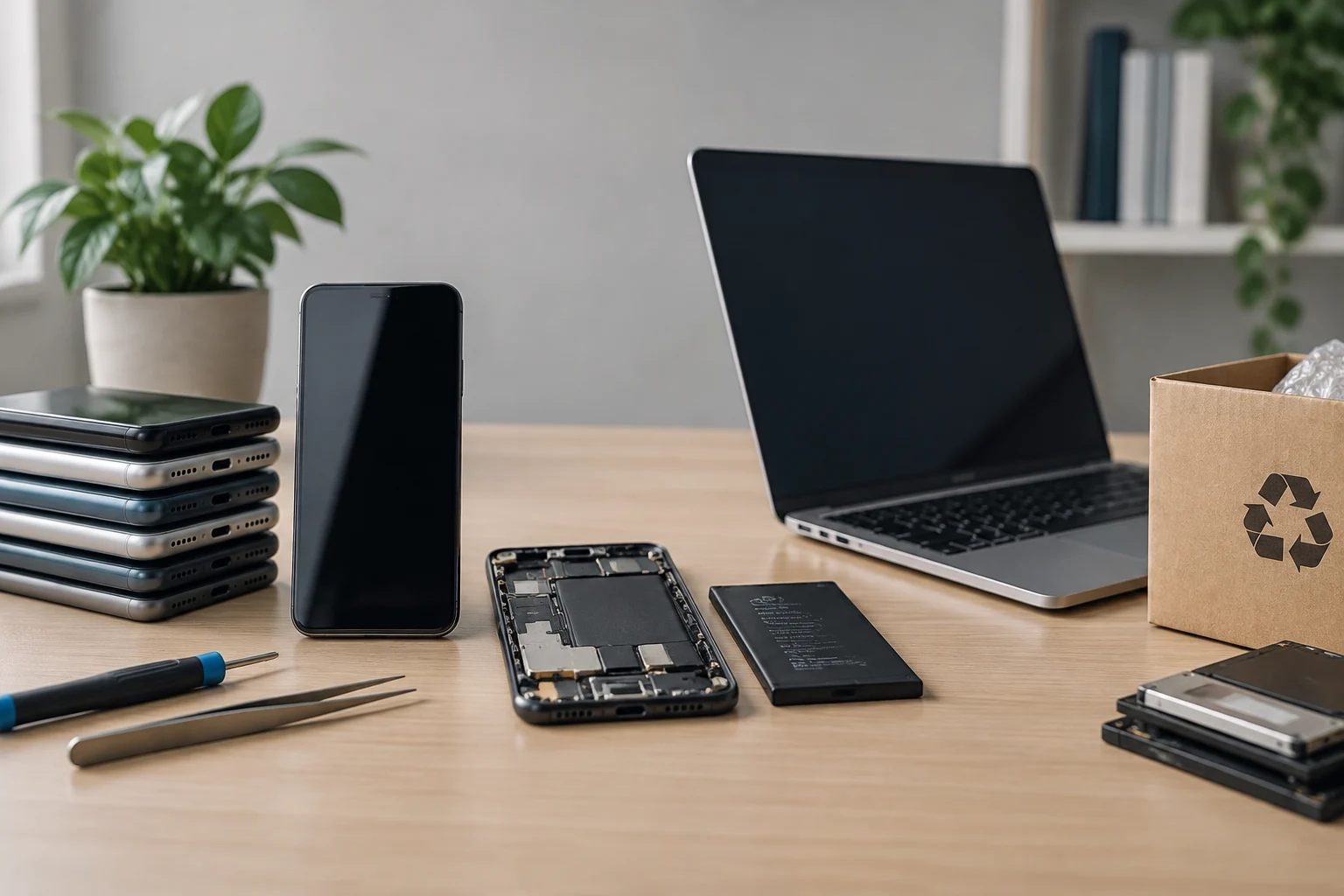
How to estimate a resale without inventing a depreciation curve
For an individual purchase, the most prudent estimation starts by identifying the equipment precisely: brand, model, capacity, memory, connectivity variant, and market. Then, current ads for the same model and condition are compared, separating the asking price from the effectively closed price. If there are only ads, the result is a supply reference, not proof of how much it sells. It is advisable to note the consultation date because the market changes with launches, promotions, and availability.
A practical comparison can be organized in four checks. The more equivalent the units are, the less likely it is to attribute to support a difference that actually corresponds to capacity, condition, or accessories:
- Support: official end date or update commitment applicable to that variant; in Windows, edition and eligibility for later versions.
- Repair: European label class where applicable, availability and cost of parts, and service options in the local market.
- Condition: battery, screen, casing, keyboard, ports, repair history, and included accessories.
- Market: comparable offers for the same model and configuration, seller, condition, and date; distinguish ad, buyback, and closed sale.
For companies, the decision is not just how much will be recovered when selling. One must compare the expected resale value with support, repair, data management, refurbishment, and downtime costs. Accounting depreciation responds to tax and registration rules; it does not predict the market price. An inventory that retains serial number, configuration, purchase date, incidents, and condition when removing the device improves the quality of any subsequent valuation.
A staggered rotation policy also reduces the risk of selling the entire fleet at an unfavorable time, although it does not guarantee better prices. The decision should be linked to operational needs and the actual support cycle, rather than fixing an identical timeframe for all devices. For small organizations, an inspection and an appraisal or buyback quote of the lot may be more useful than applying accounting percentages as if they were selling prices.
What can be concluded and what cannot
Evidence allows sustaining that support and repairability are pertinent criteria for evaluating the future utility of mobile phones and tablets in Europe, and that physical wear and technological obsolescence can affect computer equipment. It also allows pointing out that European requirements add repairability information and specific design and spare parts obligations. It does not allow calculating a depreciation curve for 2026 nor claiming which category retains its price better in Spain.
The most useful recommendation before buying is to check the obligations and promises applicable to the exact model, and not to pay more for specifications that do not respond to a real need. Before selling, it is advisable to clean the data, document the condition, and compare equivalent offers, recording whether it is an advertised price or a purchase proposal. In fleets, the same logic helps separate the accounting value from the economic value.
Residual value is, in short, a conditioned estimate, not a fixed property of the device. Prolonged support and accessible repair reduce uncertainties, but do not ensure a high resale; a recognized brand or a powerful spec sheet also do not automatically compensate for a degraded battery, a low-demand configuration, or the lack of buyers. The practical decision consists of valuing the total cost of use along with a current market reference, not in treating the future price as a promise.