
A specification sheet brings together figures that do not mean the same thing
When comparing power banks, it is easy to look first at the biggest number on the box: capacity in mAh or maximum power in watts. But those figures answer different questions. Capacity describes an amount of electrical charge under certain conditions; power indicates the rate at which energy can be transferred. Neither figure, on its own, proves how many times a phone can be charged or how long a laptop will take to regain battery power.
It helps to separate at least four questions: how much energy the product stores, how much power it can deliver through each output, which charging profiles it supports, and what happens when several ports are used at the same time. A specification sheet may advertise a maximum that can be reached only on a particular port or under a specific profile. If the conditions are not stated, the figure provides incomplete information, not a guarantee of performance in every situation.
The comparison rule is not to treat capacity, power and compatibility as synonyms. A power bank with a high mAh rating does not necessarily have higher output power; another with more watts may provide less total energy. To compare options meaningfully, identify the unit, the port to which the figure applies, and the conditions described by the manufacturer. This avoids using an eye-catching number as a substitute for the other specifications needed to assess a particular use. It also helps distinguish what a product can store from what it can deliver through a particular connection. A headline figure can be useful, but only when it is read in context and alongside the rest of the product information.
mAh and Wh: electrical charge versus energy
Milliamp-hours (mAh) express electrical charge. Watt-hours (Wh), by contrast, express energy. The relationship depends on voltage: Wh = (mAh ÷ 1000) × voltage. That is why two batteries with the same mAh figure can represent different amounts of energy if the figure refers to different voltages. When a manufacturer publishes Wh, that unit makes a more direct energy comparison possible, provided it refers to the same kind of measurement and is not a figure calculated using different assumptions.
The advertised figure does not necessarily equal the energy that will reach a device. Voltage conversion and losses occur between the cells and the USB output; use, temperature and charging conditions also affect the result. Without an independent measurement conducted using a stated method, the label cannot tell you how much usable energy a particular phone will receive or how many complete recharges it will get.
When reading a specification sheet, look for the rated capacity and, if provided, the energy in Wh; also check which voltage each value refers to. If only mAh is listed and the reference voltage is not clarified, do not turn the figure into a precise energy comparison. The mathematical conversion helps interpret units, but it does not replace a measurement of energy available at the output. In other words, calculating Wh from mAh requires knowing the voltage to which the capacity applies; without that information, the calculation does not provide a comparable basis. Keep the published figure distinct from any figure you calculate yourself, and record the voltage assumption whenever you make a conversion. That way, a derived value is not mistaken for a manufacturer measurement or an independently verified output.
Watts and charging profiles: match them to the device
Power is expressed in watts (W) and describes a rate of energy transfer. At an electrical output, it is related to voltage and current: W = V × A. However, the maximum wattage alone does not tell you every combination the product supports. A useful specification sheet lists the available output profiles, such as voltage and current, and clarifies whether the maximum applies to a particular USB-C output or to all ports combined.
USB Power Delivery (USB PD) is a power-delivery standard documented by USB-IF. To find out whether a power bank can charge a device at the expected power, compare the capabilities at both ends: the profile offered by the power bank and the profile accepted by the device. The device determines what it requests and may limit the power; an output with a higher maximum does not force the device to charge at that maximum. The device’s own documentation is the reference for its requirements.
Finding the word “fast” or a prominent wattage figure is not enough. Check the USB PD profile listed for the port, the maximum power and the conditions required to obtain it. If the device manual does not state the requirement, or the power-bank manufacturer does not clarify its profiles, compatibility and likely speed are less certain. Missing information does not prove incompatibility, but it also cannot confirm the advertised performance for a specific use. Distinguishing a theoretical output maximum from the relevant profile makes a comparison more precise, although it still cannot predict the actual result on its own. A device may negotiate a different operating level depending on its own design and the conditions of use, so the figures should be treated as compatibility information, not as a guaranteed charging time.
USB-C is the connector; the protocol and cable matter too
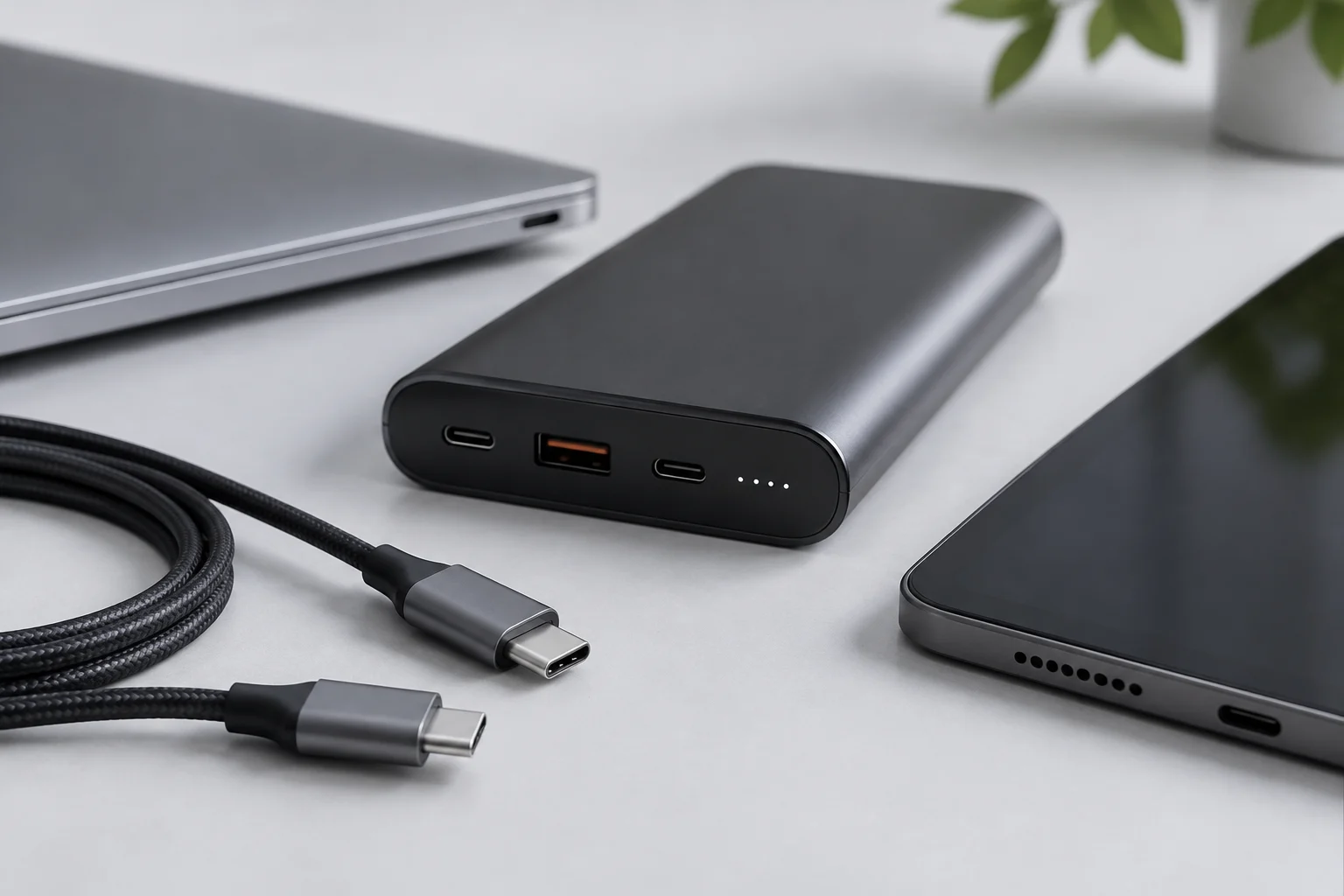
USB-C identifies a connector shape, not a universal promise about power or capabilities. Two products with USB-C ports may support different capabilities. Rather than assuming that any USB-C combination will charge at maximum speed, check which protocol each device supports and what the power bank specifies for each port. USB-IF documentation distinguishes USB Power Delivery as a power-delivery specification; the connector’s name does not replace that information.
The cable is part of the connection. Its characteristics may limit available power, and its capacity should not be inferred solely from the connector’s appearance. Consult the cable specifications and manufacturers’ instructions, especially if you intend to power a laptop or use a high power level. If a cable is not included, its cost and the need to purchase a compatible one may also affect the decision. Check the specific accessory you plan to use rather than assuming that all cables with the same plug shape offer the same capabilities.
Simultaneous use of outputs matters as well. Some manufacturers list a port’s maximum power separately from the combined power available when several devices are connected. Check whether the specification sheet explains how power is shared and whether performance changes when another output is occupied. If that information is not published, it is not prudent to add the ports’ maximum ratings as if they could all be delivered at once. In a comparison, recording the individual and combined figures separately prevents a rating for each output from being mistaken for simultaneous performance. It is also useful to note any stated conditions, because a combined limit may be different from the maximum available when only one device is connected.
A document-based comparison, not a promise of runtime
To compare models without hands-on testing, build your own table using consistent data: energy in Wh if stated, capacity in mAh and reference voltage, output profiles for each port, maximum power per port, combined limit, and included cables. Also record a link to the manufacturer’s product page or manual and the date you consulted the information. If a figure is not provided, mark it “not specified” rather than filling it in with an assumption.
A compact table can help organize the criteria, but it should not mix measurements of different kinds or be filled with incomparable figures. For example, mAh without a reference voltage is not enough to conclude which product stores more energy. Similarly, the maximum power on one port is not the combined power and cannot establish how long a particular device will take to charge. Keeping each figure with its unit and context makes it easier to see which comparisons are supported and which cannot be made from the available information.
USB-IF documents help verify the USB PD specification; product pages and manuals help confirm what the manufacturer declares for each power bank and device. These sources are not interchangeable: the standard defines a technical framework, while the product sheet describes declared capabilities for a model. A rigorous document-based comparison explains what is known and what remains unmeasured, rather than turning a marketing figure into a practical result. Saving the sources you consulted also makes it possible to recheck the details if a product page changes or a compatibility question needs to be revisited. Keep calculations clearly identified as calculations and manufacturer claims clearly identified as claims. That distinction helps readers understand both the value and the limits of the comparison.
Checklist before buying
Before deciding, follow these steps and keep track of questions the documentation does not resolve:
- Check that capacity is given with a unit and, if possible, that the manufacturer also publishes energy in Wh and its reference voltage.
- Look for the USB PD profiles and output power for each port, not just the maximum highlighted on the packaging.
- Check how much power the device you want to charge can accept and whether its manufacturer explains any specific limits or requirements.
- Verify the cable specifications and whether it is included.
- Check the combined power available when several devices are connected and note any conditions stated by the manufacturer.
- Separate published data, derived calculations and matters that would require an independent test.
This review helps organize information without confusing what the manufacturer declares with what has been verified under real-use conditions. If an important detail is missing, the checklist also helps identify the remaining uncertainty: it may concern the reference voltage, the profile for a port or the power available when several devices are connected. Recording that absence is more useful than completing the specification sheet with an inference unsupported by the available documentation. The comparison then retains its limits instead of hiding them behind a sweeping conclusion about which model will perform better in every use case. Without independent tests conducted under stated conditions, this comparison cannot establish actual usable energy, runtime, the charging time of a particular device, or behavior at different temperatures and loads. It also cannot prove that a power bank advertised at a particular power level sustains that maximum throughout a charging cycle. These are methodological limits, not an automatic objection to the product: they indicate which questions a label or specification sheet cannot answer by itself. Recording them makes the conclusion more transparent and helps prevent estimates from being mistaken for measured results.