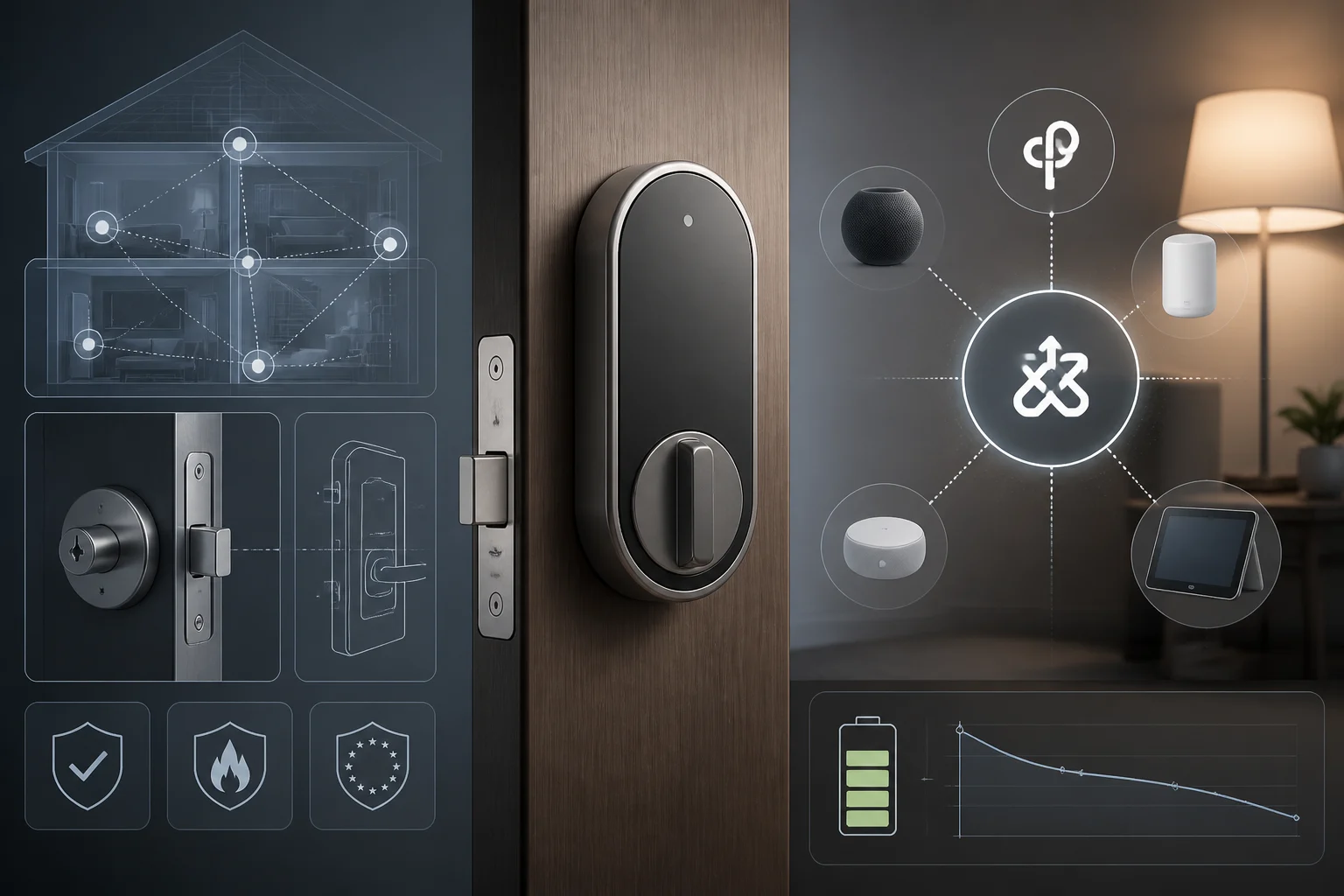
Quick summary: when a smart lock makes sense—and when it doesn’t
A smart lock can be useful if you want to automate locking or manage access, but the Matter label alone does not guarantee that every feature will work locally. Your experience depends on the lock as well as the controller and app you use. Before buying, confirm which operations are available in the specific combination you plan to use, and which require an internet connection or an account with the manufacturer. Consider whether your essential tasks—such as locking, unlocking, or managing access—are supported in the way you expect, rather than relying on a general compatibility claim.
Matter was designed to encourage interoperability among compatible products and ecosystems. That does not mean every feature, app, or service is interchangeable, or that compatibility with one ecosystem proves another will offer the same options. Treat compatibility as a list of specific functions to verify, not as a general promise that every platform will work identically. A feature might be exposed in one app but not another, and the conditions for using it may also differ. Check current documentation for the exact lock and platform combination before making a decision.
For doors subject to emergency-exit requirements or fire-safety conditions, do not choose a lock based only on its connectivity. Check the requirements that apply to the door and its hardware assembly with the relevant authority or a qualified professional. UL explains that the application of UL 294 and UL 1034 depends on the device type and installation context; a reference to a standard does not, by itself, prove that a particular product is certified or suitable for every door. Connectivity and compliance are separate questions, and both need to be assessed for the actual installation.
Compatibility: Matter, Thread, BLE, and Wi‑Fi
Matter is a connectivity standard for connected-home devices. Thread is a networking technology that can be part of a Matter installation, but it is not another name for Matter and does not guarantee greater range or battery life in every home. The Thread Group describes Thread network topologies and the role of border routers in communication with other networks. Device placement, radio conditions, and the home’s configuration all affect the result, so it cannot be promised that adding a border router will always improve battery life or coverage. The presence of Matter and Thread in a product description is not a substitute for checking how the actual system is designed to work.
Before buying, check whether your chosen ecosystem supports Matter locks and which operations it exposes for the specific model. Google’s compatible-device page documents the types of devices its platform supports, but it does not establish that every lock offers the same set of features in every app. For Thread, consult the ecosystem manufacturer’s documentation to find out what compatible equipment is required and whether you already have it; do not assume that any speaker or hub can act as a border router. Verify the necessary equipment and its role in the precise setup you intend to use.
Matter does not eliminate the need to review setup, user administration, and features that depend on the manufacturer’s app. If local control matters to you, look for explicit model documentation describing which operations remain available without internet access. Distinguish those operations from notifications, remote access, and synchronization, which may depend on external services. Also check whether the documentation describes what happens during an internet outage, rather than inferring local availability from the presence of a Matter logo.
Local versus cloud: what can you do without an account?
Do not assume that locking, unlocking, creating codes, viewing history, and receiving alerts all use the same communication path. Support for a standard is not enough to ensure that all credential management is available in every app or without an account. Check each function in the documentation for the lock and the ecosystem you plan to use. Where the documentation is unclear, ask the manufacturer to specify which functions require a login, internet access, or a cloud service, and which are handled locally by the lock or home system.
Remote unlocking availability and requirements can vary by platform and configuration. Before relying on it, consult the current documentation for Google Home, Apple Home, Alexa, and the specific model; do not extrapolate a rule from one platform to another. Also check how remote unlocking is authorized and what security controls the chosen system provides. Knowing that a lock can be controlled remotely does not tell you how an authorization is granted or what checks are required, so confirm those details before treating the feature as suitable for your needs.
A useful check before relying on a feature is to consult the official guide for the model and home system, and ask the manufacturer what happens if internet access is lost. If you test by disconnecting the internet, limit your conclusion to that particular configuration: the result does not guarantee that a software update, hub change, or new installation will behave in the same way. Record the conditions of your test and avoid treating a single successful test as a guarantee for every future setup.
Formats and physical fit: deadbolt and backset
For doors prepared for a deadbolt, measure the backset: the distance from the center of the cross-bore to the door edge. Schlage says its residential locks typically use measurements of 2‑3/8 or 2‑3/4 inches. That information is a reference for its products, not a guarantee that every lock will fit or adjust to both measurements. Compare the actual measurement with the specifications and installation instructions for the model you are considering. Make sure you understand which measurement the product accepts before ordering, rather than assuming a familiar standard is universal.
Also check the door thickness, the dimensions of the lock body, and the space available on both sides of the door. A lock may fail to fit even when the backset matches. The alignment of the bolt and strike plate also matters: if the mechanism encounters resistance, consult the manufacturer’s instructions or an installer instead of assuming the motor will compensate for the problem. A smart motor should not be treated as a remedy for a door or hardware assembly that is incorrectly aligned.
For doors with other cylinder profiles, including those common in many European markets, do not extrapolate measurements from a US deadbolt. Confirm the exact door format and mechanical compatibility before buying. If the door is subject to emergency-egress, fire-protection, or access-control requirements, verify the local rules and the certification applicable to the installed assembly. Physical compatibility, connectivity, and regulatory suitability are distinct checks; a positive answer to one does not establish the others.

Verifiable security and quality
References to standards can help clarify what has been evaluated, but standards are not interchangeable and do not, by themselves, guarantee the security of a complete door. UL discusses UL 294 and UL 1034 in the context of access-control devices and electric locking mechanisms; their application depends on the device and scenario. Check that the product documentation clearly identifies the standard and the scope of the evaluation, rather than relying on a generic claim such as “certified security.” A standard name without information about the exact product and assessment is not enough to establish what has actually been tested.
A reference to a standard is not sufficient to claim that a particular lock meets its requirements. Look for a verifiable declaration or certification for the exact model and check which component and scope it covers. Do not use a standard that applies to one component as a substitute for evaluating other components or the complete assembly. The door, lock, hardware, and installation context can all matter, so keep the claim within the scope of the available evidence.
When comparing products, look for documentation from the manufacturer or certifying body, the exact model name, and the scope of the test. If you plan to replace components, ask whether the change affects the installation’s conformity. For regulated doors, seek qualified advice: compliance depends on local conditions and rules, not just on the label on the lock. This is particularly important where a door has a specified safety or access function, because the product’s general marketing description cannot determine whether the installed assembly meets the applicable requirement.
Privacy, updates, and support
Matter compatibility alone does not tell you how long a product will receive updates, what data it records, or whether credentials can be migrated to another lock. Review the manufacturer’s support policy, update notes, and explanation of which features require an account or remote service. If this information is not published, ask before buying and treat the absence of a clear answer as a limitation in your decision. Do not infer a support period or data practice from the connectivity standard used by the lock.
Platforms may have their own setup and security requirements. Do not extrapolate one platform’s requirements to Apple Home, Google Home, or Alexa: check current documentation for each system and the specific model. Compatibility can change with updates, so keeping the manuals and setup instructions is useful. Check whether the manufacturer documents how updates are delivered and what steps are needed to maintain the connection with the selected ecosystem.
To assess medium-term support, check whether the manufacturer publishes an update period, recovery procedures, and options for replacing the device. The availability of these policies is informative, but it does not guarantee that the product will receive a particular feature or a specific length of support. Treat stated policies as part of the purchasing evidence, and distinguish a published commitment from an assumption based on the product’s current capabilities.
Battery and emergency power
Battery life cannot be inferred from the networking protocol alone: product design, number of cycles, mechanical fit, temperature, and configuration all play a role. Compare the battery chemistry and format listed in the technical specifications, and treat any stated runtime as an estimate subject to the conditions declared by the manufacturer. The same lock may perform differently under different usage and installation conditions, so a headline figure should not be treated as a guaranteed duration for every household.
You cannot generalize the battery type or emergency-power arrangement for an entire category of locks; these features depend on the model. Before buying, verify the required battery, replacement procedure, and whether an external emergency power option is available in the technical specifications for the exact product. That information alone cannot predict real-world battery life in a home. Check whether the model provides low-battery warnings and how those warnings are delivered, since an alert’s availability does not establish a particular runtime.
Before installation, check how to access the battery compartment and what emergency procedure the manufacturer documents. Keep an appropriate replacement battery available and review charge alerts if the model offers them. A smooth mechanical installation can avoid unnecessary strain, but its effect on battery life will depend on the door and how the lock is used. There is no basis for promising a number of months without comparable test conditions. For a useful comparison, rely on stated testing conditions and the product’s exact specifications rather than assuming that protocol choice determines endurance.