
A promising material, but not an immediate replacement
Metal-halide perovskites have attracted interest because they combine effective light absorption with the potential to make thin layers using lower-temperature processes than those used in some conventional photovoltaic technologies. A review hosted by TU Delft describes their rapid progress in efficiency and identifies cost, processability and the possibility of expanding their applications as potential advantages. That explains the enthusiasm; it does not, by itself, show that producing competitive modules is already easy or inexpensive. Source: TU Delft.
The term “perovskite” describes a crystal structure, not one single material with identical performance in every case. Composition and layer design affect optical and electrical response, while encapsulation and operating conditions influence stability. For that reason, a figure published for one particular cell should not automatically be applied to every device based on this family of materials.
A useful reading of the field’s status requires distinguishing three levels: the efficiency of a small cell under controlled measurement, the performance of a module made over a larger area, and the performance maintained after prolonged exposure. These are related indicators, but they are not interchangeable. The evidence provided includes records and a review on scaling; it does not provide a consistent series of lifetime tests that would support a general claim about commercial service life.
What an efficiency record means
Conversion efficiency expresses the fraction of incident solar energy turned into electricity under specified measurement conditions. It is an essential metric for comparing devices, but interpreting it requires context and traceability: active area, protocol, independent certification, architecture and date. A LONGi announcement reports a record of 35.5% for a crystalline-silicon and perovskite tandem cell. This is the company’s announcement of its result, not evidence that a commercial module maintains that efficiency in operation. Source: LONGi.
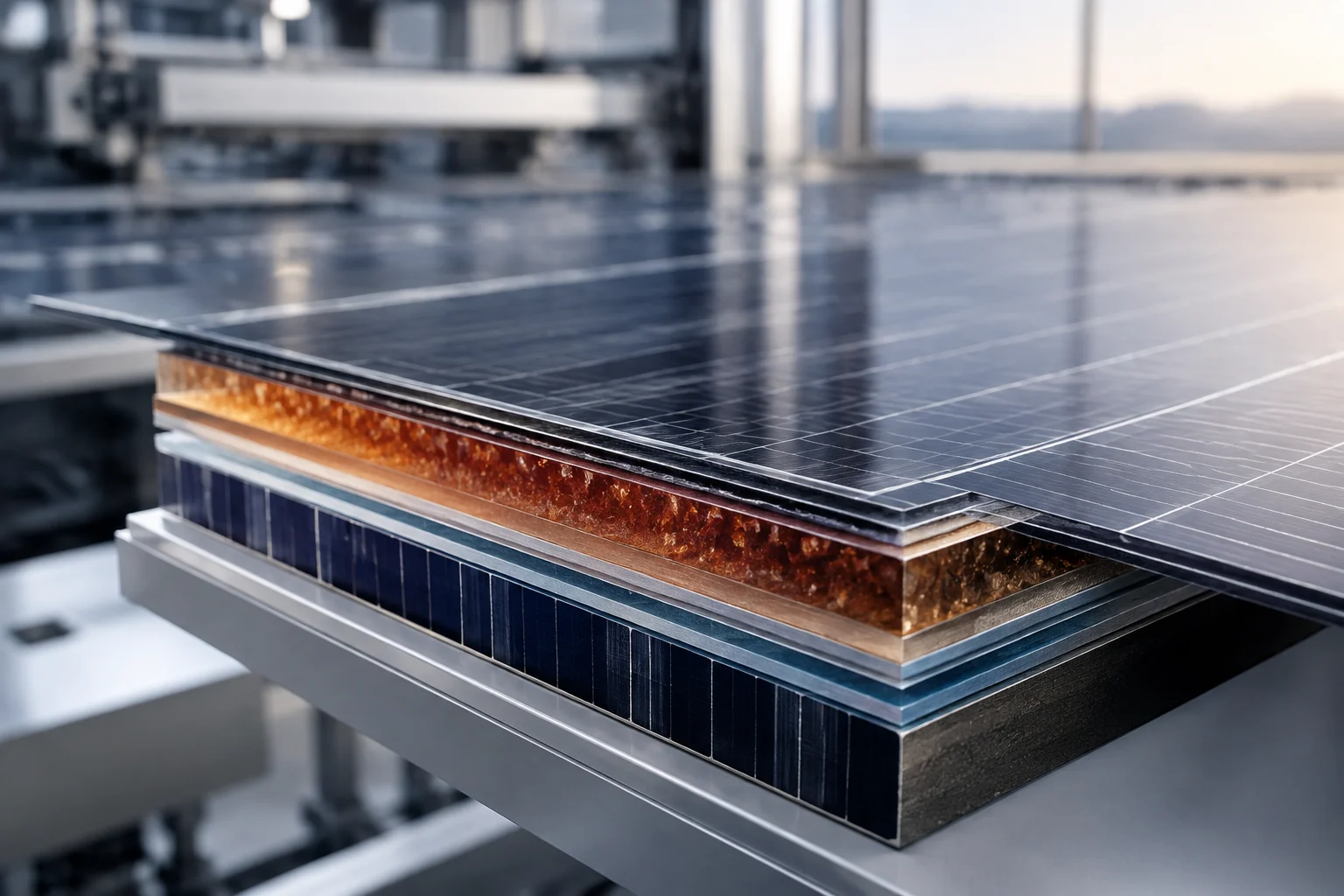
A tandem cell distributes light capture across materials with different spectral responses. In a perovskite-silicon combination, the layers can use different parts of the spectrum and, under certain conditions, exceed the practical limit of a single junction. The outcome depends on the complete device: contacts, charge transport, optical losses, compatibility between layers and the manufacturing process. A laboratory improvement therefore demonstrates the potential of an architecture, not automatically an equivalent gain in installed systems.
Records also belong to different categories. It is not sound to compare a single cell, a large-area module and a different technology without qualification, or to present a single-junction result as if it were a tandem result. The sources available here do not provide a set of certified, comparable measurements for all those categories. The 35.5% figure should be read as an announced result for a specific cell, not as the performance of panels available on the market.
Stability: the question efficiency does not answer
Humidity, heat, radiation and operating cycles can affect the absorber as well as interfaces, contacts and encapsulation. Assessing durability takes more than observing that a cell works initially: test conditions, duration, power loss and failure criteria must be specified. The TU Delft review identifies stability challenges as among the issues relevant to taking the technology to scale, but the research material provided does not detail one lifetime that represents all compositions and designs. Source: TU Delft.
Accordingly, the problem should not be summed up as though every perovskite degraded at the same rate, or as though one encapsulation solution had resolved it universally. Composition, protective layers and environment matter. Accelerated tests are useful for comparing devices and detecting degradation mechanisms, but on their own they are not equivalent to years of outdoor operation; extrapolating from them requires suitable models and validation.
Anyone assessing a stability claim should, at a minimum, check which device was tested, under what protocol and conditions, for how long, how much its power changed and whether the result was independently reviewed. Without those details, the responsible conclusion is limited: stability is an active area of research, but the sources considered are not enough to certify representative commercial longevity.
Scaling up manufacturing changes the problem
Increasing a cell’s area is not simply a matter of repeating a laboratory process many times. In thin films, thickness and composition uniformity, defects, interface quality and the connection between subcells can all affect the result. The TU Delft review focuses specifically on progress and challenges in scaling up perovskite solar-cell technology, framing the transition from small devices to larger-scale manufacturing as a technical challenge in its own right. Source: TU Delft.
A high percentage in a small sample does not, by itself, provide information about performance per square metre, the yield of conforming units, process stability, production costs or module reliability. Those quantities require manufacturing data and specific tests. The information provided does not establish a verifiable economic comparison between industrial perovskite lines and silicon lines, so it would not be rigorous to claim a current cost advantage on the basis of potential processability.
Scale also affects performance assessment: a module includes interconnections, encapsulation and components that may not appear in a cell measurement. As area increases, controlling local defects and losses becomes crucial. The gap between a cell record and a reliable product is an engineering and evidence-from-the-field issue, not a discrepancy that can be resolved by choosing the latest figure.
The tandem route: adding to silicon rather than replacing it all
Combining perovskites with silicon offers an integration route: a perovskite layer can complement a lower silicon cell instead of requiring the entire photovoltaic infrastructure to be replaced by a new technology. The record announced by LONGi illustrates that this architecture is being developed industrially and can achieve high figures in specific devices. However, a company announcement is not enough to determine its cost, sustained performance or commercial availability. Source: LONGi.
The promise depends on solving, at the same time, the manufacture of the top layer, its electrical and optical coupling to silicon, protection from the environment and repeatability across useful areas. It also matters whether processes are compatible with production and quality control. The TU Delft source provides a review framework for scaling; it does not prove that all these obstacles have already been resolved by devices that have achieved records. Source: TU Delft.
The interest in the tandem option should therefore not be confused with completed mass adoption. At the stage described by the available sources, it is more precise to speak of a promising technological direction and notable results in research devices than of a general replacement for silicon. Assessing the transition will require public data on modules, certification, prolonged operation and repeatable manufacturing.
What to watch before talking about commercial adoption
The evidence provided supports two limited conclusions: perovskite efficiency has progressed rapidly, according to the academic review hosted by TU Delft, and LONGi reported a 35.5% record for a silicon-perovskite tandem cell. It is not enough, however, to set a date for mass deployment or forecast what market share these cells will have in five or ten years. Expectations depend on technical advances and industrial testing that cannot be inferred from one isolated record.
The most useful approach is not a firm prediction, but a checklist:
- Certified results with a clearly defined category: cell or module, area and protocol.
- Stability tests stating conditions, duration and power retention.
- Data for modules of relevant area, uniformity and manufacturing yield.
- Evidence of repeatable production and outdoor performance, in addition to laboratory announcements.
- Comparable economic information, with scope and date, rather than general promises of low cost.
Bottom line: demonstrated potential, service life still to be documented
Perovskites have moved from laboratory curiosity to a field making rapid progress, with a tandem route that could raise conversion efficiency. LONGi’s figure shows the level of ambition and the result reported by a manufacturer, while the TU Delft review underscores that scaling the technology is a distinct research and development challenge. Neither piece of evidence should be presented as sufficient proof that a perovskite-silicon module with demonstrated durability and economics for mass deployment already exists.
A balanced assessment is that efficiency opens the opportunity; stability and scaling will determine its practical value. This does not mean commercialization is impossible or that it will happen by a particular date. It means the transition must be measured using verifiable modules, long-duration tests and repeatable manufacturing, not laboratory peaks alone.
The limits of this analysis are explicit: it is based on the sources listed and the information they describe; it does not include original testing or an exhaustive review of certification standards or record databases. Nor does it allow a direct comparison of all perovskite chemistries. Those limitations restrict the scope of the conclusion, but do not invalidate it: the records are real as reported results; large-scale adoption still requires different and broader evidence.