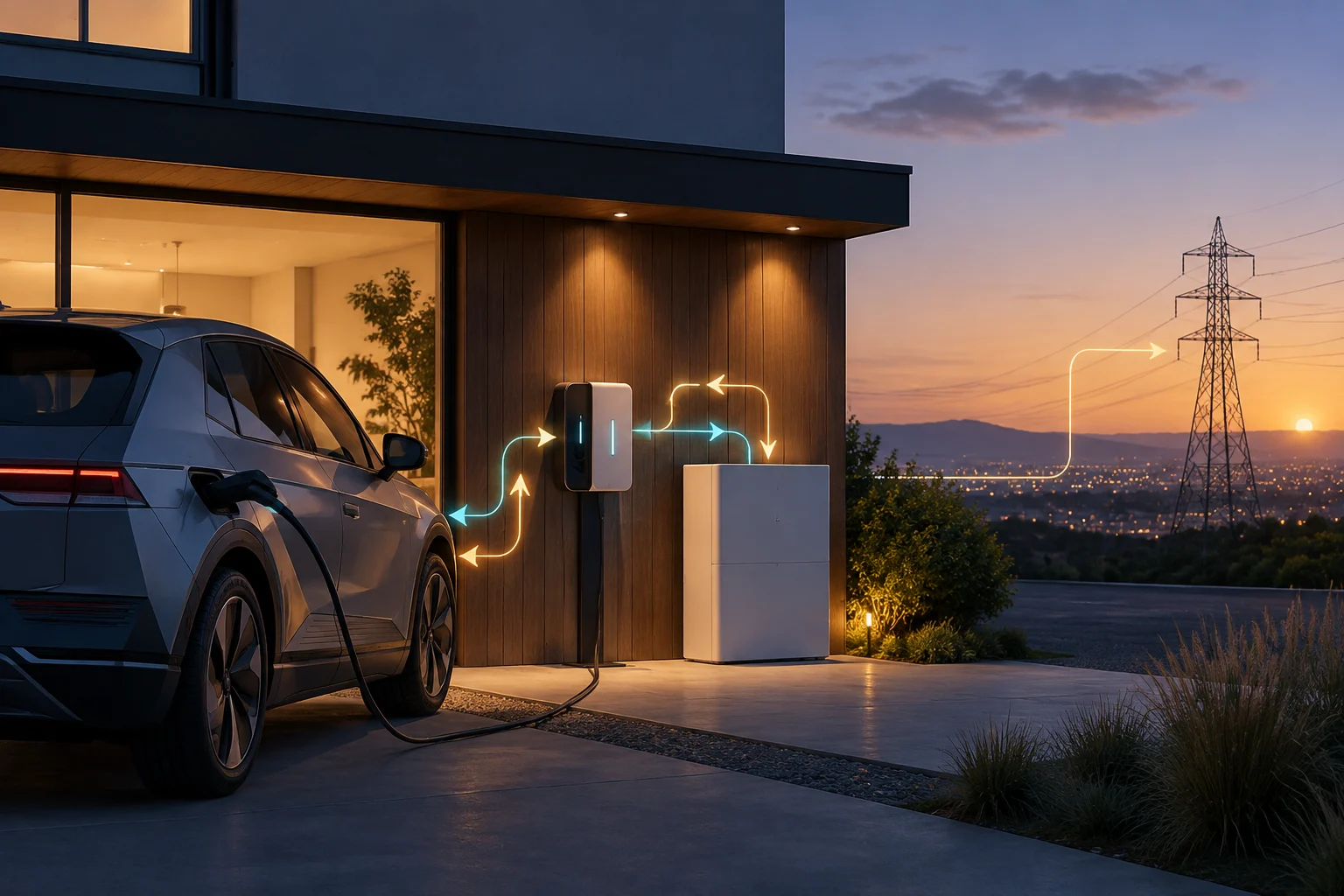
Three different destinations for vehicle energy
Ordinary charging moves electricity from the grid into the battery. With bidirectional charging, the flow can be reversed: the vehicle supplies energy to another destination through compatible equipment. But terms such as V2L, V2H and V2G describe different uses and should not be treated as synonyms. The capability depends on the vehicle, charger or adapter and, where relevant, the installation and grid operator.
V2L (vehicle-to-load) means supplying power to an electrical load, for example an appliance connected to the vehicle or to an enabled accessory. V2H (vehicle-to-home) means powering a home, usually through equipment and an installation designed for that purpose. V2G (vehicle-to-grid) involves exchanging energy with the electricity grid. The latter is not simply a matter of plugging in a cable: it requires compatible equipment and authorized connection conditions.
The distinction matters when comparing specifications. A power outlet or an external power-supply function does not, by itself, show that the vehicle can support a home's electrical panel, and compatibility with a home solution does not confirm that exporting energy to the grid is permitted. The US Department of Energy's Alternative Fuels Data Center defines a bidirectional vehicle as one that can both charge and discharge electricity through compatible charging equipment, to supply energy to a building or the grid; this definition does not certify any particular model. (Source: AFDC, authority on bidirectional electric vehicles)
What a communication standard contributes
ISO 15118-20:2022 is a standard for communication between an electric vehicle and its supply equipment. The IEC catalogue entry identifies that edition and publication; CharIN, an industry association, describes its role in the charging ecosystem and links it to bidirectional charging services. The standard provides a common framework for communication, but its existence does not mean that all cars, chargers and grids implement the same functions or that every combination has been validated. (Sources: IEC, ISO 15118-20:2022; CharIN, V2G)
Interoperability has several layers. The connector and protocol may enable communication, but the implemented functions, control of energy flow, charger configuration and connection conditions must also match. CharIN presents interoperability testing and grid integration as parts of V2G work; that is a sign that the standard is one component of the system, not an individual guarantee of compatibility. (Source: CharIN, interoperability and V2G)
The International Electrotechnical Commission also lists documents in the IEC 61851 series related to charging systems. Their titles and catalogue entries help identify the scope of technical documents, but they are not enough to determine whether a particular home installation can operate bidirectionally. That requires the product specifications, the applicable edition and local rules. (Sources: IEC 61851-23-1:2026; IEC 61851-23-3:2026)
Check the vehicle by model and market
Before assuming V2H or V2G is available, look for the vehicle manufacturer's official documentation for the exact model, model year, trim and market. Check whether the manufacturer declares energy discharge capability, which modes it supports, what equipment it requires, and whether it sets restrictions involving software, the battery, warranty or operating conditions. A general reference to bidirectional charging on a brand website is no substitute for a technical specification, manual or compatibility list for the version sold in your country.
It is also important to distinguish technical capability from an announcement and from a feature enabled for customers. A press release may describe a plan or pilot; a specification may state conditional compatibility; and commercial availability requires further information about timing, region and required equipment. You cannot infer compatibility for a specific vehicle from ISO 15118-20 or a V2G label: standards and industry-association materials explain the framework, but do not, on their own, substantiate each manufacturer's implementation.
The documentation reviewed for this guide does not allow us to confirm a list of specific vehicles offering home discharge or grid export with chargers available in a particular market. We therefore do not present models as compatible or turn the capabilities of a standard into a product promise. The useful check is to ask the manufacturer for an explicit compatibility reference covering the vehicle, equipment and market combination, and to keep the response or associated technical document.
What to require in the charger specification
The equipment specification should state explicitly whether it supports bidirectional power flow and for what use: supplying loads, home backup or exchanging energy with the grid. Check compatibility with the specific vehicle and the protocol used, along with charging and discharging power, operating conditions and any additional components required. If a specification only gives charging power or connector type, those details do not prove that the equipment can return energy.
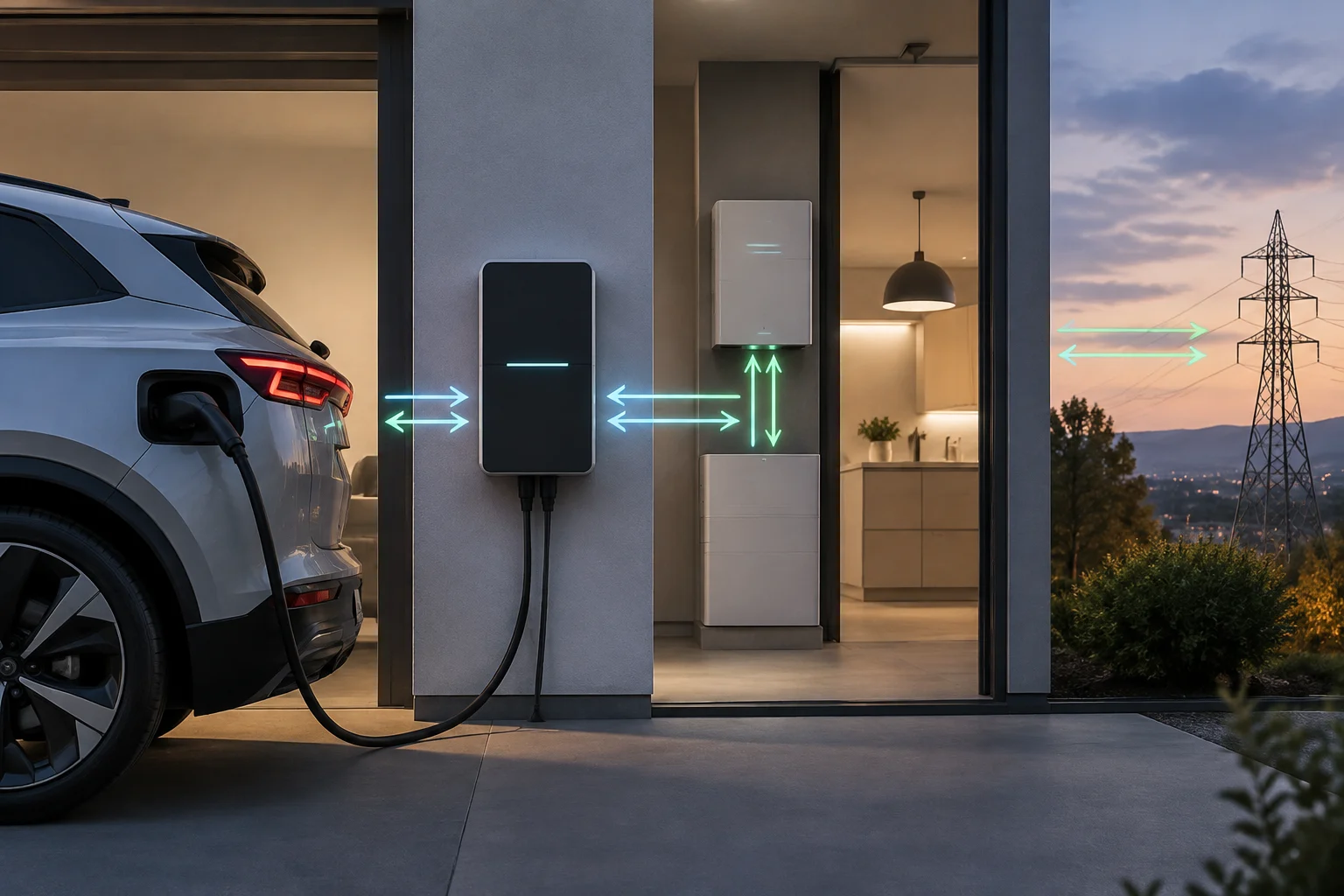
Also ask where electrical conversion takes place and which elements make up the complete system: charger, control unit, protective devices, energy management system and, where applicable, storage or a backup interface. It is unwise to compare power figures alone without knowing whether they refer to charging or discharging, whether they are continuous or peak values, and which installation conditions apply. Read all figures in the manufacturer's documentation for the relevant variant.
CharIN describes interoperability as a matter of standards and testing between participants in the ecosystem. In practice, a broad marketing claim such as “V2G-ready” calls for specific questions: which vehicles and versions have been validated? Which operating mode is supported? In which countries is it offered? What firmware version or service is needed? Without these details, the label indicates an intention or general capability, not that the system will work in a particular installation. (Source: CharIN, V2G interoperability)
Installation, safety and grid connection
V2H and V2G involve a building's electrical installation or the public grid, so they are not projects involving simply plugging an arbitrary device into an outlet. The design must account for protection and flow control, and prevent a backup installation from unintentionally energizing circuits or sections of the grid. The equipment and procedures required depend on the system architecture and local regulations; general interoperability documentation is no substitute for a professional assessment.
For V2G, check with the electric utility or relevant operator whether exporting is permitted, which technical requirements apply, and whether authorization, a metering configuration or a specific contract is needed. Rules may vary by jurisdiction and connection type. The AFDC record cited here documents a California provision that allows the state authority to require bidirectional capabilities for certain vehicle classes under specified conditions; it is not universal approval of installations or a rule that automatically applies outside that state. (Source: AFDC, California)
Before signing a contract, request a written scope identifying the vehicle, charger, installation components, operating mode and who is responsible for approval by the grid operator. If the goal is to keep essential loads running during an outage, verify that the system explicitly offers off-grid backup and identify which circuits it would cover: the ability to export energy does not, by itself, show that it can power a home disconnected from the grid.
A practical checklist to avoid false equivalences
The review can be organized into six checks. These are not a compatibility certificate; they help identify what evidence is missing before basing a purchase on an advertised feature.
- Define the use: powering appliances, backing up a home or exporting to the grid; these are different goals.
- Identify the exact vehicle variant: model, year, trim, market and manufacturer documentation.
- Confirm the required equipment: charger or adapter, controls, protective devices and compatibility declared by their manufacturers.
- Clarify power and conditions: discharge versus charge, limits, software, warranty and configuration.
- Check installation and permits: qualified electrician, home requirements and operator authorization where applicable.
- Distinguish the status of the evidence: a published standard, an announced capability, an available product and a tested combination are not equivalent.
The prudent conclusion is that bidirectional charging already has relevant standards and interoperability work behind it, but this does not mean that any vehicle can supply energy to any home or grid. ISO 15118-20 helps frame the communication; actual performance depends on implementations and requirements that must be substantiated separately. For a purchase decision, the useful evidence is not the V2G label, but explicit, current compatibility for the exact system and market of use.